
Introduction
Five years ago, "using AI in marketing" mostly meant a chatbot that answered FAQs and a spreadsheet formula that auto-tagged leads. In 2026, that picture looks almost quaint. AI now drafts first versions of blog posts, predicts which subscribers will churn before they do, decides in real time how much to bid on a Google Ads auction, and writes thousands of personalized ad variations while a marketing team sleeps.
This shift did not happen overnight, but it accelerated faster than almost anyone in the industry expected. Businesses adopted AI not because it was trendy, but because the alternative — relying purely on manual processes — could no longer keep pace with the volume of data, content, and customer touch points modern marketing demands. Competitors who embraced AI in digital marketing started shipping more content, running smarter ad campaigns, and responding to customers faster, and everyone else had to catch up.
In this guide, you will learn what AI in digital marketing actually means, why it has become essential rather than optional in 2026, the specific ways it is reshaping content, SEO, social media, email, advertising, and customer support, the tools leading the space, and a practical, step-by-step plan for putting AI to work in your own marketing — without losing the human judgment that still separates good marketing from great marketing.
What Is AI in Digital Marketing?
At its core, artificial intelligence in marketing means using software that can learn from data and make decisions or generate content with little to no direct human input for each individual task. Instead of a marketer manually segmenting an email list or writing fifty product descriptions one by one, AI systems handle the repetitive, pattern-based work, and humans focus on strategy and oversight.
Three technologies do most of the heavy lifting behind AI-powered marketing:•
Machine Learning (ML): Helps marketing platforms learn from historical campaign data to predict outcomes, such as which ad creative is likely to convert best for a given audience segment.•
Natural Language Processing (NLP): Allows tools like ChatGPT, Claude, and Gemini to understand and generate human-like text, which powers everything from blog drafts to chatbot conversations and sentiment analysis on customer reviews.•
Predictive Analytics: Uses historical and behavioral data to forecast future actions, such as predicting which customers are likely to make a purchase, unsubscribe, or respond to a particular offer.
In practice, these technologies overlap constantly. A predictive analytics model might flag that a customer is about to churn, an NLP-driven tool then drafts a personalized win-back email, and a machine learning algorithm decides the optimal time to send it. That kind of coordinated, automated decision-making is what people mean when they talk about AI in digital marketing today.
Why AI Is Becoming Essential for Marketers in 2026
A decade ago, AI in marketing was a competitive advantage reserved for companies with deep pockets and dedicated data science teams. In 2026, it is closer to table stakes, for a few clear reasons.
Increased Competition
Every industry now has more digital competitors producing more content and running more campaigns than ever before. Standing out requires either dramatically more output or dramatically smarter targeting — and often both. AI makes both achievable without proportionally larger teams or budgets.
Data-Driven Marketing
Marketers today are flooded with data from websites, apps, social platforms, ad networks, and CRMs. Sorting through that volume manually is no longer realistic. AI tools process this data continuously and surface insights — such as which content drives the most qualified leads — that would take a human analyst days or weeks to uncover.
Rising Customer Expectations
Customers have grown used to platforms like streaming services and e-commerce sites anticipating what they want. They now expect the same from every brand they interact with: relevant emails, timely offers, and support that feels personal rather than generic. AI-powered personalization is largely how brands meet that bar at scale.
Automation Needs
Marketing teams are frequently asked to do more with the same or smaller headcount. Automating repetitive work — scheduling posts, tagging leads, generating first-draft copy — frees up human time for strategy, creative direction, and relationship-building, which AI still cannot fully replace.
Personalization Demands
Generic, one-size-fits-all campaigns increasingly underperform. AI enables personalization at a scale no manual process could match — different subject lines, product recommendations, or ad creatives for different micro-segments, sometimes down to the individual user.
1. AI-Powered Content Creation
Content creation has seen perhaps the most visible AI transformation. Marketers now use AI writing assistants to draft blog posts, generate email copy variations, and produce social media captions in a fraction of the time manual writing once took.
Tools like ChatGPT, Claude, and Gemini are widely used for brainstorming headlines, producing first drafts, repurposing long-form content into shorter social posts, and even translating campaigns into multiple languages. The most effective marketing teams treat AI output as a strong starting point — a first draft that a human editor then refines for accuracy, brand voice, and originality, rather than a final, publish-ready product.
2. AI in SEO
AI-powered SEO strategies have moved well beyond simple keyword density checks. AI tools now help marketers understand search intent — whether a searcher wants information, a product comparison, or a direct purchase — and recommend content structures that match that intent.
Specific applications include faster keyword research and clustering, content optimization recommendations based on what is already ranking, and technical SEO audits that flag crawl errors, slow-loading pages, or broken internal links. Platforms such as Surfer SEO, Semrush, and Ahrefs have built AI directly into their keyword research, content scoring, and competitive analysis features, making AI and SEO almost inseparable in 2026.
3. AI in Social Media Marketing
Social media moves fast, and AI helps marketers keep up. AI tools now handle content scheduling across multiple platforms, analyze audience behavior to determine optimal posting times, and flag emerging trends before they peak. Engagement optimization tools can suggest which captions, hashtags, or formats are likely to perform best for a specific audience, based on patterns from past content.
4. AI in Email Marketing
Email remains one of the highest-ROI marketing channels, and AI has made it sharper. Automated campaigns can now trigger based on real-time user behavior rather than fixed schedules. AI-driven personalization adjusts subject lines, send times, and even product recommendations per recipient, while predictive targeting identifies which segments are most likely to convert on a given offer — improving open rates and reducing wasted sends.
5. AI-Powered Advertising
Platforms like Google Ads and Meta Ads have built AI deeply into their core systems. Audience targeting algorithms now identify high-value prospects based on subtle behavioral signals, while automated bid optimization adjusts spend in real time to maximize results within a set budget. Programmatic advertising — buying and placing ads automatically through real-time bidding — relies almost entirely on AI to match the right ad to the right person at the right moment.
6. AI Chat bots and Customer Support
AI chat bots now provide 24/7 support, answering common questions instantly instead of making customers wait for business hours. Beyond support, well-designed chatbots also qualify and capture leads, guide visitors toward relevant products, and hand off complex issues to human agents seamlessly — often improving both customer engagement and conversion rates in the process.
7. Predictive Analytics
Predictive analytics has become one of the most strategically valuable applications of AI in marketing. By analyzing past behavior, these models can forecast which customers are likely to make a purchase, which are at risk of churning, and how a planned campaign is likely to perform before it even launches — letting marketers adjust strategy proactively rather than reactively.
Challenges and Risks of AI in Marketing
AI adoption is not without friction, and ignoring the risks tends to backfire. Here are the most common challenges marketers face, along with practical ways to address them.
Data Privacy Concerns
AI tools often rely on customer data to personalize experiences, which raises legitimate privacy questions. Solution: be transparent about data collection, comply with regulations like GDPR or CCPA, and choose AI vendors with clear, audited data-handling policies.
AI Bias
AI models can reflect biases present in their training data, leading to skewed targeting or messaging. Solution: regularly audit AI outputs for fairness, diversify training and testing data where possible, and keep a human reviewer in the loop for sensitive campaigns.
Over-Automation
Automating too much, too fast, can make a brand feel impersonal or robotic. Solution: automate repetitive tasks first, and keep humans directly involved in strategy, brand voice, and any customer-facing edge case.
Content Quality Issues
Unedited AI-generated content can be generic, repetitive, or factually inaccurate. Solution: treat AI output as a draft, fact-check claims, and have an experienced editor refine tone, accuracy, and originality before publishing.
Dependence on AI
Over-reliance on AI tools can erode a team’s core strategic and creative skills over time. Solution: use AI to handle execution while deliberately keeping strategic thinking, creative direction, and final decision-making in human hands
Future of AI in Digital Marketing
Looking toward the rest of this decade, several trends are already shaping where AI in marketing is headed next.
- Hyper-Personalization: Personalization will move beyond segments to individual-level experiences across every touchpoint a customer has with a brand.
- AI Search Engines: AI-driven search experiences are changing how people find information, pushing marketers to optimize for conversational, AI-generated answers rather than just traditional rankings.
- Voice Search Optimization: As more searches happen by voice, content will need to answer natural, spoken-language queries directly and concisely.
- AI Video Generation: Tools that generate short marketing videos from text prompts are making video content dramatically faster and cheaper to produce.
- Autonomous Marketing Campaigns: Expect AI systems that can plan, launch, and adjust entire campaigns with minimal manual intervention, under human-set guardrails.
- Predictive Customer Journeys: AI will increasingly map and anticipate each customer’s likely path to purchase, allowing brands to intervene at the most influential moments.
Industry analysts broadly agree on the direction, even as specific tools and platforms keep evolving: AI is shifting from a set of point solutions bolted onto marketing workflows to an integrated layer that touches nearly every stage of the customer journey. Marketers who build comfort with these tools now will be far better positioned for the more autonomous, AI-native marketing of 2030.
How Businesses Can Start Using AI Today
Adopting AI does not require an enterprise budget or a data science team. A focused, step-by-step approach works well for businesses of any size.
- Define Goals: Identify the specific marketing problem you want AI to solve first, such as faster content production, better-qualified leads, or reduced ad waste.
- Choose AI Tools: Select one or two tools that match that goal rather than trying to adopt an entire AI stack at once.
- Train Your Team: Teach your team how to prompt, review, and edit AI output so quality stays consistent with your brand standards.
- Automate Repetitive Tasks: Start with low-risk, high-volume tasks like social scheduling, first-draft writing, or basic customer support questions.
- Analyze Performance: Track clear metrics — time saved, engagement, conversion rate — to see whether the AI tool is actually delivering value.
- Scale Successful Campaigns: Once a workflow proves itself, expand it to more campaigns, channels, or team members before adding new tools.
Conclusion
AI in digital marketing in 2026 is no longer an experimental add-on; it is a core part of how competitive businesses create content, optimize for search, run ads, and serve customers. From AI-powered SEO and content creation to predictive analytics and autonomous ad bidding, the technology is reshaping nearly every corner of the marketing function.
That said, the businesses winning with AI are not the ones automating everything blindly. They are the ones using AI to handle volume and repetition while keeping human judgment firmly in charge of strategy, brand voice, and the relationships that ultimately drive loyalty.
The future of digital marketing belongs to teams that learn to work alongside AI rather than against it — or worse, ignoring it. Start small, measure results, and scale what works. The businesses that begin building that muscle today will be the ones setting the pace in 2030.
Ready to bring AI into your own marketing strategy? Start with one tool, one workflow, and one clear goal this week — and build from there.
Key Takeaways
- AI in digital marketing combines machine learning, NLP, and predictive analytics to automate and personalize marketing at scale.
- Rising competition, data volume, and customer expectations are making AI adoption essential rather than optional in 2026.
- AI is transforming content creation, SEO, social media, email, advertising, customer support, and predictive analytics.
- Tools like ChatGPT, Claude, Gemini, Surfer SEO, Semrush, Ahrefs, Canva AI, HubSpot AI, Jasper AI, and Copy.ai lead the current landscape.
- Key risks — data privacy, bias, over-automation, and content quality — are manageable with human oversight and clear policies.
- The future points toward hyper-personalization, AI search, voice optimization, AI video, and more autonomous campaign management.
- Businesses can start small: one goal, one tool, one automated workflow, then scale based on measured results.
Suggested Internal Linking Opportunities
Consider linking this article to other relevant content on your site to strengthen topical authority and improve site navigation:
- A dedicated guide on “AI Tools for Content Marketing” or similar tool round-ups.
- Your “SEO Services” or “SEO Strategy” page, linking from the AI and SEO section.
- A “Social Media Marketing Services” page, linked from the AI in Social Media section.
- An “Email Marketing” service or guide page, linked from the AI in Email Marketing section.
- A “PPC / Paid Advertising Services” page, linked from the AI-Powered Advertising section.
- A case study or portfolio page showcasing results from an AI-assisted campaign, if available.
- A “Contact Us” or “Get a Free Marketing Audit” page, linked from the conclusion or CTA.
Suggested External Authoritative Sources
To strengthen E-E-A-T, consider citing or linking to authoritative, regularly updated sources such as:
- Google Search Central Blog — for official SEO and search guidance.
- HubSpot Marketing Statistics and Research — for current marketing benchmark data.
- Semrush or Ahrefs blogs — for SEO and AI search trend research.
- Gartner or McKinsey marketing and AI research reports — for industry-level adoption statistics.
- Meta for Business and Google Ads Help Center — for official advertising platform documentation.
Always verify that any statistic or claim you cite from an external source is current at the time of publishing, since AI and marketing data evolve quickly.
10 Image Ideas with Alt Text for SEO
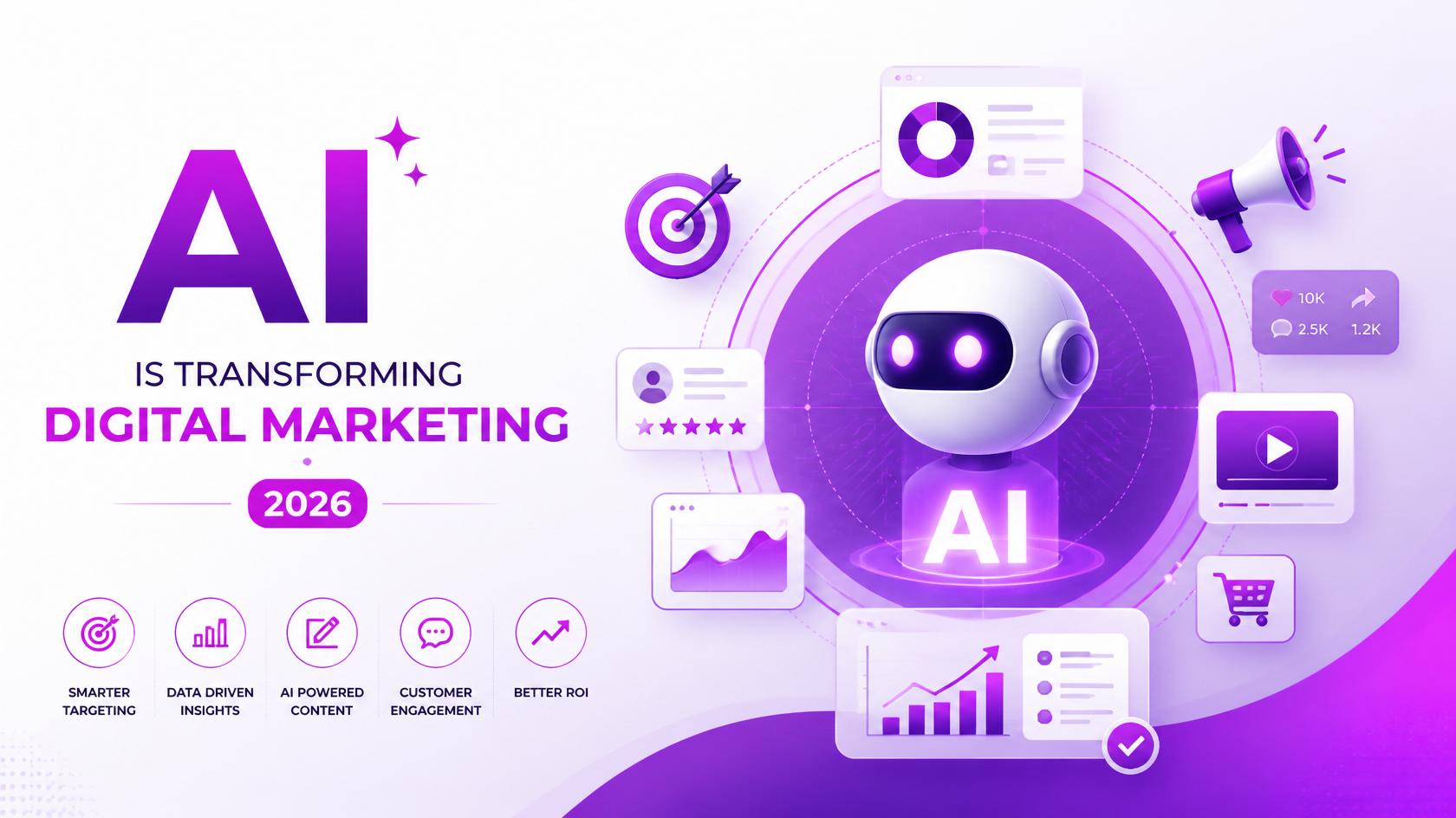
- Hero image — abstract visual of AI and marketing icons (charts, megaphone, gears) blending together. Alt text: “AI in digital marketing concept showing robot hand and marketing icons”
- Simple diagram illustrating Machine Learning, NLP, and Predictive Analytics. Alt text: “Diagram of machine learning, NLP, and predictive analytics in marketing”
- Screenshot-style graphic of an AI writing assistant interface drafting a blog post. Alt text: “Marketer using AI writing assistant to draft blog content”
- Mockup of an SEO tool dashboard with keyword scores and recommendations. Alt text: “AI-powered SEO dashboard showing keyword and content optimization data”
- Visual of a social media content calendar with AI scheduling icons. Alt text: “Social media content calendar automated with AI scheduling tool”
- Graphic showing personalized email variations sent to different customer segments. Alt text: “Personalized email marketing campaign powered by AI segmentation”
- Illustration of programmatic ad bidding across multiple platforms. Alt text: “AI-powered ad targeting and bid optimization on Google and Meta Ads”
- Mockup of a chatbot conversation window on a business website. Alt text: “AI chatbot providing 24/7 customer support on a website”
- Chart or graph visualizing predictive customer behavior trends. Alt text: “Predictive analytics chart forecasting customer purchase behavior”
- Photo-style graphic of a team whiteboard session planning an AI marketing roadmap. Alt text: “Marketing team planning AI adoption strategy roadmap for 2026”
Frequently Asked Questions
- What is AI in digital marketing?
AI in digital marketing refers to the use of machine learning, natural language processing, and predictive analytics to automate, optimize, and personalize marketing activities such as content creation, advertising, SEO, email campaigns, and customer support.
- How does AI improve SEO?
AI improves SEO by speeding up keyword research, analyzing search intent more accurately, recommending content optimizations, and flagging technical issues such as crawl errors or slow page speed, all of which help content rank higher and faster.
- Which AI tools are best for marketers in 2026?
Popular choices include ChatGPT and Claude for content and strategy, Surfer SEO, Semrush, and Ahrefs for search optimization, Canva AI for design, and HubSpot AI, Jasper AI, or Copy.ai for marketing automation and copywriting.
- Is AI replacing digital marketers?
No. AI is replacing repetitive tasks, not marketers. Strategy, brand judgment, creativity, and relationship-building still require human oversight, and marketers who learn to direct AI tools effectively are becoming more valuable, not less.
- What is the future of AI marketing?
The future points toward hyper-personalization at scale, AI-driven search experiences, voice and visual search optimization, AI-generated video, and increasingly autonomous campaign management guided by human strategists.
- Can small businesses afford to use AI marketing tools?
Yes. Many AI marketing tools offer free tiers or affordable monthly plans, making AI-powered content creation, scheduling, and analytics accessible even to solo entrepreneurs and small teams.
- Does using AI content hurt SEO rankings?
Search engines do not penalize content simply because AI assisted in creating it. What matters is whether the content is helpful, accurate, and demonstrates real expertise and experience, in line with Google’s quality guidelines.
- How can I start using AI in my marketing strategy?
Start small: pick one repetitive task such as social scheduling or first-draft writing, choose a reliable AI tool, train your team on prompts and review steps, then measure results before scaling to other areas.
- What skills do marketers need in the age of AI?
Prompt writing, data interpretation, critical editing, and strategic thinking are becoming essential, since AI handles execution while marketers focus on direction, brand voice, and decision-making.
- Will AI marketing tools become more affordable over time?
As AI infrastructure matures and competition between providers increases, prices for AI marketing tools are generally expected to become more accessible, especially for small and mid-sized businesses.