Affiliate Marketing Strategies

Affiliate Marketing Strategies

Blogging Strategies to Boost Affiliate Sales

Introduction You’ve published affiliate blog posts. You’ve dropped your links in naturally, added a call-to-action, maybe even followed a checklist from a “how to start affiliate marketing” guide. And yet, month after month, your affiliate dashboard still shows close to nothing. Here’s the uncomfortable truth: most affiliate blogs don’t fail because affiliate marketing doesn’t work — they fail because blogging strategies to boost affiliate sales require far more than simply placing links inside decent content. Weak niche selection, thin reviews, ignored search intent, and zero trust-building all quietly sink otherwise promising blogs before they ever get a fair chance. The good news is that this is entirely fixable. In this guide, you’ll learn exactly how affiliate blogging actually works, why most affiliate blogs struggle, how to choose a niche and affiliate programs that set you up to win, keyword research built specifically for buyer intent, how to write product reviews and content that genuinely convert, SEO and trust-building strategies, and a full 30-day action plan to put it all into practice. Let’s fix what’s actually holding your affiliate income back. What is Affiliate Blogging? Affiliate blogging is the practice of publishing content — reviews, guides, comparisons, tutorials — that recommends products or services through unique affiliate links, earning a commission whenever a reader makes a qualifying purchase. How It Works A blogger joins an affiliate program, receives a unique tracking link, and embeds that link naturally within helpful content. When a reader clicks the link and completes a purchase (within the program’s cookie window), the blogger earns a commission — typically a percentage of the sale or a fixed fee. Benefits Low startup costs compared to creating your own products Scalable, largely passive income once content is published and ranking Flexibility to promote products across nearly any niche No customer service or fulfillment responsibilities Real-World Example A blog reviewing budget kitchen appliances might earn a commission every time a reader clicks through to Amazon and purchases the recommended blender — with no need to manufacture, ship, or support the product directly. Why Most Affiliate Blogs Fail Poor SEO – Content that’s never found by searchers can’t convert anyone. Thin Content – Short, generic reviews fail to build the confidence needed for a purchase decision. Wrong Niche – Highly saturated or extremely low-commission niches make growth unnecessarily difficult. Too Many Affiliate Links – Overloading posts with links feels manipulative and reduces trust. No Trust – Readers won’t click links from a blog that feels impersonal or unverified. No Audience Research – Writing about what you assume readers want, instead of what they’re actually searching for. Ignoring User Intent – Publishing the wrong content format for a given keyword’s actual intent. No Email List – Relying entirely on search traffic instead of building a reusable audience asset. Weak CTAs – Vague or buried calls-to-action that never actually prompt a click. Poor Website Speed – Slow-loading pages increase bounce rate before readers ever reach your links. Keyword Research for Affiliate Blogs Affiliate blogging depends heavily on targeting the right type of keyword, not just any keyword with search volume. Commercial Keywords – Terms showing purchase consideration, like “best budget blender.” Buyer Keywords – Highly specific, ready-to-purchase phrases, like “buy online.” Long-Tail Keywords – Longer, specific phrases with lower competition, like “best blender for smoothies under $100.” Low Competition Keywords – Terms realistic for newer sites to rank for while authority builds. Search Intent – Understanding whether a keyword calls for a review, comparison, or general guide. Recommended Tools Google Keyword Planner – Free volume data, useful for initial keyword validation. Ahrefs – Detailed keyword difficulty and competitor keyword gaps. Semrush – All-in-one keyword and content gap analysis. Ubersuggest – Budget-friendly keyword ideas for beginners. Google Search Console – Reveals which queries you’re already ranking for, often surfacing quick-win opportunities. Writing Product Reviews That Convert Ideal Review Structure Brief introduction addressing the reader’s specific problem or goal Quick verdict or summary for skimmers Key features and specifications Pros and cons, presented honestly Personal experience or testing details, where possible Comparison to relevant alternatives Who should buy it, and who shouldn’t Clear, well-placed call-to-action What Makes a Review Convert Pros and Cons – Balanced, honest assessments build far more trust than purely positive reviews. Features – Clear, specific details rather than vague marketing language. Personal Experience – First-hand usage details (even brief ones) significantly boost credibility. Alternatives – Mentioning competing options shows genuine, unbiased research. Who Should/Shouldn’t Buy – Helps readers self-select with confidence, reducing returns and increasing trust. CTA Placement – Include a clear call-to-action after the verdict, after the pros/cons, and at the article’s end. SEO Strategies for Affiliate Blogs On-Page SEO – Optimized titles, headings, and natural keyword placement throughout each review or guide. Technical SEO – Fast load times, mobile-friendliness, and clean site structure so content can actually be found. Internal Linking – Connect related reviews, comparisons, and guides to strengthen topical relevance. External Linking – Link to manufacturer specs or authoritative sources to support your claims. Topical Authority – Cover a niche comprehensively across multiple interlinked posts, not just isolated reviews. Schema Markup – Use Review and Product schema where appropriate to unlock rich snippets. Image SEO – Original product photos with descriptive alt text improve both trust and search visibility. Core Web Vitals – Fast, stable-loading pages reduce bounce rate before readers reach your links. Featured Snippets – Structure key comparisons and answers concisely to increase snippet eligibility. Topical Clusters – Build pillar buying guides supported by individual product review posts. Content Marketing Strategies Publish Consistently – A realistic, sustainable schedule beats sporadic bursts of content. Update Old Content – Refresh reviews and prices regularly, especially for fast-changing products. Build Topical Authority – Expand comprehensively within your niche rather than spreading too thin. Create Content Clusters – Interlink pillar guides with supporting review and comparison posts. Repurpose Content – Turn blog posts into social media content, email newsletters, or short videos. Guest Blogging – Build backlinks and referral

Affiliate Marketing Strategies

Best Affiliate Marketing Programs to Join in 2026

Best Affiliate Marketing Programs to Join in 2026: Top High-Paying Networks for Beginners & Experts Affiliate marketing continues to expand rapidly in 2026, as more brands shift their marketing budgets toward performance-based partnerships instead of traditional advertising. But here’s the part beginners often overlook: your success depends heavily on choosing the right affiliate program, not just creating great content. The best affiliate marketing programs 2026 has to offer vary widely in commission structure, product quality, and long-term earning potential. Picking the wrong one can mean months of effort for minimal reward, while the right program can turn consistent content into steady passive income. In this guide, you’ll learn exactly what an affiliate program is, how to evaluate one before joining, a detailed breakdown of fifteen top programs across niches, the highest-paying categories in 2026, beginner-friendly options, recurring commission opportunities, and a complete step-by-step guide to getting started. Let’s find the right programs for your affiliate marketing journey.,,,,,,,,,,,,,,,,,, How to Choose the Best Affiliate Program Not all programs are created equal. Before joining, evaluate: Commission percentage – Higher isn’t always better if the product rarely sells. Cookie duration – Longer windows give you credit even for delayed purchases. Product quality – Poor products lead to refunds, complaints, and lost trust. Brand reputation – Well-known, trusted brands typically convert better. Conversion rate – A lower commission on a high-converting product can outperform a high commission on a poorly converting one. Payment methods – Confirm the program supports a payment method that works for you. Minimum payout threshold – Lower thresholds mean faster access to your earnings. Affiliate support – Responsive program managers can help resolve tracking or payment issues quickly. Tracking dashboard – Clear, reliable reporting helps you optimize your strategy. Recurring commissions – Subscription-based products can create predictable, compounding monthly income. Top 15 Best Affiliate Marketing Programs to Join in 2026 1. Amazon Associates Overview: One of the largest and most recognized affiliate programs, covering millions of physical products. Commission Rate: Typically 1–10%, varying by product category. Cookie Duration: 24 hours. Payment Method: Direct deposit, check, or Amazon gift card. Best For: Beginners and product review or listicle content. Pros: Huge product catalog, high brand trust, easy approval. Cons: Short cookie duration, relatively low commission rates. Official Website: affiliate-program.amazon.com Why You Should Join: Its brand recognition alone often boosts click-through and conversion rates for beginners. 2. ClickBank Overview: A digital marketplace focused on info products, courses, and software. Commission Rate: Often 10–75%, depending on the vendor. Cookie Duration: Commonly around 60 days. Payment Method: Direct deposit, check. Best For: Digital products and niche info-product marketers. Pros: High commission potential, wide range of digital products. Cons: Product quality varies significantly between vendors. Official Website: clickbank.com Why You Should Join: Strong option for affiliates in self-improvement, health, or online education niches. 3. CJ Affiliate Overview: A long-established affiliate network connecting affiliates with major global brands. Commission Rate: Varies by individual brand. Cookie Duration: Varies by brand. Payment Method: Direct deposit. Best For: Established publishers seeking access to big-name brands. Pros: Access to reputable, well-known merchants. Cons: Some brands have stricter approval requirements. Official Website: cj.com Why You Should Join: A reliable network for scaling once you have consistent traffic and content. 4. ShareASale Overview: A popular network hosting thousands of small-to-midsize merchant programs. Commission Rate: Varies by merchant. Cookie Duration: Varies by merchant. Payment Method: Direct deposit, check. Best For: Niche bloggers seeking diverse brand options. Pros: Large merchant selection, beginner-friendly interface. Cons: Commission and cookie terms vary widely, requiring research per merchant. Official Website: shareasale.com Why You Should Join: Ideal for finding niche-specific brands beyond mainstream retailers. 5. Impact Overview: A modern affiliate platform used by many well-known consumer and SaaS brands. Commission Rate: Varies by brand. Cookie Duration: Varies by brand. Payment Method: Direct deposit, PayPal. Best For: Affiliates promoting SaaS, apparel, or travel brands. Pros: Clean interface, strong brand partnerships. Cons: Some programs require an established audience for approval. Official Website: impact.com Why You Should Join: A strong option for affiliates looking to diversify beyond traditional retail products. 6. PartnerStack Overview: A network specializing in B2B and SaaS affiliate and partner programs. Commission Rate: Varies by brand, often recurring. Cookie Duration: Varies by brand. Payment Method: Direct deposit, PayPal. Best For: Affiliates in the software, productivity, or business tools space. Pros: Strong recurring commission opportunities. Cons: Smaller product catalog compared to general retail networks. Official Website: partnerstack.com Why You Should Join: Excellent for building predictable, recurring monthly income through SaaS referrals. 7. Fiverr Affiliates Overview: The affiliate program for the popular freelance services marketplace. Commission Rate: Flat fee per qualified referral, or hybrid options depending on the campaign. Cookie Duration: Typically 30 days. Payment Method: PayPal, direct deposit. Best For: Content creators in business, freelancing, or entrepreneurship niches. Pros: Recognizable brand, relevant to a broad freelance and business audience. Cons: Commission structures can be less straightforward than simple percentage models. Official Website: affiliates.fiverr.com Why You Should Join: A natural fit for content around freelancing, side hustles, or small business tools. 8. Bluehost Overview: A widely used web hosting provider popular among new bloggers. Commission Rate: Flat fee per qualified sign-up. Cookie Duration: Around 90 days. Payment Method: PayPal, check. Best For: Blogging, WordPress, and “how to start a website” content. Pros: High demand from beginner bloggers, long cookie duration. Cons: Highly competitive niche with many established affiliates. Official Website: bluehost.com 9. Hostinger Overview: A budget-friendly hosting provider with a popular affiliate program. Commission Rate: Competitive percentage-based commissions, up to a high percentage on certain plans. Cookie Duration: Around 30 days. Payment Method: PayPal, wire transfer. Best For: Budget hosting content and international audiences. Pros: Strong commission potential, globally recognized brand. Cons: Requires clear disclosure since pricing promotions change frequently. Official Website: hostinger.com Why You Should Join: A strong alternative or complement to Bluehost for hosting-focused content. 10. Semrush Overview: A leading SEO and digital marketing software suite. Commission Rate: Recurring, high-value commissions per qualifying subscription. Cookie Duration: Extended duration,

Affiliate Marketing Strategies

Top Affiliate Marketing Mistakes to Avoid for Higher Earnings

Top Affiliate Marketing Mistakes to Avoid for Higher Earnings (2026 Guide) Affiliate marketing looks simple on the surface: promote a product, share a link, earn a commission. Yet most beginners who try it never earn a consistent income. The problem usually isn’t the business model — it’s the top affiliate marketing mistakes that quietly sabotage their efforts. In this guide, you’ll learn exactly why so many affiliates struggle, the fifteen most common mistakes holding people back, and the practical fixes top earners use instead. Avoiding these mistakes alone can significantly increase your affiliate earnings, even without changing your niche or your traffic sources. By the end, you’ll have a complete checklist, tool recommendations, and a clear action plan to grow your affiliate income the right way in 2026. Why Most Affiliate Marketers Don’t Make Money Unrealistic Expectations Many beginners expect fast results and quit within weeks, long before their content has time to rank or build trust. Lack of Strategy Posting random content without a clear niche, keyword plan, or traffic strategy leads to scattered, ineffective effort. Poor SEO Without basic SEO knowledge, content rarely reaches the audience actively searching for it. Wrong Niche Choosing a niche with no real buyer intent or affiliate programs makes monetization nearly impossible from the start. Even excellent writing can’t overcome a niche where people simply aren’t searching to buy anything. Low-Quality Content Thin, generic content fails to satisfy either readers or Google’s Helpful Content standards, limiting both trust and rankings. Many beginners focus on publishing quantity over quality, assuming more articles automatically mean more traffic — but Google increasingly rewards depth, originality, and genuine usefulness over sheer volume. No Clear Monetization Plan Some beginners publish content for months without a defined plan for which products to promote, where to place links, or how to guide readers toward a purchase decision. Without this clarity, even well-ranked content can fail to convert into actual commissions. Top Affiliate Marketing Mistakes to Avoid 1. Choosing the Wrong Niche Why it hurts: A niche with low demand, no affiliate programs, or oversaturated competition makes it extremely difficult to gain traction, regardless of how good your content is. How to choose a profitable niche: Validate demand using keyword tools, confirm relevant affiliate programs exist, and choose a topic you can realistically create content about for years. A quick way to test viability is searching your niche topic alongside terms like “best” or “review” and checking whether established competitors are already earning commissions there — if they are, there’s likely real demand. Quick Fix: Before committing to a niche, spend a week researching search volume, existing affiliate programs, and competitor content. This upfront diligence saves months of wasted effort later. 2. Promoting Too Many Products Spreading your focus across dozens of unrelated products dilutes your authority and confuses your audience. When every page promotes a different, loosely related product, readers struggle to see you as a trusted expert in any single area. Instead, focus on a handful of products you genuinely understand and can recommend confidently, and let your content build deep, specific authority around them. Why it hurts: Search engines and readers alike reward topical focus. A site that reviews everything from kitchen gadgets to software tends to rank worse than a focused site covering one category in depth. The fix: Audit your current content and identify your three to five best-performing or most relevant products. Build additional content clusters around those specific products rather than constantly introducing new ones. 3. Ignoring SEO Keyword research: Target keywords with clear buyer intent, like “best,” “review,” or “vs.” Search intent: Match your content format to what searchers actually want — a comparison, a tutorial, or a simple answer. Internal links: Connect related articles to build topical authority and guide readers deeper into your site. External links: Reference authoritative sources to strengthen trust and credibility. Image SEO: Use descriptive file names and alt text to improve accessibility and search visibility. Many beginners treat SEO as an afterthought, adding keywords after the content is written rather than planning around search intent from the start. This backwards approach often results in content that ranks poorly because it doesn’t actually match what searchers are looking for. Instead, research your target keyword’s search intent first — is the searcher looking to buy, compare, or simply learn? — and structure your entire article around fully satisfying that intent. 4. Writing Low-Quality Content Helpful content: Write to genuinely help readers, not just to rank. User intent: Ensure your content fully answers the specific question behind the search. Originality: Avoid copying competitor structure or phrasing — add your own insight. Value: Prioritize depth and clarity over filler word count. 5. Not Understanding the Product Recommending a product you don’t fully understand often leads to vague, unconvincing content that fails to answer real buyer questions — and can damage your credibility if the recommendation turns out to be inaccurate. Readers researching a purchase typically have specific concerns: pricing tiers, integration options, customer support quality, or how a product compares to alternatives. If your content can’t answer these specific questions with confidence, readers will look elsewhere for a more thorough source — often a competitor’s article. The fix: Before writing a review, spend time using the product yourself, reading its documentation, or researching detailed user feedback so you can speak to specifics rather than generic marketing language. 6. Promoting Products You Don’t Trust Readers can sense inauthentic recommendations. Promoting products purely for high commissions, without genuine belief in their value, erodes long-term trust and repeat readership. 7. Depending Only on Social Media Social platforms can drive quick traffic, but algorithm changes can suddenly limit your reach overnight. Google traffic is more sustainable because well-optimized content can continue ranking and earning for years with minimal ongoing effort. 8. Not Building an Email List Email marketing creates a stable, owned audience independent of any algorithm. Lead magnets: Offer a free guide or checklist in exchange for an email signup. Newsletters: Stay consistently

Affiliate Marketing Strategies

How to Start Affiliate Marketing with No Money in 2026

Can You Start Affiliate Marketing with No Money? Yes — it’s absolutely possible. Thousands of affiliates have started using entirely free platforms and free traffic sources. That said, it’s important to separate realistic expectations from hype. Expectations vs. Reality Starting for free means trading money for time. Instead of paying for ads or premium tools, you’ll invest more hours into content creation, community engagement, and organic promotion. Time Investment Expect to spend several hours per week consistently for at least three to six months before seeing meaningful results. Free traffic generally takes longer to build than paid traffic. Skills Required Basic writing ability Willingness to learn SEO fundamentals Consistency and patience Comfort with trial and error Common Misconceptions “No money” doesn’t mean “no effort” — it simply shifts the investment from cash to time. Free traffic sources can be just as effective as paid ones when used strategically and consistently. Benefits of Starting Without Investment Low financial risk – You have nothing to lose financially if things don’t work out immediately. Learn valuable skills – Writing, SEO, marketing, and analytics skills that carry into future opportunities. Flexible work – Build your business around your existing schedule. Global opportunities – Reach audiences and affiliate programs worldwide. Passive income potential – Free content can continue generating income long after publishing. Scalable business model – Once you see what works, you can reinvest early earnings to grow faster. Key Takeaway: Starting with no money forces you to build genuinely valuable content and real audience trust — habits that create a much stronger long-term foundation than shortcuts ever could. Step-by-Step Guide to Start Affiliate Marketing with No Money Step 1: Learn the Basics of Affiliate Marketing Before publishing anything, spend a few days understanding how commissions, cookies, and affiliate networks work. Free resources like affiliate network blogs, YouTube tutorials, and official program help centers are excellent starting points. Step 2: Choose a Profitable Niche Pick a niche that balances your genuine interest with commercial demand. Popular beginner-friendly niches include: Technology Finance Health Fitness Beauty Education AI Tools Digital Marketing Software Travel Step 4: Create Free Content You don’t need a paid website to begin. Free platforms let you start publishing immediately: Blog platforms (e.g., WordPress.com free tier, Blogger) – Advantage: full article control. Limitation: less customizable than self-hosted sites. Medium – Advantage: built-in readership. Limitation: less control over branding and SEO. LinkedIn – Advantage: great for B2B/software niches. Limitation: content has a shorter visibility window. Quora – Advantage: direct access to people actively asking questions. Limitation: strict self-promotion rules. Reddit – Advantage: highly engaged niche communities. Limitation: requires authentic, non-promotional participation. Facebook – Advantage: groups allow community building. Limitation: organic reach can be limited. Instagram – Advantage: strong visual engagement. Limitation: link placement is restricted outside bio/Stories. Pinterest – Advantage: long content lifespan and search-like discovery. Limitation: requires consistent, appealing visuals. YouTube Shorts – Advantage: fast content production and reach. Limitation: shorter format limits in-depth explanation. TikTok – Advantage: strong organic discovery for new accounts. Limitation: highly saturated, fast-paced trends. Threads – Advantage: growing platform with lower competition. Limitation: smaller established audience currently. Step 5: Generate Free Traffic SEO – Optimize content for search engines to earn free, long-term traffic. Pinterest SEO – Use keyword-rich pin titles and descriptions. YouTube SEO – Optimize titles, descriptions, and tags for search. Google Discover – Publish timely, engaging content that can appear in users’ Discover feeds. Facebook Groups – Share value-first content in relevant communities. Quora Marketing – Answer questions genuinely, linking to your content when relevant. Reddit Communities – Participate authentically before ever sharing links. Email Marketing – Start a free-tier email list to nurture an owned audience. Content Repurposing – Turn one blog post into multiple social posts, a video script, and an email. Step 6: Create Helpful Content That Converts Product Reviews – Honest, detailed evaluations of a single product. Tutorials – Step-by-step guides showing how to use a product. Comparisons – “X vs Y” articles for buyer-intent searches. Buying Guides – Comprehensive guides for a category of products. Listicles – “Best of” round-up articles. Case Studies – Documented results from using a product. How-to Articles – Solve a specific problem, naturally recommending relevant tools. Step 7: Build Trust Transparency – Be upfront about your affiliate relationships. Honest reviews – Share both pros and cons. Disclosure – Always include a clear affiliate disclosure statement. EEAT – Demonstrate real experience, expertise, authority, and trustworthiness in your content. Personal experience – Use products yourself whenever possible. Helpful recommendations – Prioritize the reader’s needs over commission size. Long-term audience relationships – Engage genuinely rather than only promoting. Step 8: Track and Improve Performance Monitor: Clicks Conversions Bounce rate Click-through rate (CTR) Organic traffic Search rankings Return on investment (ROI, measured in time and effort) Recommended free analytics tools: Google Analytics, Google Search Console, and built-in platform insights (YouTube Studio, Pinterest Analytics, Instagram Insights) Common Mistakes Beginners Make Waiting for the “perfect” niche – Solution: choose a solid niche and start; refine as you learn. Publishing content without keyword research – Solution: always check search intent before writing. Overloading content with affiliate links – Solution: place links naturally where they help the reader. Skipping affiliate disclosures – Solution: always disclose clearly and early. Promoting products you haven’t researched – Solution: prioritize honesty and real experience. Expecting instant results – Solution: commit to at least 3–6 months of consistent effort. Spreading effort across too many platforms at once – Solution: master one or two platforms first. Ignoring analytics – Solution: review performance data regularly to guide decisions. Writing thin, generic content – Solution: aim for depth and genuine helpfulness. Neglecting mobile readability – Solution: check how your content appears on phones. Affiliate Marketing Success Tips Choose a niche you can talk about for years. Focus on solving real problems, not just selling. Always disclose affiliate relationships. Test products yourself whenever possible. Prioritize long-term SEO over short-term tactics. Build an email list from your very first week. Repurpose content across

Affiliate Marketing Strategies

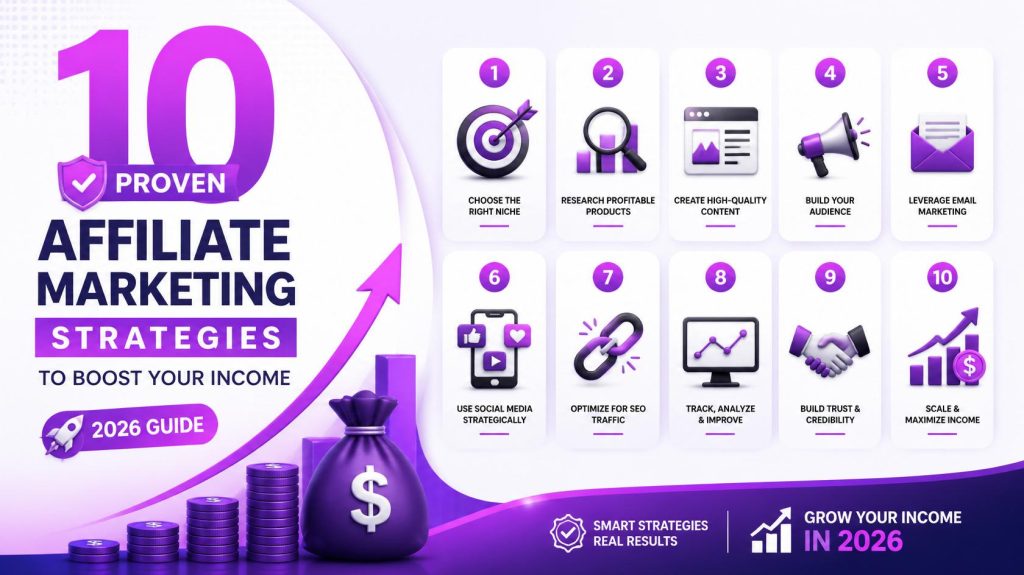
10 Proven Affiliate Marketing Strategies to Boost Your Income (2026 Guide)

10 Proven Affiliate Marketing Strategies to Boost Your Income 1. Choose a Profitable Niche Why it works: A focused niche helps you build authority faster, attract a specific audience, and rank higher on Google because your site demonstrates clear topical relevance. Step-by-step implementation: 1. List 3–5 topics you’re genuinely interested in. 2. Check commercial demand using free tools like Google Trends and Search Console. 3. Confirm affiliate programs exist in that niche. 4. Analyze competitor websites to gauge difficulty. 5. Narrow down to one specific, focused niche (e.g., “home fitness equipment” instead of just “fitness”). Example: Instead of a broad “technology” blog, a beginner might focus specifically on “budget laptops for students,” making it easier to rank and convert. Beginner tip: Pick a niche you can talk about for years without getting bored. Advanced tip: Look for “underserved” sub-niches within a popular category where competition is lower but demand still exists. Common mistake: Choosing a niche based purely on high commissions without any personal interest, leading to burnout. Solution: Balance profitability with genuine curiosity. Best tools: Google Trends, Google Keyword Planner, Semrush. 2. Build a High-Quality Website Why it works: A well-structured, fast, and trustworthy website is the foundation for SEO rankings and reader trust — both essential for affiliate conversions. Step-by-step implementation: 1. Choose a memorable, niche-relevant domain name. 2. Select reliable, fast hosting. 3. Install WordPress and a clean, mobile-friendly theme. 4. Set up essential pages: About, Contact, Privacy Policy, and Affiliate Disclosure. 5. Structure your navigation around your core content categories. Example: A clean, simple review site with clear categories (e.g., “Reviews,” “Guides,” “Comparisons”) tends to outperform cluttered, ad-heavy sites in both rankings and user trust. Beginner tip: Don’t overdesign — clarity and speed beat flashy visuals every time. Advanced tip: Use a lightweight page builder like Elementor with optimized images to maintain design flexibility without sacrificing site speed. Common mistake: Launching with a bloated theme full of unnecessary plugins that slow the site down. Solution: Stick to essential plugins only. Best tools: WordPress, Elementor, hosting providers like Hostinger or Bluehost. 3. Create SEO-Optimized Content Why it works: Search engines remain one of the largest sources of consistent, free, buyer-intent traffic — and well-optimized content compounds in value over time. Step-by-step implementation: 1. Research keywords with clear buying intent. 2. Structure content with proper H1–H3 headings. 3. Write comprehensive, genuinely helpful answers. 4. Add internal links between related articles. 5. Optimize meta titles, descriptions, and image alt text. Example: A detailed “Best Budget Laptops Under $600” article that compares specs, pros, cons, and includes affiliate links naturally within the recommendations. Beginner tip: Focus on answering the exact question in the search query as clearly as possible. Advanced tip: Build “content clusters” — a main pillar page linked to several supporting articles — to establish topical authority. Common mistake: Writing thin, generic content that doesn’t fully answer the reader’s question. Solution: Aim for depth and completeness over word count alone. Best tools: Rank Math, Yoast SEO, Semrush, Ahrefs. 4. Target Long-Tail Keywords Why it works: Long-tail keywords have lower competition and higher conversion rates because they capture very specific search intent. Step-by-step implementation: 1. Start with a broad seed keyword. 2. Use keyword tools to find longer, more specific variations. 3. Prioritize keywords with clear commercial or informational intent. 4. Create dedicated content around each long-tail keyword. 5. Track rankings and refine over time. Example: Instead of targeting “running shoes,” target “best running shoes for flat feet women” — far easier to rank for and highly relevant to a specific buyer. Beginner tip: Long-tail keywords often contain 4+ words and sound like natural questions. Advanced tip: Group related long-tail keywords into a single comprehensive article to capture multiple search queries at once. Common mistake: Only targeting highly competitive, short keywords early on. Solution: Build authority with long-tail content first. Best tools: Google Search Console, Semrush, AnswerThePublic. 5. Promote Products You Trust Why it works: Authentic recommendations build reader trust, which directly improves click-through and conversion rates, and aligns with Google’s E-E-A-T guidelines. Step-by-step implementation: 1. Test or thoroughly research the product before promoting it. 2. Be honest about both pros and cons. 3. Share personal experience or specific use cases. 4. Include real screenshots or results where possible. 5. Update reviews as products change. Example: A genuine review that says “This tool saved me three hours a week, but the mobile app still needs work” converts better than a purely promotional review. Beginner tip: Never promote a product solely because of a high commission if it doesn’t genuinely help your audience. Advanced tip: Create comparison content between the product you recommend and its top competitor for stronger buyer-intent capture. Common mistake: Promoting products without any real experience or research. Solution: Prioritize trust over short-term commission size. Best tools: Personal testing, customer review sites, product demo access. 6. Build an Email List Why it works: An email list is a stable, owned audience that isn’t dependent on search engine or social media algorithm changes. Step-by-step implementation: 1. Create a valuable lead magnet (checklist, guide, or mini-course). 2. Add opt-in forms across your website. 3. Choose an email marketing platform. 4. Send consistent, value-first newsletters. 5. Include relevant affiliate recommendations naturally within emails. Example: A “Free Affiliate Marketing Starter Checklist” opt-in can convert blog visitors into long-term subscribers. Beginner tip: Focus on providing value in every email, not just promotions. Advanced tip: Segment your list based on interests or behavior for higher-converting, targeted campaigns. Common mistake: Only emailing subscribers when promoting a product. Solution: Maintain a healthy ratio of helpful content to promotional emails. Best tools: ConvertKit, MailerLite, ActiveCampaign 7. Use Social Media Marketing Why it works: Social platforms offer direct access to highly engaged audiences and can drive immediate traffic while your SEO content matures. Step-by-step implementation: 1. Choose one or two platforms that fit your niche and audience. 2. Share valuable tips, not just promotional posts. 3. Include affiliate links in bios, Stories, or pinned posts. 4.

Affiliate Marketing Strategies

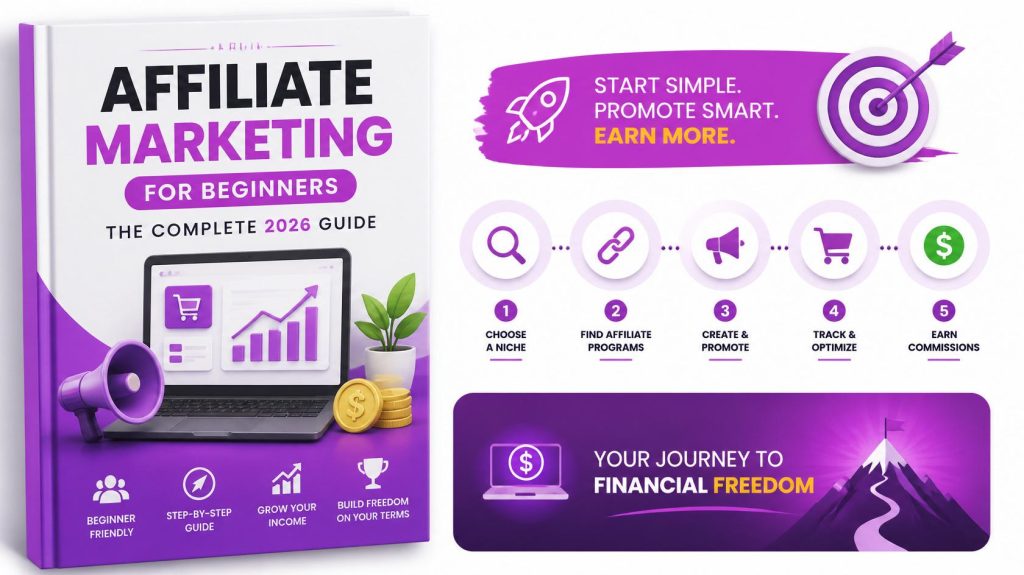
Affiliate Marketing for Beginners: The Complete 2026 Guide

What is Affiliate Marketing? Affiliate marketing is a performance-based business model where you earn a commission by promoting someone else’s product or service. When a person clicks your unique affiliate link and makes a purchase (or completes another required action), the merchant pays you a percentage or a flat fee. In simple terms: you recommend, someone buys, you earn. Real-world example: Say you run a fitness blog. You write a review of a protein powder brand and include your affiliate link. A reader clicks the link, buys the product, and you earn a commission — without ever handling shipping, customer service, or inventory. How Affiliate Marketing Works (in one sentence) You promote a product, a customer buys through your link, tracking software records the sale, and the merchant pays you a share of the revenue. Why Companies Use Affiliate Marketing Businesses love affiliate marketing because they only pay for actual results — sales or leads — instead of spending money on ads that might not convert. It’s a low-risk, high-reward marketing channel for brands, and a genuine income opportunity for affiliates like you. Types of Affiliate Marketing There are three main types of affiliate marketing, based on how closely you’re connected to the product you promote. 1. Unattached Affiliate Marketing You have no real connection to the niche or product. You simply run ads or place links without expertise or authority. Advantages: No need for niche expertise; quick to start. Disadvantages: Low trust, lower conversion rates, harder to build a brand. Best use case: Paid ad campaigns for quick, transactional products. 2. Related Affiliate Marketing You promote products connected to your niche, even if you haven’t personally used them. Advantages: Higher relevance, better audience alignment. Disadvantages: Slightly lower trust than personal recommendations. Best use case: Niche blogs and content creators reviewing category-relevant products. 3. Involved Affiliate Marketing You promote products you’ve personally used and can vouch for with real experience. Advantages: Highest trust, highest conversions, aligns with Google’s E-E-A-T guidelines. Disadvantages: Requires more time to test and document your experience. Best use case: Long-term authority sites and personal brands. Recommendation for beginners: Start with related affiliate marketing, and move toward involved affiliate marketing as you gain product experience — this builds long-term trust and better search rankings. Benefits of Affiliate Marketing Here are the biggest reasons millions of people are turning to affiliate marketing in 2026: Low investment – Start with just a website and your time. Passive income potential – Content keeps earning long after you publish it. Remote work – Work from anywhere with an internet connection. Flexible schedule – No fixed hours or bosses. Unlimited earning potential – No salary cap. No inventory – You never handle products or shipping. No customer service – The merchant handles returns and support. Scalability – One article can generate sales for years. Global audience – Sell to customers anywhere in the world. Diverse income streams – Promote multiple programs simultaneously Short answer: yes, if you approach it strategically. Market Trends E-commerce continues to grow worldwide, and brands are shifting more marketing budget toward performance-based channels like affiliate marketing because it’s measurable and cost-effective. AI’s Impact on Affiliate Marketing AI tools now help affiliates research keywords, draft content outlines, generate images, and analyze competitors faster than ever. However, Google continues to reward original, experience-based content — meaning human insight, testing, and authentic reviews matter more, not less. The Growing Creator Economy More people are building personal brands on YouTube, Instagram, and blogs, and affiliate marketing is often their first monetization method because it requires no product creation. Realistic Expectations Affiliate marketing is not a get-rich-quick scheme. Most beginners take three to twelve months of consistent effort before seeing meaningful income. Those who treat it like a real business — with a niche, a content plan, and SEO — tend to succeed far more than those looking for shortcuts. How to Start Affiliate Marketing Follow these ten steps to launch your affiliate marketing journey the right way. Step 1: Choose a Niche Pick a topic you’re genuinely interested in and that has commercial potential — meaning people actually spend money in that space (finance, tech, health, travel, etc.). Step 2: Find Affiliate Programs Search for affiliate programs related to your niche. Look at commission rates, cookie duration, and payment terms before joining. Step 3: Build a Website A website is your home base — it builds authority and isn’t dependent on a social platform’s algorithm. Step 4: Choose a Domain Pick a short, brandable, easy-to-remember domain name related to your niche. Step 5: Set Up Hosting Choose reliable, beginner-friendly hosting with good speed and uptime. Affiliate Marketing Strategies Use these proven strategies to grow your affiliate income: SEO – Rank content on Google for long-term traffic. Blogging – Publish in-depth articles around buyer-intent keywords. YouTube – Create video reviews, tutorials, and unboxings. Pinterest – Drive visual traffic to blog posts and product pages. Instagram – Use Reels and Stories with swipe-up links. Facebook – Build niche groups and pages for community trust. Email Marketing – Nurture leads with value-packed newsletters. LinkedIn – Promote B2B and SaaS affiliate products. Podcasts – Mention products naturally within episodes. Quora – Answer questions with helpful, link-supported responses. SEO Tips for Affiliate Marketing To rank your affiliate content on Google in 2026, focus on: Keyword Research – Target buyer-intent keywords like “best,” “review,” and “vs.” On-Page SEO – Optimize titles, headers, meta descriptions, and URL slugs. Internal Linking – Connect related articles to build topical authority. Image SEO – Use descriptive file names and alt text. Page Speed – Compress images and use caching for fast load times. Mobile Optimization – Ensure your site is fully responsive. Schema Markup – Add review, FAQ, and product schema for rich snippets. Topical Authority – Cover a niche comprehensively, not just a few posts. Helpful Content – Write for humans first, search engines second. E-E-A-T – Show real experience, expertise, authority, and trust signals Common Mistakes Beginners Make Choosing

Scroll to Top