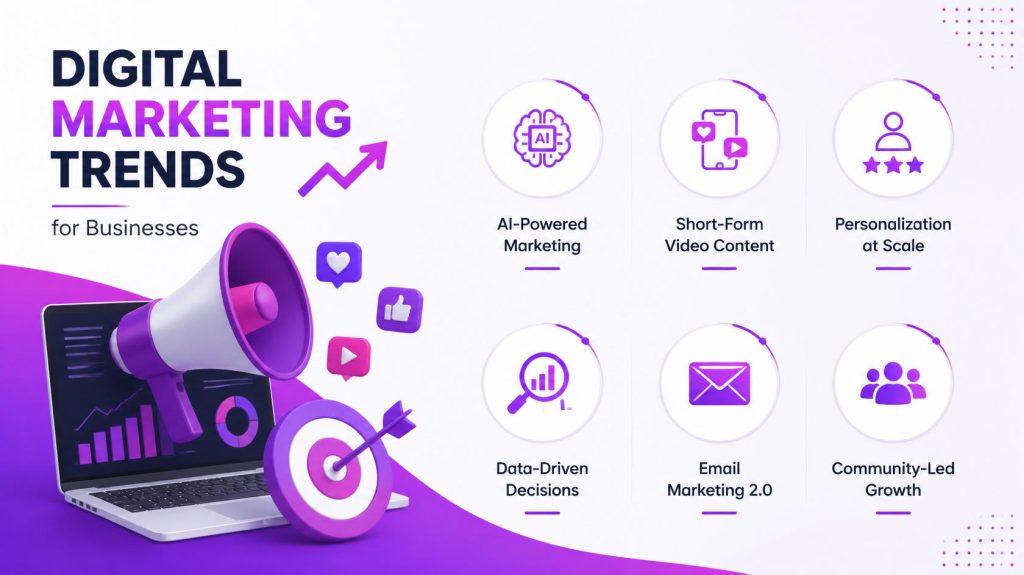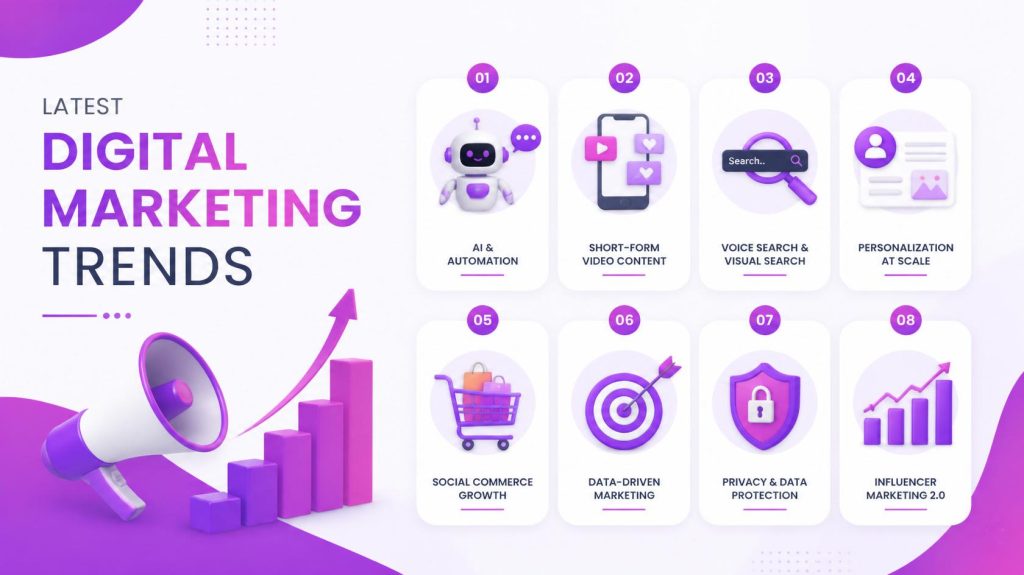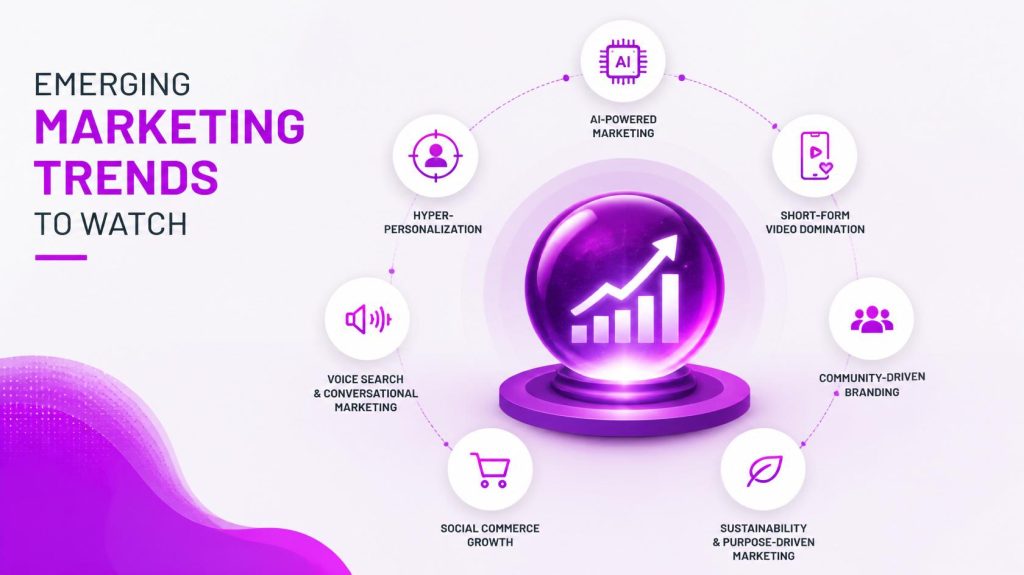
Emerging Marketing Trends to Watch
Introduction Marketing doesn’t stand still, and 2026 is proving that more than most years before it. Emerging marketing trends — from AI-driven personalization to social commerce and voice search — are changing how customers find, evaluate, and buy from businesses, often within the same year they first appear. A few years ago, ranking on Google and posting consistently on social media was often enough to stay competitive. Today, businesses are competing against AI-powered search summaries, short-form video algorithms, and customers who expect a personalized experience the moment they land on a website. Standing still is no longer a neutral choice — it’s a step backward relative to competitors who are moving forward. Following emerging marketing trends matters because it directly affects growth, sales, and customer loyalty. Businesses that adapt early tend to capture attention before their market gets crowded. Businesses that wait usually end up paying more for the same results, if they get results at all. In this guide, you’ll learn what emerging marketing trends actually are and why they matter in 2026, get a detailed breakdown of the 15 trends shaping marketing this year, see a comparison of the best marketing tools available, and walk away with a practical action plan you can apply whether you’re a beginner, a small business, a startup, or an enterprise. We’ll also cover the biggest benefits of following these trends, common mistakes to avoid, a look at where marketing is headed beyond 2026, and a detailed FAQ section addressing the questions business owners and marketers ask most often about staying current in a fast-changing landscape. What Are Emerging Marketing Trends? Emerging marketing trends are new or rapidly evolving strategies, technologies, and consumer behaviors that are starting to reshape how businesses reach and engage their audiences. Unlike established best practices, emerging trends are still gaining traction — which means early adopters often get an outsized advantage. Why Trends Change So Rapidly Three forces drive the fast pace of change: technology (especially AI), shifting consumer expectations, and platform algorithm updates. Each of these evolves on its own timeline, and when they overlap — like AI-powered features rolling out on social platforms — the resulting shift in marketing tactics can happen within months, not years. Why This Matters for Businesses Early adopters often see lower competition and lower costs for a new channel or tactic Staying current keeps your brand relevant to how customers actually behave today Understanding trends helps you avoid wasting budget on outdated tactics Trend awareness supports smarter, faster decision-making across your whole marketing plan The goal isn’t to chase every new trend that appears — it’s to recognize which ones reflect lasting shifts in customer behavior versus which are short-lived fads, and to act accordingly. Why Marketing Trends Matter in 2026 The AI Revolution AI has moved from an experimental add-on to a core part of daily marketing work — from drafting content to analyzing customer data and automating ad decisions. Businesses that build AI into their workflow are consistently able to move faster than those still relying entirely on manual processes. Changing Consumer Behavior Customers increasingly research and shop through short videos, AI chatbots, and voice assistants instead of relying only on traditional search. A marketing strategy built solely around 2022-era customer habits misses a growing share of today’s buying journey. Privacy Regulations As third-party cookies fade and privacy laws tighten worldwide, businesses that haven’t invested in first-party data collection are losing the ability to track and target effectively. Automation Marketing automation now touches nearly every channel — email, social scheduling, lead scoring, and customer support — allowing smaller teams to manage workloads that once required much larger staff. Competitive Advantage In a crowded digital landscape, the businesses that adapt to emerging trends fastest typically capture disproportionate attention, simply because fewer competitors are there yet. For example, a business that builds a strong first-party email list today will be far less affected by the ongoing loss of third-party cookies than a competitor still relying entirely on retargeting ads. The same logic applies across nearly every trend in this guide: early, deliberate action tends to compound into a lasting advantage. Top Emerging Marketing Trends to Watch in 2026 Here’s a detailed look at the 15 trends most likely to shape marketing strategy and results this year. 1. Artificial Intelligence (AI) in Marketing AI now touches nearly every part of the marketing workflow, from content creation to customer support. AI content: drafting blogs, ads, and product copy faster, with human editing for accuracy and voice AI ads: automated bidding and creative testing that optimizes in real time AI analytics: surfacing patterns in customer data that would take humans far longer to find manually Predictive marketing: forecasting which customers are likely to buy, churn, or respond to an offer AI chatbots: handling routine questions instantly, day or night Benefits: faster execution, lower costs, and deeper insights. Challenges: the risk of generic output without human review, and the need for reliable data to train models on. Best tools: ChatGPT, Claude AI, and Google Gemini for content and research; Semrush and HubSpot for AI-assisted SEO and automation. 2. Hyper-Personalization Personalization has moved beyond simply using a customer’s first name in an email. Personalized emails: content and offers tailored to purchase history and browsing behavior Product recommendations: dynamic suggestions based on real-time activity Dynamic websites: pages that change content or offers depending on the visitor Customer journeys: mapped and adjusted based on where each individual is in their decision process 3. Voice Search Optimization Smart speakers and voice assistants continue to grow as a daily habit for quick answers and local searches. Smart speakers: increasingly common in homes and cars for hands-free searches Conversational keywords: longer, natural-language phrases replace short, robotic queries Voice SEO: structuring content to directly answer spoken questions Local search optimization: voice queries often include “near me” and location-based phrasing 4. Video Marketing Evolution Video continues to diversify rather than consolidate into one dominant format. Short-form videos: quick, algorithm-friendly content for