Trending & High-Traffic Topics

Trending & High-Traffic Topics

Make Money Online

Introduction Here’s a question worth sitting with: what if your laptop could realistically become a second income stream this year? It’s not a far-fetched idea anymore — the creator economy, remote freelance work, and AI-powered side hustles have made making money online more accessible in 2026 than at almost any point before. The shift is real. AI tools now let one person do the work that used to require a small team. Remote jobs have normalized location-independent income. Freelancing platforms connect beginners with global clients within days, not months. And the creator economy continues rewarding anyone willing to consistently show up with something genuinely useful to share. This guide covers 25 proven ways to make money online in 2026, organized for every experience level — from complete beginners with zero investment, to advanced earners ready to build scalable digital businesses. You’ll get realistic income expectations, the skills and platforms that matter most, the AI tools accelerating this shift, common beginner mistakes, and a practical 30/60/90-day roadmap to get started. Let’s get into it. What is Making Money Online? Making money online means earning income through internet-based work, products, or services — ranging from freelance gigs and content creation to selling digital products and building online businesses. How It Works Most online income falls into a few core categories: trading time for money (freelancing, remote jobs), building an audience that generates revenue (blogging, YouTube, social media), selling products or services (e-commerce, digital products, courses), or building systems that earn with less ongoing effort (affiliate marketing, passive digital products). Benefits Flexible schedule and location independence Low startup costs compared to traditional businesses Scalable income potential beyond a fixed salary Access to global clients and markets Common Misconceptions “It’s instant money” – Nearly every legitimate method takes weeks or months of consistent effort before meaningful income appears. “You need to be technical” – Many profitable paths (freelancing, virtual assistance, content creation) require no coding at all. “Passive income means no work” – Most “passive” income requires significant upfront effort before it becomes low-maintenance. Why More People Are Earning Online in 2026 AI – Tools like ChatGPT and Claude let solo earners produce content, code, and services faster than ever. Remote Jobs – Companies increasingly hire globally, expanding opportunity beyond local job markets. Digital Economy – More commerce, education, and services have shifted permanently online. Freelancing – Platforms have matured, making it easier to find consistent client work. Creator Economy – Audiences increasingly support independent creators directly through content, products, and memberships. Detailed Breakdown Freelancing — Offer services like writing, design, or programming directly to clients. Skills: Any marketable skill plus communication. Tip: Build a focused portfolio around one specialty rather than listing everything you can do. Common mistake: Underpricing services early on and struggling to raise rates later. Blogging — Publish content around a niche topic and monetize through ads, affiliate links, or products. Skills: Writing, basic SEO. Tip: Pick a niche you can write about consistently for a year or more. Common mistake: Abandoning a blog after a few months before SEO traction builds. Affiliate Marketing — Earn commissions promoting other companies’ products through unique referral links. Skills: Content creation, audience building. Tip: Only promote products you’d genuinely recommend — trust drives long-term conversions. Common mistake: Promoting too many unrelated products, diluting audience trust. Dropshipping — Sell products online without holding inventory; a supplier ships directly to customers. Skills: Marketing, basic e-commerce management. Tip: Focus on a specific product niche rather than a broad general store. Common mistake: Ignoring supplier reliability and shipping times. Print on Demand — Sell custom-designed merchandise that’s printed and shipped only after a sale. Skills: Basic design, niche research. Tip: Validate designs with small test batches before heavy marketing spend. Common mistake: Ignoring print quality and mockup accuracy. YouTube — Build a channel monetized through ads, sponsorships, and products. Skills: Video editing, on-camera or voiceover presence. Tip: Consistency and a clear content niche matter more than production perfection early on. Common mistake: Constantly switching niches before an audience can form. Instagram Creator — Build an audience and monetize through sponsorships, affiliate links, and products. Skills: Visual content creation, engagement. Tip: Prioritize a consistent aesthetic and posting schedule. Common mistake: Focusing only on follower count instead of genuine engagement. TikTok Creator — Build short-form video content monetized through the platform’s creator programs, sponsorships, and product sales. Skills: Short-form storytelling, trend awareness. Tip: Study trending formats but adapt them to your specific niche. Common mistake: Copying trends without adding any original angle. Content Writing — Write articles, blog posts, or web copy for clients or publications. Skills: Strong writing, research, basic SEO knowledge. Tip: Specialize in a profitable niche like finance, health, or technology. Common mistake: Not building a portfolio before pitching higher-paying clients. Graphic Design — Create logos, social media graphics, or marketing materials for clients. Skills: Design software proficiency, visual communication. Tip: Build a focused portfolio showcasing your best niche work. Common mistake: Undercharging to win early clients, then struggling to raise prices. Beginner-Friendly Online Income Ideas If you’re just starting out, prioritize low-investment, low-complexity methods first: freelance writing or virtual assistance (minimal upfront skill barrier), online tutoring in a subject you already know well, or selling simple digital products like printables. These paths let you start earning while you build more advanced skills over time. Online Income Without Investment Several methods above require essentially no upfront money — just time and effort: Freelance writing, virtual assistance, or social media management using free tools and existing skills Content creation on YouTube, Instagram, or TikTok using just a smartphone Blogging on free or low-cost platforms while building an audience Affiliate marketing through existing social media profiles Realistic expectation: Zero-investment methods still require significant time investment before generating meaningful income — there’s no genuinely free shortcut to fast money. Passive Income Ideas Blogging – Ad and affiliate revenue continues from older posts long after publishing. YouTube – Older videos keep generating ad revenue and driving new subscribers. Affiliate
Trending & High-Traffic Topics

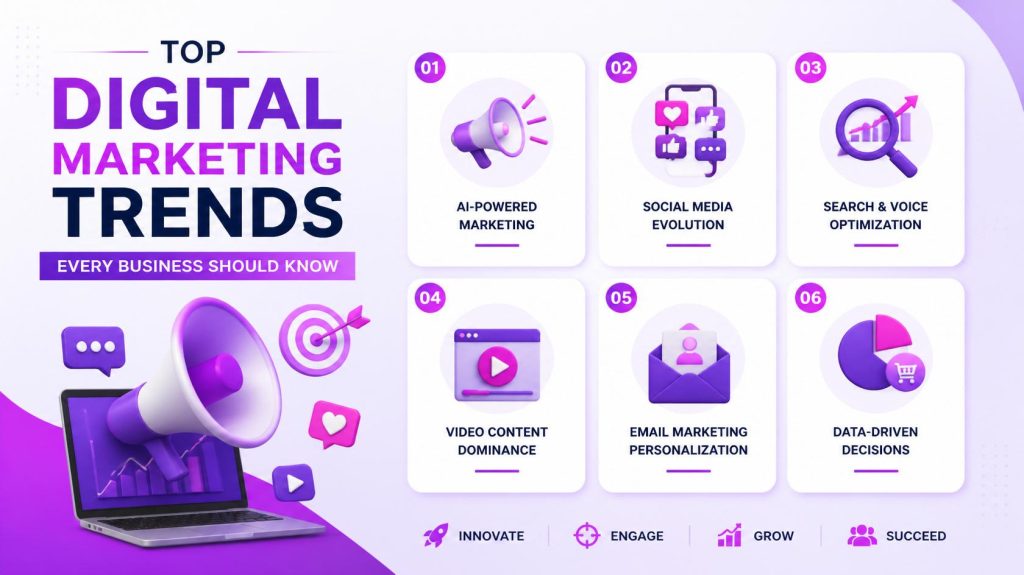
Top Digital Marketing Trends Every Business Should Know

Top Digital Marketing Trends Every Business Should Know in 2026 Every year, digital marketing shifts a little more — new platforms rise, algorithms change, and customer habits evolve. If you’re a business owner, marketer, or startup founder, keeping up with the top digital marketing trends isn’t optional anymore. It’s the difference between a brand that grows steadily and one that gets left behind. In 2026, the pace of change has only picked up. Artificial intelligence is rewriting how content gets created and discovered, search behavior is moving away from clicks and toward instant answers, and customers expect brands to show up wherever they are — on social media, in search results, on WhatsApp, and inside their inbox. This guide breaks down the digital marketing trends that matter most this year, explains why they matter, and gives you practical steps to put them to work. Whether you run a small local shop or manage marketing for a growing company, you’ll walk away with a clear roadmap for 2026 and beyond. Why Following Digital Marketing Trends Matters Trends aren’t just buzzwords — they reflect real shifts in how people search, shop, and engage with brands online. Businesses that adapt early usually capture the biggest gains, while those that wait often end up playing catch-up at a higher cost. Here’s what staying current with digital marketing trends actually delivers for your business: Better ROI — modern tools and channels are often more efficient than outdated tactics, so your marketing budget stretches further. More customers — showing up where your audience already spends time means more discovery and more leads. Stronger branding — consistent, up-to-date marketing builds trust and recognition over time. Higher conversions — trend-aware strategies (like personalization and interactive content) are proven to convert better than generic campaigns. Competitive advantage — early adopters of a trend often dominate search rankings and social visibility before competitors catch on. Top Digital Marketing Trends in 2026 Let’s go through the digital marketing trends shaping 2026, one by one, with practical tips you can apply right away. 1. AI-Powered Marketing Artificial intelligence has moved from an experimental tool to a core part of everyday marketing. Businesses of every size now use AI to save time, personalize experiences, and make smarter decisions. Where AI is making the biggest impact: AI content creation — drafting blog outlines, ad copy, and social captions faster than ever. AI chatbots — answering customer questions instantly, any time of day. AI customer service — handling routine support tickets so human agents can focus on complex issues. AI analytics — spotting patterns in customer behavior that would take humans weeks to find. AI personalization — tailoring product recommendations and messaging to each visitor. The challenge with AI is balance: over-relying on it without a human review step can lead to generic, error-prone content. The businesses winning with AI in 2026 use it to speed up the first draft, then add a human layer of brand voice, accuracy checks, and original insight. 2. Zero-Click Searches A zero-click search happens when a searcher gets their answer directly on the results page — through a featured snippet, a knowledge panel, or an AI-generated overview — without clicking through to any website. This matters because a growing share of searches now end without a single click. If your content isn’t structured to appear in these answer boxes, you can lose visibility even while ranking well. How to optimize for zero-click visibility: Answer questions directly and concisely near the top of your page, so featured snippets can pull your content. Use structured data (schema markup) so search engines understand your content clearly. Target ‘People Also Ask’ questions with clear, well-formatted answers. Use bullet points, numbered steps, and tables — formats search engines love to feature. 3. Voice Search Optimization Smart speakers and voice assistants have made spoken search a daily habit for millions of people. Voice queries tend to be longer and more conversational than typed searches, which changes how you should approach keyword targeting. Smart speakers — optimize for natural, spoken-language queries rather than short keyword phrases. Conversational keywords — target question-based phrases like ‘what is’ and ‘how do I’. Local SEO — a large share of voice searches are local (‘near me’ searches), so location pages matter more than ever. FAQ optimization — a well-structured FAQ section is one of the easiest ways to capture voice search traffic. 4. Video Marketing Dominance Video continues to be one of the most engaging content formats across every platform, and short-form video in particular has become the default way younger audiences discover new brands. Short-form videos — quick, scroll-stopping content built for platforms like Reels, Shorts, and TikTok. YouTube SEO — optimizing titles, descriptions, and thumbnails to rank inside YouTube’s own search engine. Live streaming — real-time engagement that builds trust and urgency (product launches, Q&As, behind-the-scenes). Video ads — often outperform static image ads for engagement and recall. Customer testimonials — video reviews build more trust than written ones because viewers can see genuine reactions. 5. Personalization in Marketing Generic, one-size-fits-all marketing no longer cuts through the noise. Customers expect brands to recognize their preferences and history, and personalized experiences consistently drive higher engagement and loyalty. Personalized emails — using purchase history and browsing behavior to tailor subject lines and offers. Product recommendations — ‘customers also bought’ style suggestions that boost average order value. Dynamic website content — pages that adjust based on visitor location, device, or past visits. Customer segmentation — grouping your audience by behavior so each group gets relevant messaging. Key Takeaways Checklist Before moving on, use this checklist to capture the core action points from this guide: AI should support your marketing team, not replace human judgment and brand voice entirely. Content needs to be structured for zero-click visibility, not just traditional rankings. Voice and local search go hand in hand for businesses that serve a physical area. Video, especially short-form, deserves a dedicated slot in your content calendar. Personalization and first-party data

Trending & High-Traffic Topics

The Future of Digital Marketing in 2030

Introduction Ten years ago, a brand could grow substantially by maintaining a decent website, posting on social media a few times a week, and running basic Google Ads. Today, that approach would barely register. The pace of change in digital marketing has been relentless — and the acceleration is not slowing down. By 2030, the digital marketing landscape will look fundamentally different from anything we recognise today. Artificial intelligence will not just assist marketers — it will autonomously manage campaigns, generate content, predict customer behaviour, and personalise every touchpoint in real time. Search engines will transform from link directories into AI-powered answer engines that cite brands rather than rank them. Social platforms will become full commerce ecosystems. And privacy-first, consent-based marketing will no longer be a trend — it will be the only legal and ethical option available. The businesses that will thrive in this environment are not necessarily the largest or the most established. They are the ones that invest in understanding where marketing is heading, build the right capabilities today, and adapt fast enough to stay relevant. In this comprehensive guide, you will learn: What digital marketing will look like in 2030 — and why it is fundamentally different from today The most important trends, technologies, and strategies shaping the decade ahead How SEO, social media, email, and PPC advertising will evolve The skills marketers will need and the challenges businesses must prepare for Actionable steps you can take right now to build your 2030 readiness Whether you are a startup founder, a seasoned marketer, or a student beginning your career — this guide gives you the strategic foresight to act early and compete effectively in the decade ahead. Section 1: What Is Digital Marketing in 2030? Digital marketing in 2030 will be defined by one core shift: the move from human-executed campaigns to AI-orchestrated customer experiences. The fundamental goal — connecting the right message with the right person at the right moment — remains the same. But the methods, speed, precision, and scale at which it is achieved will be unrecognisable compared to today. From Campaign-Based to Continuous Marketing Today, most businesses plan and launch discrete campaigns with defined start and end dates. By 2030, marketing will operate as a continuous, always-on system — AI agents monitoring customer signals in real time, adjusting messaging, reallocating budgets, and personalising content autonomously, with human marketers setting strategy and evaluating outcomes rather than executing individual campaigns. AI-Driven Customer Journeys The customer journey of 2030 will be orchestrated by AI that understands each individual’s preferences, purchase history, content engagement, social behaviour, and real-time intent signals — delivering the precise message, in the precise format, through the precise channel, at the precise moment most likely to drive the desired action. Hyper-Personalisation as the Baseline In 2030, hyper-personalisation will not be a competitive differentiator — it will be the minimum consumer expectation. Brands that cannot deliver individualised experiences at scale will face growing disengagement, lower conversion rates, and accelerating customer churn to competitors who can. Data-Driven Decision Making at Every Layer Marketing decisions in 2030 will be informed by predictive data at every level — from macro budget allocation across channels down to the optimal subject line for a specific individual subscriber. Gut instinct will give way to probabilistic forecasting, and the marketers who thrive will be those who can interpret data, challenge model outputs intelligently, and translate insights into creative strategy. Section 2: Why Digital Marketing Will Change Dramatically by 2030 The AI Revolution Is Accelerating AI capabilities are advancing at a pace that consistently outstrips even optimistic projections. The AI tools available in 2030 will be exponentially more capable than what we use today — moving from AI assistants that help humans execute tasks to AI agents that autonomously manage entire marketing functions. Fundamental Changes in Consumer Behaviour Younger generations entering their peak spending years by 2030 will have profoundly different media consumption habits — shorter attention spans, higher personalisation expectations, stronger distrust of intrusive advertising, and primary discovery through AI-recommended content rather than traditional search. Voice Assistants and Smart Devices The proliferation of voice assistants, smart home devices, wearables, and connected appliances is creating entirely new marketing channels. By 2030, a meaningful proportion of product discovery, research, and purchase decisions will occur through voice interaction — requiring fundamentally different optimisation approaches than screen-based search. The Death of Third-Party Cookies and the Cookie-Less Internet The elimination of third-party cookies — already underway — will be complete by 2030, fundamentally changing how digital advertising targeting works. Businesses that have not built robust first-party and zero-party data strategies will find their advertising precision dramatically reduced. Global Privacy Regulations GDPR, CCPA, and emerging privacy frameworks worldwide are establishing a clear direction: consumer data belongs to consumers. By 2030, comprehensive privacy regulations will govern marketing practices in most major markets, requiring explicit consent, transparent data practices, and genuine value exchange for data sharing. Section 3: Top Digital Marketing Trends in 2030 These are not speculative future concepts — they are developments already underway, accelerating toward mainstream adoption by 2030. Understanding them now gives you the lead time to build capabilities before they become competitive necessities. Artificial Intelligence Marketing By 2030, AI will be embedded in every aspect of digital marketing — from ideation and content creation to campaign management, customer segmentation, performance optimisation, and outcome reporting. Businesses not operating with AI at the core of their marketing function will be structurally disadvantaged. Generative AI Generative AI will produce personalised marketing content — text, images, video, audio, and interactive experiences — at individual scale. Rather than creating one version of a campaign for all customers, AI will generate thousands of variations, each optimised for a specific individual’s preferences, context, and intent. AI Content Creation Content production will shift from a human-intensive process to a human-directed, AI-executed function. Human marketers will set strategy, tone, and editorial direction; AI will execute at scale, maintaining brand consistency while personalising delivery across formats and channels. AI Video Generation By

Trending & High-Traffic Topics

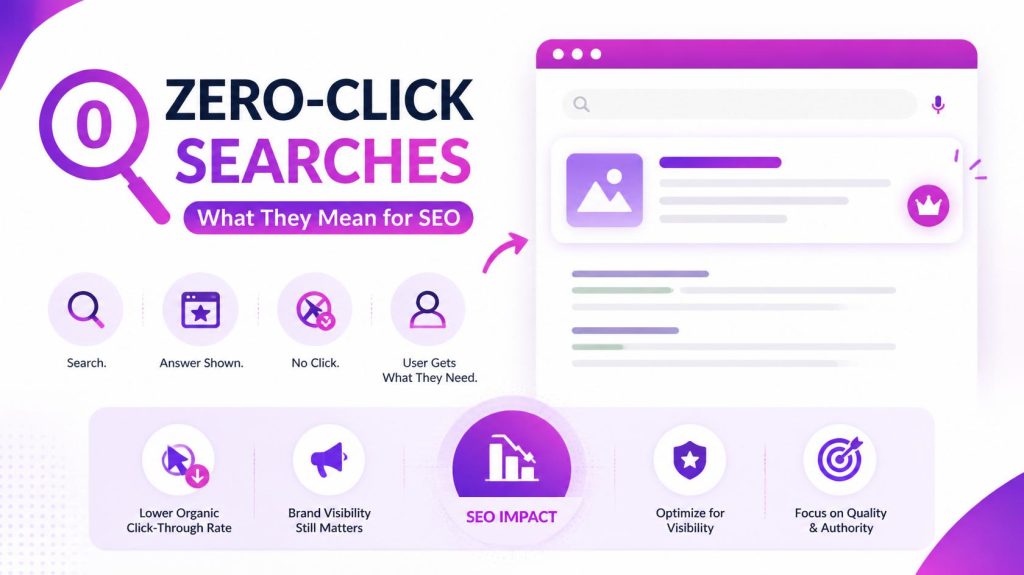
Zero-Click Searches: What They Mean for SEO

Introduction Type a question into Google today, and there’s a good chance you’ll get your answer without ever clicking a single link. The weather, a quick calculation, a celebrity’s age, a summarized AI Overview — Google hands it all over right on the results page. This is the world of zero-click searches, and it’s quietly reshaping how SEO works. Google Search has changed dramatically over the past few years. What used to be a simple list of ten blue links has turned into a rich results page packed with featured snippets, knowledge panels, AI-generated summaries, maps, and more. Each of these features is designed to answer your question instantly, right where you are. For website owners, marketers, and SEO professionals, this shift raises a real question: if people aren’t clicking through anymore, what happens to organic traffic? Should businesses panic, or is this simply a new landscape that requires a new strategy? In this complete 2026 guide, you’ll learn exactly what zero-click searches are, why Google introduced them, how they affect SEO, and — most importantly — practical, actionable strategies to stay visible, build authority, and keep earning traffic even as more searches end without a click. What Are Zero-Click Searches? Zero-click searches happen when a user types a query into Google and gets their answer directly on the search results page, without clicking through to any website. The search itself satisfies the need, so the journey ends right there. Featured Snippet Answer: What Is a Zero-Click Search? A zero-click search is a Google search that ends without the user visiting any website, because the answer — such as a definition, calculation, or AI-generated summary — appears directly on the results page. Why They Happen Zero-click searches happen because Google has gotten very good at understanding exactly what users want and pulling the answer straight from the web or its own knowledge systems, then displaying it instantly. The Evolution of Google Search Google Search has evolved from a simple list of links into an answer engine. Featured snippets came first, followed by knowledge panels, local packs, and now AI Overviews that summarize entire topics using generative AI, pulling from multiple sources at once. How Zero-Click Searches Work Zero-click results come in many formats, each designed to satisfy a specific type of query instantly. AI Overview: An AI-generated summary that appears at the top of results, synthesizing information from multiple sources into one answer. Example: searching “how does compound interest work” may show a full AI-written explanation. Featured Snippets: A highlighted box pulling a direct answer, list, or table from a ranking webpage. Example: searching “how to tie a tie” often shows numbered steps pulled from a blog post. Knowledge Panels: Information boxes about people, places, or organizations, usually sourced from the Knowledge Graph. Example: searching a celebrity’s name shows their age, birthplace, and career facts. Maps: Interactive map results for location-based queries. Example: searching “gas stations near me” shows a map with pins. People Also Ask: An expandable list of related questions with short answers. Example: searching “benefits of yoga” shows related questions like “Is yoga good for weight loss?” Why Google Introduced Zero-Click Searches Better user experience: Instant answers save users time and effort. Faster answers: Many queries have simple, factual answers that don’t require a full website visit. Mobile search: Small screens benefit from concise, instant answers rather than scrolling through pages. AI integration: Generative AI allows Google to synthesize information from multiple sources into a single, coherent answer. User satisfaction: Google’s core goal is to keep users happy and returning, and instant, accurate answers support that goal. How Zero-Click Searches Affect SEO Zero-click searches bring both challenges and opportunities for SEO. Here’s a balanced look at the impact. The Challenges Reduced clicks: Fewer users land on your website even when your content answers their query. Lower CTR: Click-through rates for many informational keywords have declined as more answers appear directly on the results page. The Opportunities Brand visibility: Appearing in a featured snippet or AI Overview puts your brand name in front of users, even without a click. Higher impressions: Your content can appear more often in search results, building familiarity over time. Better authority: Being cited as a source in an AI-generated answer signals trust and relevance to both users and search engines. Are Zero-Click Searches Bad for SEO? Not necessarily. While a drop in click-through rate can feel discouraging, zero-click results often bring branding value that’s easy to overlook. When your business appears in a featured snippet, knowledge panel, or AI Overview, users see your brand name and message even if they don’t click. Over time, this repeated visibility builds trust and recognition, which can lead to direct visits, branded searches, and conversions later on. Types of Zero-Click Search Results Featured Snippets A highlighted answer box pulled from a ranking page, often shown as a paragraph, list, or table. Example: “What is the capital of France?” shows a direct one-line answer. AI Overviews AI-generated summaries that combine information from several sources into one comprehensive answer, often with linked citations. Knowledge Graph A panel of structured facts about a specific entity, such as a person, place, or organization, displayed alongside search results. Local Pack A group of three local business results shown for location-based searches, complete with ratings, hours, and directions. Shopping Results Product listings with images, prices, and retailer names shown directly for shopping-related queries. How to Optimize for Zero-Click Searches Target featured snippet opportunities by directly answering common questions in 40–60 words. Implement schema markup, including FAQ, HowTo, and Article schema, to help search engines understand your content. Use structured data consistently across key pages. Write clear, descriptive headings that mirror how users phrase their questions. Use numbered lists and bullet points to make step-by-step content easy to extract. Include comparison tables where relevant, since these are often pulled into rich results. Create question-based content that mirrors natural search queries. Strengthen internal linking to help search engines understand topical relationships across your site.

Trending & High-Traffic Topics

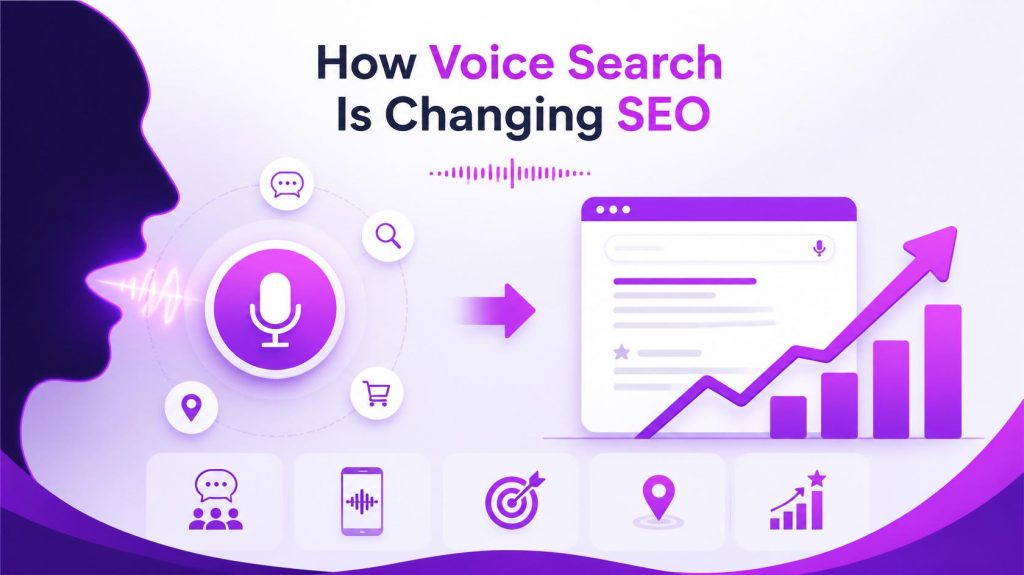
How Voice Search Is Changing SEO

Introduction “Hey Google, find a coffee shop near me.””Alexa, what’s the weather today?” These everyday commands are more than convenient habits — they represent one of the biggest shifts in how people search for information, and it’s changing SEO forever. Voice assistants like Google Assistant, Siri, and Alexa have moved from novelty features into daily essentials. Smart speakers sit on kitchen counters, voice search is built into nearly every smartphone, and AI-powered assistants are answering questions faster than ever before. For businesses and website owners, this shift matters. Voice search doesn’t work like typed search. People speak in full, natural sentences, ask direct questions, and expect fast, accurate answers — often just one answer, read aloud. In this complete 2026 guide, you’ll learn exactly what voice search is, why it’s growing so quickly, how it’s reshaping SEO strategy, the ranking factors that matter most, and practical, actionable steps to optimize your website for voice search, local search, and AI-powered search experiences. What Is Voice Search? Voice search lets users speak a query into a device instead of typing it, and receive a spoken or on-screen answer. It relies on speech recognition and artificial intelligence to interpret natural spoken language and return relevant results. Featured Snippet Answer: What Is Voice Search SEO? Voice search SEO is the practice of optimizing website content so it can be easily found, understood, and read aloud by voice assistants like Google Assistant, Siri, and Alexa in response to spoken queries. Examples of Voice Search “What’s the best pizza place near me?” “How do I fix a leaking faucet?” “What time does the pharmacy close today?” How It Works A user speaks a query into a phone, smart speaker, or car assistant. Speech recognition software converts spoken words into text. Natural language processing interprets the meaning and intent behind the words. The search engine matches the interpreted query with relevant, well-optimized content. The assistant reads back a single answer or short list, often pulled from a featured snippet. The AI Behind Voice Search Voice search is powered by a combination of natural language processing (NLP), machine learning, and semantic search technology, which allow search engines to understand conversational, question-based language rather than relying only on exact keyword matches. Why Voice Search Is Growing So Fast Several factors are driving the rapid rise of voice search, and together they explain why it’s no longer a niche feature. Smartphones: Built-in voice assistants make speaking a query faster than typing on a small screen. Smart speakers: Devices have become common household fixtures for quick answers and daily tasks. Google Assistant, Alexa, and Siri: Continuous AI improvements have made these assistants far more accurate and conversational. AI improvements: Better language models mean fewer misunderstood queries and more useful answers. Convenience: Speaking is often faster and easier than typing, especially on the go. Hands-free searching: Voice search fits naturally into driving, cooking, exercising, and multitasking. How Voice Search Is Changing SEO Voice search is reshaping SEO because spoken queries behave very differently from typed ones. Here’s what’s changing. Conversational Keywords Instead of typing “best running shoes,” a voice searcher might ask, “What are the best running shoes for flat feet?” Content needs to reflect natural, conversational phrasing. Long-Tail Keywords Voice queries tend to be longer and more specific, making long-tail keywords more valuable than short, generic terms. Question-Based Searches Many voice queries start with who, what, where, when, why, or how, so structuring content around clear questions and answers improves visibility. Search Intent Voice search puts a stronger emphasis on understanding what the user actually wants, not just matching keywords. Natural Language Content written in a natural, human tone tends to match spoken queries better than stiff, keyword-stuffed text. How Google Understands Voice Queries Google uses several AI systems together to interpret spoken queries and match them with the best possible content. NLP (Natural Language Processing): Helps Google understand grammar, phrasing, and conversational structure. Machine Learning: Continuously improves search accuracy based on patterns in real user queries. BERT: A language model that helps Google understand the context of words within a full sentence, not just in isolation. MUM: A more advanced model capable of understanding complex, multi-part questions across formats and languages. RankBrain: An AI system that helps interpret unfamiliar or ambiguous search queries. Entity SEO: Focuses on optimizing for real-world people, places, and things rather than isolated keywords, helping search engines connect content to the knowledge graph. Top Voice Search Ranking Factors Website speed: Fast-loading pages are favored, since voice assistants prioritize quick, reliable answers. Mobile-friendly design: A responsive, easy-to-navigate mobile site is essential. HTTPS: Secure websites are trusted more by search engines. Schema markup: Structured data helps search engines understand and surface your content accurately. Featured snippets: Ranking in position zero significantly increases the chance of being read aloud. Local SEO: Optimized local listings are critical for “near me” voice queries. Content quality: Clear, accurate, well-organized content performs better in voice results. Domain authority: Trusted, established sites are more likely to be referenced. Internal linking: Helps search engines understand site structure and content relationships. Core Web Vitals: Page experience metrics influence overall ranking potential. Best Voice Search SEO Strategies Use conversational language throughout your content. Directly answer common user questions. Optimize FAQ sections with clear, concise answers. Target long-tail, question-based keywords. Implement structured data and schema markup. Improve local SEO signals and listings. Fully optimize your Google Business Profile. Improve page speed across mobile and desktop. Create genuinely high-quality, helpful content. Target featured snippet opportunities with concise answers. Voice Search and Local SEO A huge portion of voice searches are local — people asking for businesses, services, or directions near them right now. “Near me” searches: Optimize content and listings for location-based intent. Local businesses: Ensure your business appears accurately across local directories. Google Maps: Keep your map listing complete, accurate, and regularly updated. Business listings: Consistent information across platforms builds trust with search engines. Reviews: Positive, recent reviews influence both rankings and user trust. NAP consistency: Keep

Trending & High-Traffic Topics

What Is Generative AI?

What Is Generative AI? Introduction Here’s a number worth pausing on: industry surveys suggest that a majority of large enterprises now use some form of generative AI in at least one business function, and the number keeps climbing every quarter. What started as a niche research topic inside AI labs has, in just a few years, turned into one of the biggest technology shifts of our lifetime. If you’ve heard terms like ChatGPT, Claude, Gemini, or Midjourney and wondered what actually connects them, the answer is generative AI. It’s the technology quietly rewriting how we write emails, design graphics, write code, answer customer questions, and even brainstorm business ideas. Generative AI is no longer just a buzzword for tech insiders. It’s showing up in marketing teams, classrooms, hospitals, banks, law firms, and small businesses everywhere. Whether you’re a student, a marketer, a developer, or a business owner, understanding this technology is quickly becoming as essential as knowing how to use a search engine. In this complete beginner’s guide, you’ll learn what generative AI actually is, how it works under the hood (in plain English), the different types and tools available in 2026, real-world use cases across industries, its benefits and limitations, and practical best practices for using it responsibly. By the end, you’ll have a clear, confident understanding of one of the most talked-about technologies of our time. Lorem ipsum dolor sit amet, consectetur adipiscing elit. Ut elit tellus, luctus nec ullamcorper mattis, pulvinar dapibus leo. What Is Generative AI? Generative AI refers to artificial intelligence systems that can create new content — text, images, audio, video, code, or even 3D models — instead of simply analyzing or classifying existing data. Rather than just predicting a label or a number, these systems generate something original based on patterns they’ve learned. Simple Explanation Think of generative AI as a very well-read assistant that has studied enormous amounts of text, images, and other data. When you give it an instruction, called a prompt, it uses everything it has learned to produce a fresh piece of content that fits what you asked for. Technical Explanation Under the hood, generative AI relies on deep learning models, often built on an architecture called the transformer, which are trained on massive datasets to learn statistical patterns in language, images, or sound. During generation, the model predicts the most likely next piece of content, one step at a time, based on everything it has seen so far. Why Is It Called ‘Generative’? It’s called generative because the AI generates new output rather than only recognizing or sorting existing input. Traditional AI might tell you whether a photo contains a cat. Generative AI can create a brand-new photo of a cat that never existed. Brief History of Generative AI Generative AI didn’t appear overnight. It’s the result of decades of research building on top of earlier breakthroughs. Early AI research (1950s–1980s): Scientists explored rule-based systems and symbolic logic to mimic human reasoning. Machine learning evolution (1990s–2000s): Algorithms began learning patterns from data instead of relying purely on hand-coded rules. Deep learning breakthrough (2010s): Neural networks with many layers dramatically improved image and speech recognition. Neural networks matured: Architectures like convolutional and recurrent neural networks enabled more complex pattern recognition. Transformers arrive (2017): A research paper introduced the transformer architecture, which became the foundation for modern generative AI. Rise of large language models (2018–2022): Models trained on massive text datasets began generating fluent, human-like language. Modern AI revolution (2023–2026): Multimodal AI tools capable of understanding and generating text, images, audio, and video became mainstream, embedded into everyday apps, browsers, and business software. How Generative AI Works You don’t need a computer science degree to understand the basics. Here’s a plain-language breakdown of the core building blocks. Key Concepts Explained Simply Training Data: The huge collection of text, images, or other content the model learns from before it can generate anything. Machine Learning: The broader field of teaching computers to find patterns in data and improve through experience rather than explicit programming. Neural Networks: Layered mathematical structures loosely inspired by the human brain that process information and learn patterns. Transformers: A neural network architecture that pays ‘attention’ to relationships between all parts of the input at once, making it very good at understanding context. Tokens: Small chunks of text (words or parts of words) that models process one piece at a time. Prompts: The instructions or questions you give the AI to guide what it generates. Model Training: The process of exposing a model to data repeatedly so it learns statistical patterns and relationships. Fine-Tuning: Further training a general model on a narrower dataset so it performs better on specific tasks. Reinforcement Learning: A training technique where the model is rewarded for outputs that match desired behavior, often guided by human feedback. Inference: The moment the trained model actually generates a response to your prompt in real time. Types of Generative AI Generative AI isn’t limited to chatbots. It spans multiple content formats, each powered by specialized models. Text Generation Produces articles, emails, summaries, and conversational responses. Example: drafting a marketing email in seconds. Image Generation Creates original artwork, product mockups, or photorealistic images from text prompts. Example: generating a logo concept. Video Generation Produces short video clips, animations, or edits from text or image prompts. Example: creating a product demo animation. Audio Generation Generates realistic voiceovers, sound effects, or synthetic speech. Example: converting a blog post into a podcast-style narration. Music Generation Composes original background music or melodies based on mood or genre prompts. Code Generation Writes, completes, or debugs programming code across multiple languages. 3D Model Generation Creates 3D assets for gaming, product design, and virtual environments from text or image inputs. Popular Generative AI Models Behind every AI tool is an underlying model. Here’s a look at some of the most widely used model families as of 2026. GPT Models Known for strong general-purpose reasoning and conversational ability, widely used for writing, coding, and analysis tasks.

Scroll to Top