
Introduction
Ask that question in any marketing team meeting today, and you will get fifteen different opinions in under a minute. Since ChatGPT and other generative AI tools went mainstream, “will AI replace digital marketers?” has become one of the most searched, debated, and genuinely anxiety-inducing questions in the industry.
It is not hard to see why. AI can now write a blog draft in seconds, generate a week of social captions before your coffee gets cold, and optimize an ad campaign’s bidding strategy faster than any human could manually adjust it. Businesses are adopting these tools at a rapid pace, not out of curiosity, but because the productivity gains are real and the competitive pressure to keep up is even more real.
But speed and automation are not the same thing as replacement. In this guide, you will get an honest, balanced answer to whether AI is coming for marketing jobs — covering exactly what AI does better than humans, what humans still do better than AI, how AI is reshaping every major area of digital marketing, which jobs are most exposed, which new careers are emerging, the tools worth learning, and a practical, fifteen-point plan for staying relevant no matter how this technology evolves.
What Is Artificial Intelligence in Digital Marketing?
Before answering the big question, it helps to be precise about what we are actually talking about, since “AI” gets used as a catch-all term for several distinct technologies.
- Artificial Intelligence: Software that can perform tasks — like recognizing patterns or generating language — that typically required human intelligence.
- Machine Learning: A subset of AI where systems learn from data and improve their predictions over time, rather than following fixed, hand-written rules.
- Generative AI: AI models, like ChatGPT, Claude, and Gemini, that create new content — text, images, audio, or video — based on patterns learned from massive training data sets.
- Marketing Automation: Software that automatically executes repetitive marketing tasks, such as sending triggered emails or scheduling social posts, often using AI to decide timing and targeting.
In practice, these technologies are already woven into daily marketing work: AI drafts emails, machine learning models score leads, generative AI produces ad creatives, and automation platforms run entire nurture sequences without a marketer touching a single send button. This is the baseline AI in digital marketing has already reached — and it is exactly why the replacement question feels so urgent.
Why Is AI Becoming So Popular?
- Faster Work: Tasks that took hours, like drafting reports or writing first drafts, now take minutes.
- Better Analytics: AI models process large data sets and surface patterns that would take a human analyst far longer to find manually.
- Automation: Repetitive workflows — scheduling, tagging, basic reporting — now run with minimal manual input.
- Cost Savings: Producing more content and managing more campaigns no longer requires proportionally larger teams.
- Content Creation: Blog drafts, ad copy variations, and social captions can be generated in volume almost instantly.
- Personalization: AI tailors messaging, offers, and recommendations to individual users at a scale manual segmentation cannot match.
Put simply, AI lets marketing teams do more, faster, with tighter budgets — which is precisely the combination every business is chasing.
Will AI Replace Digital Marketers?
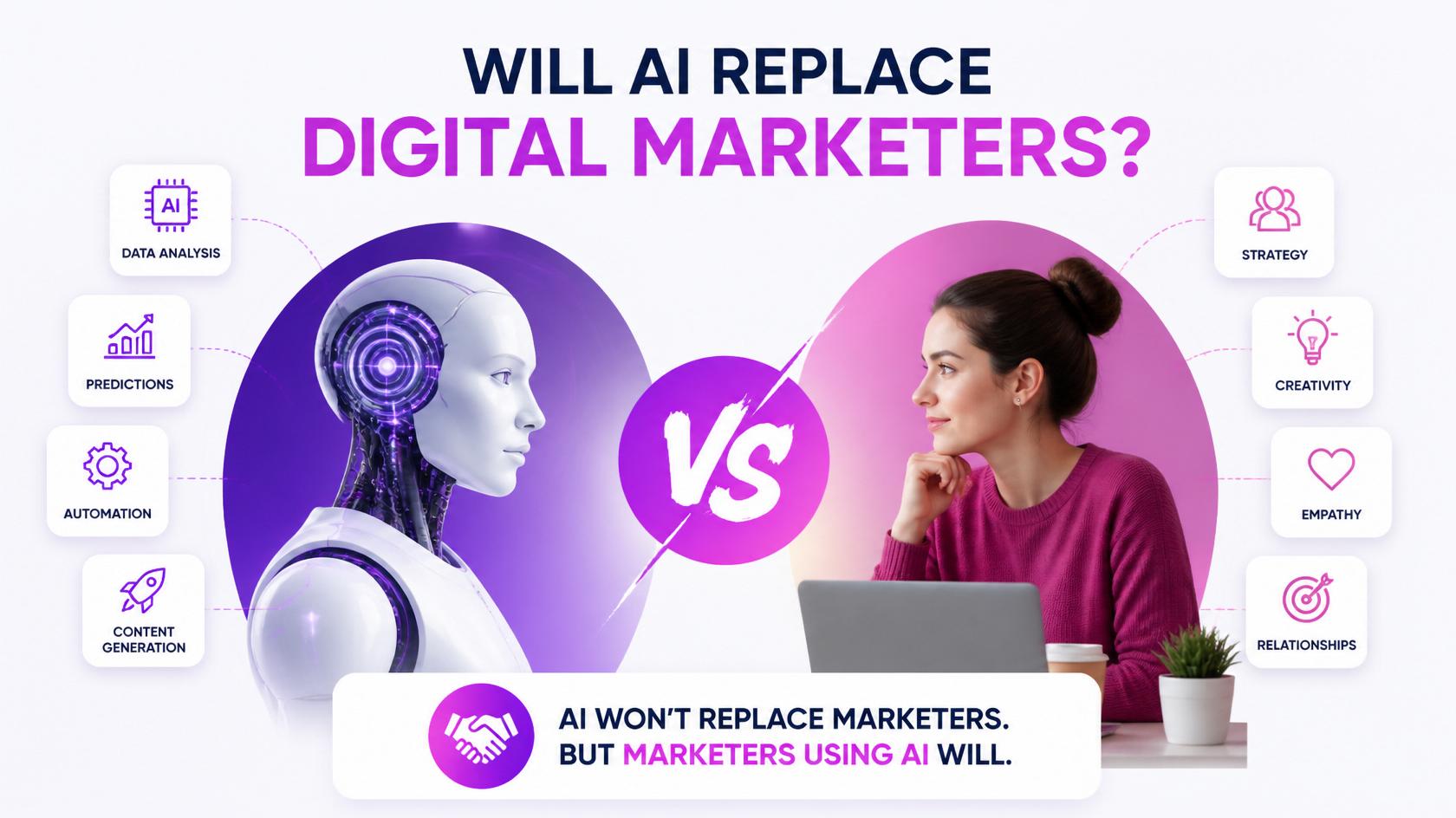
Here is the short answer: no, AI is not on track to fully replace digital marketers — but it is absolutely replacing specific tasks within marketing roles, and that distinction matters enormously.
Now the longer answer. AI is exceptional at well-defined, data-rich, repeatable tasks: drafting copy variations, analyzing large data sets, optimizing ad bids, and scheduling content. These are exactly the tasks AI is currently automating across marketing teams, and that automation is real and accelerating.
What AI still struggles with is everything that depends on judgment shaped by lived experience: understanding subtle cultural context, building genuine trust with a client or customer, making an ethical call in a gray area, or originating a creative concept nobody has tried before. These are not minor gaps — they are the core of what separates good marketing from forgettable marketing, and they are precisely where human marketers remain irreplaceable.
The realistic outcome, already playing out across the industry, is a shift in what the marketer’s job looks like rather than the disappearance of the job itself. AI becomes the engine for execution and analysis; humans become the strategists, editors, and relationship-builders directing that engine. Marketers who adapt to that shift are thriving. Those who ignore it are the ones genuinely at risk — not from AI itself, but from competitors who learned to use it well.
What AI Can Do Better Than Humans
- Data Analysis: AI processes large volumes of customer and campaign data far faster than any human analyst, spotting patterns in minutes rather than days.
- Keyword Research: AI tools surface keyword opportunities and search volume trends across thousands of terms in seconds.
- SEO Suggestions: AI-powered SEO tools score content against top-ranking competitors and flag specific gaps to fix.
- Email Automation: AI personalizes subject lines, send times, and content for thousands of subscribers simultaneously.
- Ad Optimization: AI adjusts ad bids in real time based on auction conditions far faster than manual bid management.
- Image Generation: AI tools like Midjourney and Canva AI produce campaign visuals in minutes instead of days.
- Predictive Analytics: AI models forecast customer behavior, like churn risk or purchase likelihood, from historical patterns.
- Customer Segmentation: AI groups customers into precise micro-segments based on behavior that would be tedious to sort manually.
For example, an e-commerce brand might use AI to analyze a year of purchase data, identify which customers are likely to churn next month, and automatically trigger a personalized win-back email — all without a marketer manually reviewing a single spreadsheet.
What Humans Still Do Better Than AI
- Creativity: Original ideas, unexpected angles, and genuinely new creative concepts still come from human imagination, not pattern-matching.
- Emotional Intelligence: Reading a client’s unstated concerns or a customer’s frustration in tone requires emotional awareness AI does not genuinely possess.
- Storytelling: Crafting a narrative that resonates on a human level — not just a technically correct one — remains a deeply human skill.
- Branding: Defining what a brand stands for and ensuring every touchpoint reflects that identity requires human vision.
- Strategic Thinking: Deciding why a campaign should exist, not just how to execute it, is a judgment call AI cannot make independently.
- Building Customer Trust: Long-term client and customer trust is built through consistency, honesty, and relationship history AI cannot replicate.
- Ethical Decision-Making: Navigating gray-area decisions — what to say in a crisis, what data is fair to use — requires human ethical judgment.
- Understanding Culture: Recognizing cultural nuance, humor, and sensitivity across different audiences still requires lived human experience.
These skills remain valuable precisely because they cannot be reduced to a prompt. They are the reason clients hire marketers, not just software.
How AI Is Changing Different Areas of Digital Marketing
AI in SEO
AI now speeds up keyword research, search intent analysis, and content scoring against top-ranking pages. A marketer might use Surfer SEO or Semrush to identify content gaps, then have a human writer fill them with genuinely useful, well-researched content.
AI in Content Marketing
Tools like ChatGPT and Claude draft blog posts, email sequences, and social captions in a fraction of the time manual writing once took. The best content teams use these drafts as a starting point, then add original research, data, and a distinct voice before publishing.
AI in Social Media Marketing
AI handles content scheduling, audience analysis, and trend spotting across platforms. A social media manager might use AI to identify the best posting times for each platform while still personally crafting the captions that reflect brand personality.
AI in PPC Advertising
Platforms like Google Ads and Meta Ads use AI for automated bid optimization and audience targeting. A PPC specialist sets the strategy and budget guardrails, then lets AI handle the second-by-second bidding decisions within those limits.
AI in Email Marketing
AI personalizes send times, subject lines, and content blocks for individual subscribers. A marketer might design the overall campaign structure while AI handles the granular personalization across thousands of recipients.
AI in Video Marketing
AI video tools can generate short clips, captions, and even basic edits from text prompts or existing footage. A video marketer might use AI to produce a rough cut quickly, then apply their own editing judgment for pacing and emotional impact.
AI in Customer Support
AI chatbots now handle routine questions instantly, 24/7. Support teams use AI to triage and answer common queries while routing complex or sensitive issues to human agents who can handle nuance and empathy.
AI in Analytics
AI-powered dashboards surface trends and anomalies in campaign data automatically. A marketing analyst might rely on AI to flag a sudden drop in conversion rate, then investigate the root cause and decide on a fix themselves.
Jobs That AI May Replace
Some marketing tasks are genuinely becoming automated, and being honest about this is part of giving balanced, trustworthy advice:
- Basic Copywriting: Simple, formulaic product descriptions and social captions with minimal strategic input.
- Data Entry: Manually transferring information between spreadsheets, CRMs, and reporting tools.
- Reporting: Compiling routine performance reports that AI can now generate automatically from connected data sources.
- Simple Customer Support: Answering frequently asked, low-complexity customer questions that a chatbot can resolve instantly.
- Routine Scheduling: Posting content and sending emails at predetermined times, now handled by automation platforms.
Notice a pattern: these are tasks defined by repetition and low ambiguity, not entire roles. The marketers most at risk are those whose job consists almost entirely of these tasks, with little strategic or creative responsibility layered on top.
Jobs AI Will Create
- AI Marketing Specialist: A role focused on identifying, testing, and implementing AI tools across a marketing team’s workflow.
- Prompt Engineer: A specialist who crafts and refines the prompts that get the best results from generative AI tools.
- AI Content Strategist: A strategist who plans how AI-generated content fits into a broader content and SEO strategy.
- Marketing Automation Expert: A specialist who designs and manages complex automated workflows across marketing platforms.
- AI SEO Consultant: An SEO professional who specializes in optimizing for AI-driven search experiences and AI-generated answers.
- AI Trainer: A role focused on training internal teams to use AI tools effectively and responsibly.
- AI Data Analyst: An analyst who interprets and validates AI-generated insights, ensuring decisions rest on accurate data.
These roles are growing because every business adopting AI tools needs people who understand both marketing and the technology well enough to direct it effectively. That combination of skills is currently in short supply, which is exactly why it is becoming so valuable.
Top AI Tools Every Digital Marketer Should Learn
You do not need to master every AI tool on the market, but familiarity with the following ten will cover the vast majority of modern marketing workflows.
1. ChatGPT
Overview: A conversational AI from OpenAI used widely for drafting, brainstorming, and ideation across nearly every marketing task.
Best Use Case: Drafting blog outlines, ad copy variations, and email sequences quickly.
Benefits: Extremely flexible, fast, and easy for beginners to start using immediately.
Limitations: Requires fact-checking and editing; can produce generic output without detailed prompting.
2. Claude AI
Overview: Anthropic’s AI assistant known for strong reasoning and high-quality long-form writing across large documents.
Best Use Case: Drafting in-depth articles, content strategy documents, and analyzing long reports.
Benefits: Handles nuance and long context well, producing drafts that need less heavy editing.
Limitations: No native image generation; smaller third-party app ecosystem.
3. Google Gemini
Overview: Google’s multimodal AI, integrated with Search, Workspace, and Google Ads.
Best Use Case: Generating ad copy alongside visual concepts for Google Ads campaigns.
Benefits: Tight integration with the Google ecosystem and real-time search grounding.
Limitations: Smaller plugin ecosystem compared to ChatGPT; some features roll out gradually by region.
4. Jasper
Overview: A content platform built specifically for marketing teams, with strong brand voice training features.
Best Use Case: Keeping content consistent across many writers and multiple brand accounts.
Benefits: Reliable brand voice control and team collaboration tools.
Limitations: Pricier than general-purpose AI tools; no free tier.
5. Canva AI
Overview: A design platform with built-in AI features like Magic Design and text-to-image generation.
Best Use Case: Producing social media graphics and ad creatives without a designer.
Benefits: Extremely easy to use, with a huge template library for non-designers.
Limitations: Less granular control than professional design software.
6. Surfer SEO
Overview: A content optimization tool that scores drafts against top-ranking pages for a target keyword.
Best Use Case: Optimizing blog drafts before publishing to match competitor depth and structure.
Benefits: Clear, data-backed content recommendations tied to live search results.
Limitations: Covers on-page optimization only, not link building or technical SEO.
7. Semrush
Overview: An all-in-one SEO and competitive research suite with AI-assisted content and keyword tools.
Best Use Case: Running full SEO audits and generating AI content briefs in one platform.
Benefits: Extremely comprehensive toolkit covering research, content, and reporting.
Limitations: Steeper learning curve, and can feel like overkill for very small sites.
8. Ahrefs
Overview: A backlink and keyword research platform with AI-assisted content grading and clustering.
Best Use Case: Competitor backlink gap analysis paired with AI-suggested content topics.
Benefits: Best-in-class backlink data and strong competitor analysis.
Limitations: AI writing features are less developed than dedicated content tools.
9. Frase
Overview: An AI tool that generates SEO content briefs based on SERP analysis, paired with an AI writer.
Best Use Case: Producing ready-to-use briefs for freelance writers at scale.
Benefits: Briefs are closely tied to actual search intent, saving planning time.
Limitations: AI-written drafts typically need significant editing.
10. Notion AI
Overview: An AI layer built into Notion’s workspace platform, offering summarization and writing help.
Best Use Case: Managing a content calendar with AI-assisted meeting notes and briefs.
Benefits: Combines project management with AI writing in one connected workspace.
Limitations: Not a dedicated marketing tool; AI is a feature layered on top, not the core product.
Challenges of Using AI
- AI Hallucinations: AI can state inaccurate information confidently; every claim should be independently verified before publishing.
- Copyright: AI-generated images and text can raise copyright questions depending on training data and licensing terms; review each tool’s policy carefully.
- Google Quality Guidelines: Google’s quality guidelines reward genuinely helpful, original content regardless of how it was produced, so thin AI content without real value or editing can underperform.
- Lack of Originality: Unedited AI content can sound generic or closely resemble other AI output; a strong human editing pass keeps content distinctive.
- Privacy: Feeding customer data into AI tools requires understanding each vendor’s data policy and complying with regulations like GDPR or CCPA.
- Ethical Concerns: Questions around AI training data, transparency, and disclosure to audiences are still evolving and deserve thoughtful internal policies.
- Bias: AI models can reflect biases present in their training data, which can skew targeting or messaging if left unchecked.
- Human Review: AI output is a draft, not a finished product; budgeting real editing time into every workflow protects quality and brand trust.
Biggest Mistakes Marketers Make with AI
- Publishing AI-generated content without human review
How to avoid it: Always add a dedicated editing pass before anything goes live.
- Treating every AI-generated statistic as fact
How to avoid it: Verify all data points against a credible, original source.
- Using the same generic prompts for every task
How to avoid it: Customize prompts with specific context, audience, and tone instructions.
- Ignoring brand voice settings in AI tools
How to avoid it: Train brand voice profiles where available and review tone consistently.
- Adopting too many AI tools at once
How to avoid it: Start with one tool tied to one clear goal, then expand gradually.
- Letting AI chatbots handle sensitive customer issues alone
How to avoid it: Build a clear handoff path to a human agent for complex cases.
- Overlooking data privacy when feeding customer data into AI tools
How to avoid it: Review each vendor’s data policy and comply with relevant regulations.
- Assuming AI-generated images are free to use commercially
How to avoid it: Check each tool’s licensing terms before using assets in paid campaigns.
- Neglecting to track whether AI tools are actually improving results
How to avoid it: Measure time saved and performance lift, not just adoption.
- Letting strategic and creative skills atrophy through over-reliance on AI
How to avoid it: Deliberately practice strategy and creative work without AI assistance regularly.
Frequently Asked Questions
- Will AI replace digital marketers?
No, not entirely. AI is automating specific tasks like data analysis, first-draft writing, and reporting, but strategy, creativity, and client relationships still require human marketers, making AI a powerful assistant rather than a full replacement.
- Can ChatGPT do digital marketing?
ChatGPT can help with digital marketing tasks like drafting content, brainstorming campaign ideas, and writing ad copy, but it works best as a tool guided by a human marketer rather than a standalone replacement.
- Is AI good for SEO?
Yes, AI is good for SEO when used to speed up keyword research, analyze search intent, and optimize content structure, though human judgment is still needed to verify accuracy and match true audience needs.
- Will AI replace SEO experts?
AI will likely replace some repetitive SEO tasks like basic audits and keyword clustering, but SEO experts who understand strategy, technical nuance, and search algorithm changes will remain in demand.
- Is digital marketing still a good career?
Yes. Digital marketing remains a strong career path, especially for people who combine traditional marketing skills with AI tool proficiency, since businesses increasingly need both.
- Can AI write blogs?
AI can generate blog drafts quickly, but the best-performing blogs still involve human editing for accuracy, originality, and a distinct brand voice that purely AI-generated content often lacks.
- Should businesses use AI?
Most businesses benefit from using AI for specific tasks like content drafting, ad optimization, and customer support automation, as long as outputs are reviewed and strategy remains human-led.
- Which AI tool is best for marketing?
There is no single best tool; ChatGPT and Claude work well for content, Surfer SEO and Semrush for search optimization, and Canva AI for design, so the right choice depends on the specific marketing task.
- How can marketers use AI effectively?
Marketers use AI most effectively by automating repetitive, data-heavy tasks while keeping strategic decisions, creative direction, and client relationships in human hands.
- What skills will marketers need in the future?
Prompt engineering, data interpretation, strategic thinking, and strong storytelling skills are becoming essential, since these complement what AI tools cannot fully replicate on their own.
Conclusion
So, will AI replace digital marketers? Based on everything covered above, the honest answer is no — but it will absolutely continue replacing specific repetitive tasks within marketing roles, and it will keep raising the bar for what skilled, strategic marketing looks like.
AI excels at data analysis, content drafting, ad optimization, and execution at scale. Humans remain essential for creativity, strategy, ethical judgment, and the trust-based relationships that no algorithm can replicate. The marketers thriving in 2026 are not competing against AI — they are the ones who learned to direct it.
The smartest move available to any marketer, agency, or business right now is to treat AI as a powerful partner rather than a threat to fear or a magic fix to over-rely on. Learn the tools, sharpen the human skills AI cannot replace, and let the combination of the two do the heavy lifting.