
Introduction
Digital marketing does not stand still. Every year, new platforms rise, algorithms shift, consumer habits evolve, and yesterday’s best practice quietly becomes today’s outdated tactic. In 2026, that pace of change has only accelerated, driven largely by artificial intelligence, changing search behavior, and a generation of consumers who expect brands to be fast, authentic, and personal.
For business owners, marketers, startups, and students alike, staying current is no longer optional. A strategy that worked beautifully in 2023 can quietly stop delivering results today if it hasn’t adapted to how people now search, scroll, and shop. Recent industry surveys consistently show that companies investing in AI-driven marketing, video content, and first-party data collection are outpacing competitors who haven’t updated their playbooks.
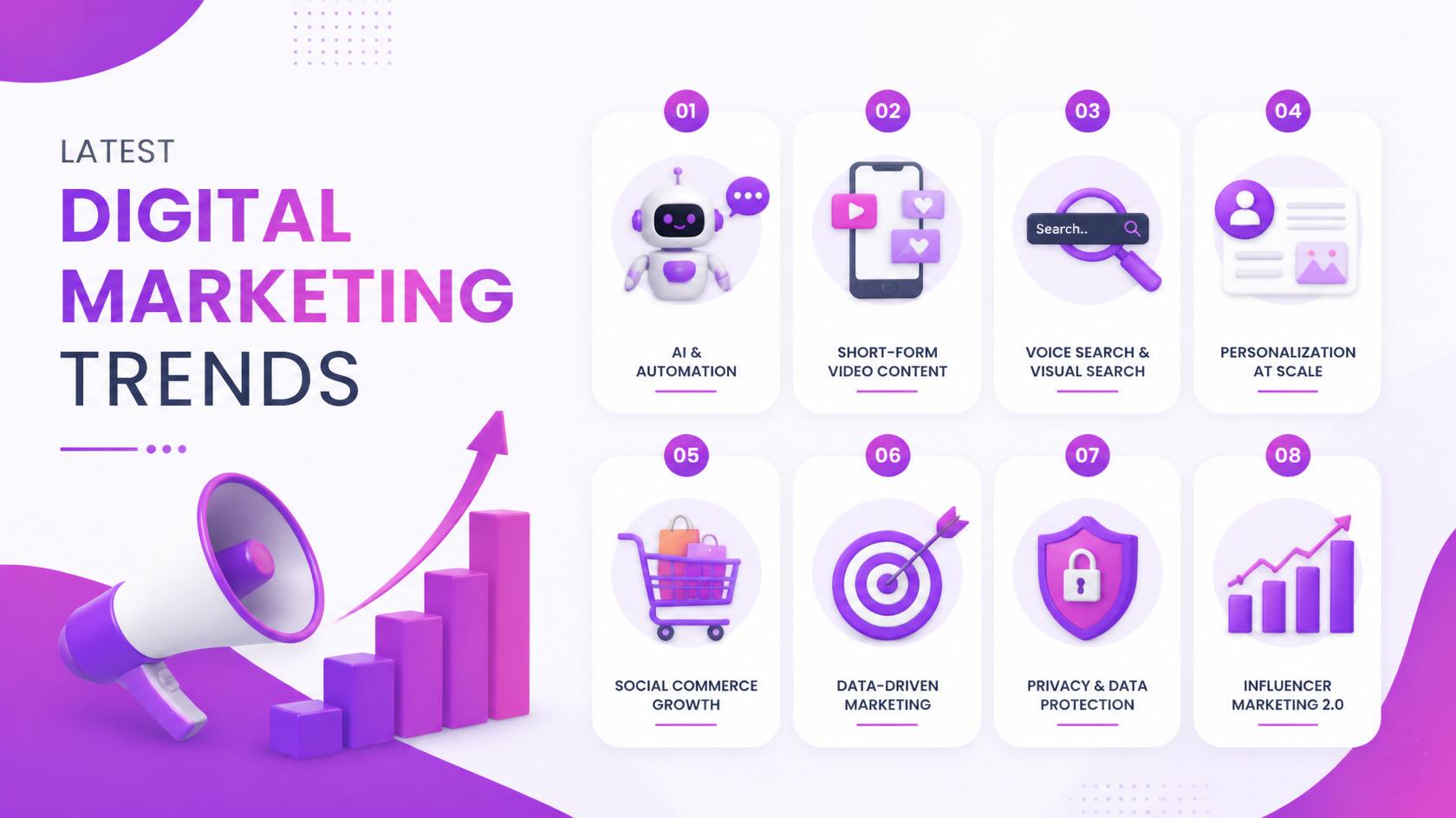
This guide walks through the fifteen most important digital marketing trends for 2026 — from AI and search engine optimization to influencer partnerships, marketing automation, and the early signs of what’s coming next. Whether you’re building a marketing strategy from scratch or refining an existing one, you’ll find practical, actionable guidance you can apply right away.
1.Artificial Intelligence (AI) in Digital Marketing
AI has moved from an experimental add-on to the backbone of modern digital marketing. Tools like ChatGPT, Claude AI, and Gemini are now used daily by marketing teams to brainstorm campaigns, draft copy, summarize research, and analyze customer data at a speed no human team could match alone.
Where AI Is Making the Biggest Impact
- AI content creation: drafting blog outlines, ad copy, product descriptions, and email sequences in minutes
- AI automation: triggering personalized messages based on real-time user behavior
- AI image and creative generation: producing on-brand visuals and ad variations at scale
- AI-powered ad platforms: Google Performance Max and Meta Advantage+ use machine learning to optimize targeting and bidding automatically
- AI chatbots and virtual assistants: handling customer queries, qualifying leads, and guiding purchases 24/7
The benefit isn’t that AI replaces marketers — it’s that AI removes repetitive work so teams can focus on strategy, creativity, and relationship-building. A small business using Claude AI to draft first versions of blog posts, for example, can publish consistently without hiring a full content team, while still applying human judgment for accuracy, tone, and brand voice.
2. SEO Trends in 2026
Search engine optimization has shifted from keyword-stuffing tactics toward genuinely helpful, expert-backed content. Google’s ongoing algorithm updates increasingly reward pages that demonstrate real experience and answer the searcher’s actual intent.
Key SEO Trends to Watch
- Helpful Content and search intent: content must directly solve the reader’s problem, not just target a keyword
- EEAT (Experience, Expertise, Authoritativeness, Trustworthiness): author bios, credentials, and citations matter more than ever
- Semantic SEO and topic clusters: covering a subject comprehensively across linked pillar and cluster pages
- Internal linking: guiding both users and search engines through related content
- Featured snippets and zero-click searches: structuring answers so they can be pulled directly into search results
- Technical SEO and Core Web Vitals: page speed, mobile usability, and stability directly affect rankings
- Structured data (schema markup): helping search engines understand and richly display your content
- AI SEO and Search Generative Experience (SGE): optimizing content to be cited by AI-generated search summaries, not just ranked in the traditional ten blue links
The rise of zero-click searches means many users now get their answer directly on the results page without clicking through. Rather than fighting this trend, smart brands optimize for visibility within AI overviews and snippets while building content depth that still earns clicks for more complex queries.
3. Voice Search Optimization
Smart speakers and voice assistants have normalized spoken search queries, which tend to be longer and more conversational than typed ones. Someone typing might search “best pizza NYC,” while the same person speaking to a smart speaker might ask, “What’s the best pizza place near me that’s open right now?”
How to Optimize for Voice Search
- Target long-tail, question-based keywords that mirror natural speech
- Write conversational content that reads the way people actually talk
- Build a strong FAQ section answering common questions in full sentences
- Keep answers concise and direct, since voice assistants typically read out only one result
- Optimize local listings, since a large share of voice searches are location-based
4. Video Marketing
Short-form video continues to dominate attention across nearly every platform. YouTube Shorts, Instagram Reels, and TikTok have trained audiences to expect fast, engaging, snackable content, while long-form video and live streaming still play a critical role in building trust and authority.
Where to Focus Your Video Strategy
- YouTube Shorts and long-form YouTube video for searchable, evergreen reach
- Instagram Reels and TikTok for discovery-driven, algorithm-boosted engagement
- LinkedIn video for B2B thought leadership and personal branding
- Live streaming for real-time Q&A sessions, product launches, and community building
- Video SEO: optimizing titles, descriptions, captions, and transcripts so videos rank in search
Real-world example: Netflix regularly uses short, highly shareable video clips across social platforms to promote new releases, turning individual scenes into standalone marketing assets rather than relying only on traditional trailers.
5. Social Media Marketing Trends
Organic reach on social platforms has become harder to earn, pushing brands to focus on genuine community building rather than broadcast-style posting. At the same time, social platforms are increasingly functioning as search engines in their own right, and social commerce is turning feeds into storefronts.
Platform-by-Platform Focus
- Instagram: Reels, Stories, and shoppable posts for discovery and direct sales
- Facebook: community groups and local business engagement
- LinkedIn: B2B networking, thought leadership, and employee advocacy
- X: real-time conversation, customer service, and industry commentary
- Threads: lightweight, conversational brand presence
- Pinterest: visual discovery for product-based and lifestyle brands
Social SEO — optimizing captions, hashtags, and video content so it surfaces in in-app search — has become just as important as traditional SEO, since many younger users now search for recommendations directly on social platforms instead of Google.
6. Influencer Marketing
Influencer marketing has matured well beyond celebrity endorsements. Brands now increasingly favor nano influencers (1,000–10,000 followers) and micro influencers (10,000–100,000 followers) because of their highly engaged, niche audiences and more affordable partnership costs.
What to Know About Modern Influencer Marketing
- Nano and micro influencers often deliver stronger engagement rates than mega influencers
- Long-term brand collaborations build more authentic trust than one-off sponsored posts
- Affiliate partnerships tie influencer compensation directly to measurable sales
- Tracking ROI requires unique discount codes, affiliate links, or dedicated landing pages
Nike has long paired high-profile athlete partnerships with grassroots creator collaborations, showing how a tiered influencer strategy can build both broad brand awareness and highly targeted, community-level trust.
7. Content Marketing
Content marketing in 2026 is about depth and structure. Search engines and readers alike favor content organized around clear pillar pages supported by related cluster articles, rather than isolated, disconnected blog posts.
Core Content Marketing Tactics
- Pillar pages and topic clusters: one comprehensive guide linked to several supporting articles
- Evergreen content: guides and resources that stay relevant and keep earning traffic for years
- Interactive content: quizzes, calculators, and tools that increase time on page
- User-generated content: reviews, testimonials, and customer photos that build trust
- Storytelling: framing your brand’s mission and customer wins as narratives, not just feature lists
8. Email Marketing
Email remains one of the highest-ROI marketing channels, and AI has made it dramatically more personal. Instead of sending the same newsletter to an entire list, modern email marketing platforms use AI to tailor subject lines, send times, and product recommendations to each subscriber.
What’s Changing in Email Marketing
- AI personalization: dynamic content blocks based on browsing and purchase history
- Automation: welcome series, cart-abandonment flows, and re-engagement campaigns that run without manual effort
- Customer journey mapping: emails triggered by specific actions, not just calendar dates
- Segmentation: grouping subscribers by behavior, interests, or purchase stage for more relevant messaging
9. Local SEO
For businesses that serve customers in a specific area, local SEO is often the single highest-impact marketing investment available. A well-optimized Google Business Profile can outperform paid ads for local intent searches like “near me” queries.
Local SEO Essentials
- Google Business Profile: complete, accurate, and regularly updated with posts and photos
- Local citations: consistent business name, address, and phone number across directories
- Reviews: actively requesting and responding to customer reviews
- Maps optimization: accurate location pins and service-area settings
- Local keywords: including city and neighborhood names naturally in page content
10. The Future of Digital Marketing
Looking beyond 2026, several emerging trends are set to reshape digital marketing further:
- AI agents: autonomous systems that can plan and execute entire campaigns with minimal human input
- Predictive marketing: using historical data to anticipate customer needs before they’re expressed
- AR and VR: immersive product try-ons and branded experiences
- Metaverse marketing: early-stage brand presence in persistent virtual spaces
- Hyper-personalization: content and offers tailored to the individual, not just the segment
Frequently Asked Questions
1. What are the latest digital marketing trends in 2026?
The biggest trends include AI-powered content and automation, evolving SEO practices focused on helpful content and EEAT, short-form video, social commerce, and a growing emphasis on first-party data due to privacy changes.
2. How is AI changing digital marketing?
AI is speeding up content creation, automating ad optimization, powering chatbots, and enabling hyper-personalized customer experiences at a scale that wasn’t possible with manual processes alone.
3. Is SEO still important in 2026?
Yes. SEO remains one of the most cost-effective long-term marketing channels, though it now requires a stronger focus on genuine expertise, search intent, and structured data rather than simple keyword targeting.
4. What is EEAT and why does it matter?
EEAT stands for Experience, Expertise, Authoritativeness, and Trustworthiness. It’s a framework Google uses to evaluate content quality, and pages that clearly demonstrate real expertise tend to rank better.
5. What are zero-click searches?
Zero-click searches happen when a user gets their answer directly on the search results page, often through a featured snippet or AI-generated summary, without clicking through to a website.
6. Should small businesses focus on Instagram or TikTok?
It depends on the audience. Instagram tends to work well across a broad age range, while TikTok often reaches younger audiences more effectively. Testing both on a small scale is the best way to decide.
7. How important is video marketing for small businesses?
Very important. Video, especially short-form content, consistently drives higher engagement than static posts and is increasingly favored by social media algorithms.
8. What is the difference between nano and micro influencers?
Nano influencers typically have 1,000 to 10,000 followers, while micro influencers have 10,000 to 100,000. Both often deliver stronger engagement rates than larger influencers due to closer audience relationships.
9. Is email marketing still effective?
Yes, email marketing continues to deliver one of the highest returns on investment of any digital channel, especially when personalized and automated based on customer behavior.
10. What is local SEO and who needs it?
Local SEO helps businesses appear in location-based searches, such as “near me” queries. It’s essential for any business with a physical location or a defined local service area.
Conclusion
Digital marketing in 2026 is defined by a mix of powerful new technology and timeless marketing fundamentals. AI, evolving SEO practices, short-form video, and social commerce are reshaping how brands reach and engage customers, while trust-building strategies like personal branding, community engagement, and first-party data collection remain as important as ever.
You don’t need to master every trend covered in this guide overnight. Start by auditing where your current strategy falls short, choose two or three trends most relevant to your business and audience, and build from there. Consistency and steady improvement will always outperform chasing every new tactic at once.
Ready to put these trends into action? Start with one change this week — whether that’s optimizing your Google Business Profile, publishing a short-form video, or setting up your first automated email sequence — and build momentum from there.