
Introduction
Every business eventually asks the same question: should we invest in AI marketing, stick with traditional marketing, or do both? The debate around AI vs traditional marketing has become one of the most important strategic decisions a business can make in 2026, because the two approaches work in fundamentally different ways.
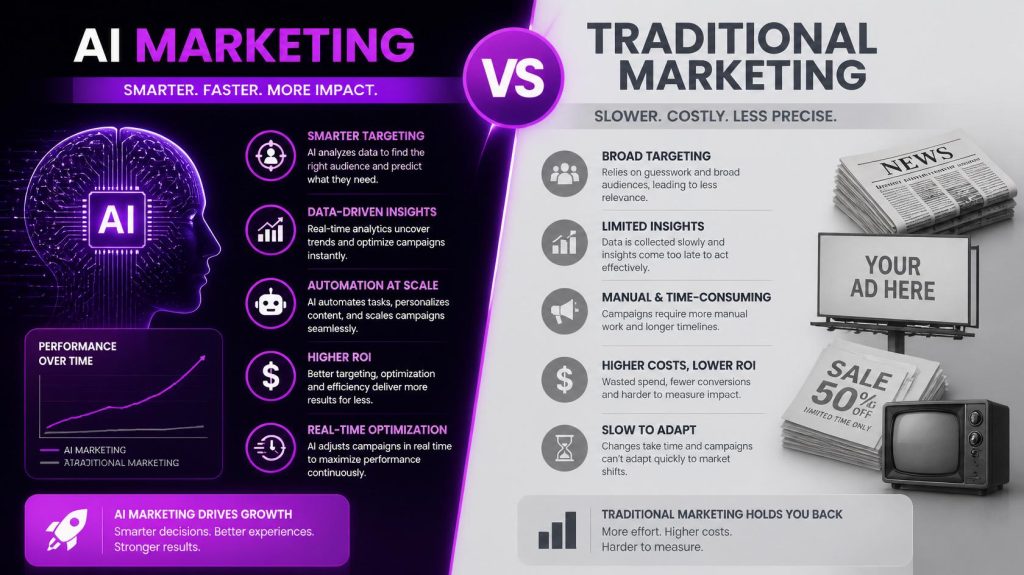
AI marketing uses machine learning, automation, and data to personalize campaigns, predict customer behavior, and optimize results in real time. Traditional marketing relies on established offline channels like TV, radio, print, and direct mail to build brand recognition and trust over time. Both have real strengths, and both have real limits.
Businesses compare AI vs traditional marketing because budgets are limited and the wrong choice wastes both time and money. A startup with a small budget has very different needs than an established enterprise with decades of brand equity and a loyal offline customer base.
In this guide, you’ll learn exactly what AI marketing and traditional marketing are, see a detailed side-by-side comparison, review the advantages and disadvantages of each approach, explore the best AI marketing tools of 2026, and get a clear recommendation on which strategy — or hybrid combination — fits your business best.
We’ll also walk through real-world examples, a dedicated breakdown for small businesses, expert tips for adopting AI without losing your brand’s human touch, and a detailed FAQ section covering the questions business owners ask most often about AI vs traditional marketing.
What Is AI Marketing?
AI marketing is the use of artificial intelligence technologies — including machine learning, natural language processing, and predictive analytics — to plan, personalize, automate, and optimize marketing campaigns. Instead of manually managing every message and ad, AI marketing systems learn from data and adjust in real time.
How AI Marketing Works
AI marketing platforms collect data from customer interactions — website visits, purchase history, email opens, ad clicks — and use algorithms to identify patterns. Those patterns power decisions like which offer to show a specific customer, when to send an email, or which ad creative is likely to perform best.
Key AI Technologies Used in Marketing
- Automation: handling repetitive tasks like email sequences, ad bidding, and social scheduling
- Machine learning: improving targeting and recommendations as more data is collected
- Predictive analytics: forecasting which customers are likely to buy, churn, or respond to an offer
- Personalization engines: tailoring content, offers, and product recommendations to each individual
Together, these technologies let a small marketing team run campaigns that once required a much larger staff, while reacting to customer behavior in near real time instead of waiting for a monthly report.
What Is Traditional Marketing?
Traditional marketing refers to offline advertising and promotional methods that existed long before digital channels — and that still play a meaningful role today. It focuses on reaching broad or local audiences through physical and broadcast media.
Common Traditional Marketing Channels
- TV ads: broad reach and strong brand-building through sight, sound, and motion
- Radio: cost-effective local reach, especially for drive-time audiences
- Newspapers: credibility and targeted local or industry-specific readership
- Billboards: constant visibility in high-traffic physical locations
- Flyers: low-cost, hyper-local promotion for events and small businesses
- Direct mail: physical, tangible offers that stand out in an inbox-fatigued world
- Events: face-to-face relationship building through trade shows, sponsorships, and community events
Traditional marketing tends to build long-term brand recognition and trust, especially in communities and demographics that still respond strongly to offline media.
Advantages of AI Marketing
AI marketing offers real, measurable benefits when it’s implemented with clear goals rather than adopted just because it’s trendy.
Automation
AI handles repetitive tasks like scheduling posts, sending follow-up emails, and adjusting ad bids, freeing up time for strategy and creative work. A retail brand, for example, can automate abandoned-cart emails that send themselves within minutes of a customer leaving the site.
Personalization
AI can tailor product recommendations, email content, and website experiences to each visitor based on their behavior, which increases the likelihood of conversion compared to generic messaging.
Better Targeting
Machine learning models identify which audience segments are most likely to convert, helping businesses spend ad budgets on people who are actually likely to buy rather than a broad, unfiltered audience.
Cost Savings
By automating manual work and improving targeting accuracy, AI marketing often reduces wasted ad spend and the need for a large in-house team to run every campaign manually.
24/7 Customer Support
AI chatbots answer common questions instantly at any hour, which improves customer experience and reduces the load on human support teams.
Disadvantages of AI Marketing
Initial Investment
Quality AI tools, integrations, and training require upfront spending, which can be a barrier for very small businesses without existing marketing infrastructure.
Learning Curve
Teams need time to learn how to use AI tools effectively, interpret their outputs correctly, and avoid over-relying on automated suggestions.
Privacy Concerns
AI marketing depends heavily on customer data, which raises privacy questions and requires careful compliance with data protection regulations.
Data Dependency
AI systems are only as good as the data they’re trained on. Incomplete or biased data leads to inaccurate predictions and poor targeting decisions.
Lack of Emotional Intelligence
AI can personalize based on data, but it cannot fully replicate genuine human empathy, humor, or the emotional nuance that builds deep brand loyalty.
Advantages of Traditional Marketing
Brand Trust
Established channels like TV and print often carry a sense of credibility and permanence that purely digital campaigns can take longer to build.
Personal Interaction
Face-to-face events and in-person sales conversations build relationships that are difficult to replicate through automated digital channels.
Local Marketing
Flyers, local radio, and community sponsorships remain highly effective for reaching a specific neighborhood or regional audience.
Strong Emotional Connection
A well-produced TV commercial or a memorable print campaign can create lasting emotional impressions that stick with audiences for years.
Better Offline Visibility
Billboards, transit ads, and in-store displays reach people throughout their day, independent of whether they are online or using a device.
Disadvantages of Traditional Marketing
High Cost
TV spots, print placements, and large-scale print runs often require significant budgets that smaller businesses may not have.
Difficult Tracking
It is hard to measure exactly how many customers came from a billboard or radio ad, making ROI calculations far less precise than digital campaigns.
Limited Audience
Traditional channels typically reach a broad or local demographic rather than precisely targeting individuals most likely to convert.
Slow Optimization
Once a print ad is published or a TV spot airs, changes cannot be made mid-campaign the way a digital ad can be adjusted in minutes.
Low Personalization
The same message reaches everyone in the audience, without the individualized offers that AI-driven marketing can provide.
Traditional Marketing Channels
- TV: strong for broad reach and high-impact brand storytelling
- Radio: cost-effective, especially for local and drive-time audiences
- Print media: newspapers and magazines that build credibility and targeted reach
- Outdoor advertising: billboards and transit ads for constant physical visibility
- Trade shows: face-to-face networking and lead generation within an industry
- Telemarketing: direct phone outreach for sales and appointment setting
- Brochures: detailed, tangible information left with prospective customers
- Newspaper ads: localized promotion with a built-in trusted readership
AI vs Traditional Marketing for Small Businesses
Budget Comparison
AI marketing tools often have lower entry costs, with many offering free tiers or affordable monthly plans, making them more accessible for businesses with limited budgets compared to traditional media buys.
ROI Comparison
AI marketing generally offers clearer, faster-to-measure ROI because every click, open, and conversion can be tracked directly, while traditional marketing ROI often relies on estimates and customer surveys.
Time Investment
AI tools reduce the hands-on time needed to run campaigns once set up, while traditional marketing often requires more lead time for design, printing, and media scheduling.
Scalability
AI marketing scales efficiently since digital ad budgets can be increased incrementally, whereas traditional marketing scaling often requires a larger jump in cost, such as buying additional TV slots or print runs.
Which Marketing Strategy Is Better in 2026?
The right answer depends heavily on your business type, audience, and goals. Here’s how it generally breaks down.
Startups
Startups typically benefit most from AI marketing because of lower costs, faster testing cycles, and the ability to iterate quickly without large upfront investment.
Local Businesses
Local businesses often do well with a hybrid approach — combining local SEO and social media with community-focused traditional tactics like flyers, local sponsorships, and direct mail.
E-commerce
E-commerce brands generally lean heavily on AI marketing for personalization, retargeting, and automated email flows, since these directly and measurably drive online sales.
B2B Companies
B2B companies often benefit from a hybrid strategy: AI-driven content and email nurturing paired with traditional relationship-building through trade shows and direct outreach.
Large Enterprises
Large enterprises typically have the resources to run both approaches at scale, using traditional media for broad brand awareness and AI marketing for precision targeting and optimization.
Future of Marketing
- AI agents: autonomous systems that can plan and execute entire campaign workflows with minimal human input
- Hyper-personalization: marketing tailored to the individual level in real time, beyond basic segmentation
- Predictive marketing: anticipating customer needs before they actively search for a solution
- Voice search: growing importance of conversational, natural-language optimized content
- Generative AI: faster production of content, images, and video variations at scale
- Automation: deeper integration between marketing, sales, and customer service systems
- Human creativity: increasing value placed on original storytelling and brand voice that AI cannot replicate
Through 2030, expect the businesses that combine AI efficiency with authentic human creativity to consistently outperform those relying on either approach alone.
Frequently Asked Questions (FAQ)
Is AI replacing traditional marketing?
No. AI is changing how marketing is executed, but traditional marketing still plays a valuable role for brand trust, local reach, and emotional connection. Most successful businesses use both together rather than replacing one with the other.
Is AI marketing better than digital marketing?
AI marketing is actually a part of digital marketing, not a separate category. It refers to using AI tools within digital channels like SEO, email, and social media to improve targeting, personalization, and efficiency.
Can AI completely replace marketers?
No. AI can automate repetitive tasks and analyze data at scale, but it cannot replace human strategy, creativity, and emotional understanding of customers, which remain essential to effective marketing.
Is AI marketing expensive?
AI marketing can be more affordable than traditional marketing in many cases, since many tools offer free or low-cost tiers, though advanced enterprise-level AI platforms can require significant investment.
Which businesses benefit most from AI marketing?
E-commerce brands, startups, and digital-first businesses tend to benefit most from AI marketing because of its speed, scalability, and measurable ROI.
Is traditional marketing still effective in 2026?
Yes, especially for local businesses, older demographics, and brand-building campaigns that benefit from broad offline visibility and emotional storytelling.
What is the biggest advantage of AI marketing?
The biggest advantage is real-time personalization and optimization, which allows campaigns to improve continuously based on actual customer behavior rather than static assumptions.
What is the biggest advantage of traditional marketing?
The biggest advantage is the strong sense of trust and emotional connection it can build, particularly through memorable, high-quality brand storytelling.
Should small businesses use AI marketing tools?
Yes, in most cases. Many AI marketing tools are affordable and can help small businesses compete more effectively with limited staff and budget.
What is hybrid marketing?
Hybrid marketing combines AI-driven digital tactics with traditional offline methods, using each approach where it performs best rather than relying entirely on one or the other.
Conclusion
When comparing AI vs traditional marketing, there is no single universal winner. AI marketing delivers speed, personalization, and measurable ROI, while traditional marketing delivers trust, emotional connection, and strong offline visibility. Each has clear strengths, and each has real limitations.
For most businesses in 2026, a hybrid approach that blends AI efficiency with the human creativity and trust-building power of traditional marketing produces the strongest, most sustainable results. The right mix depends on your industry, audience, and budget — not on which approach is trending.