
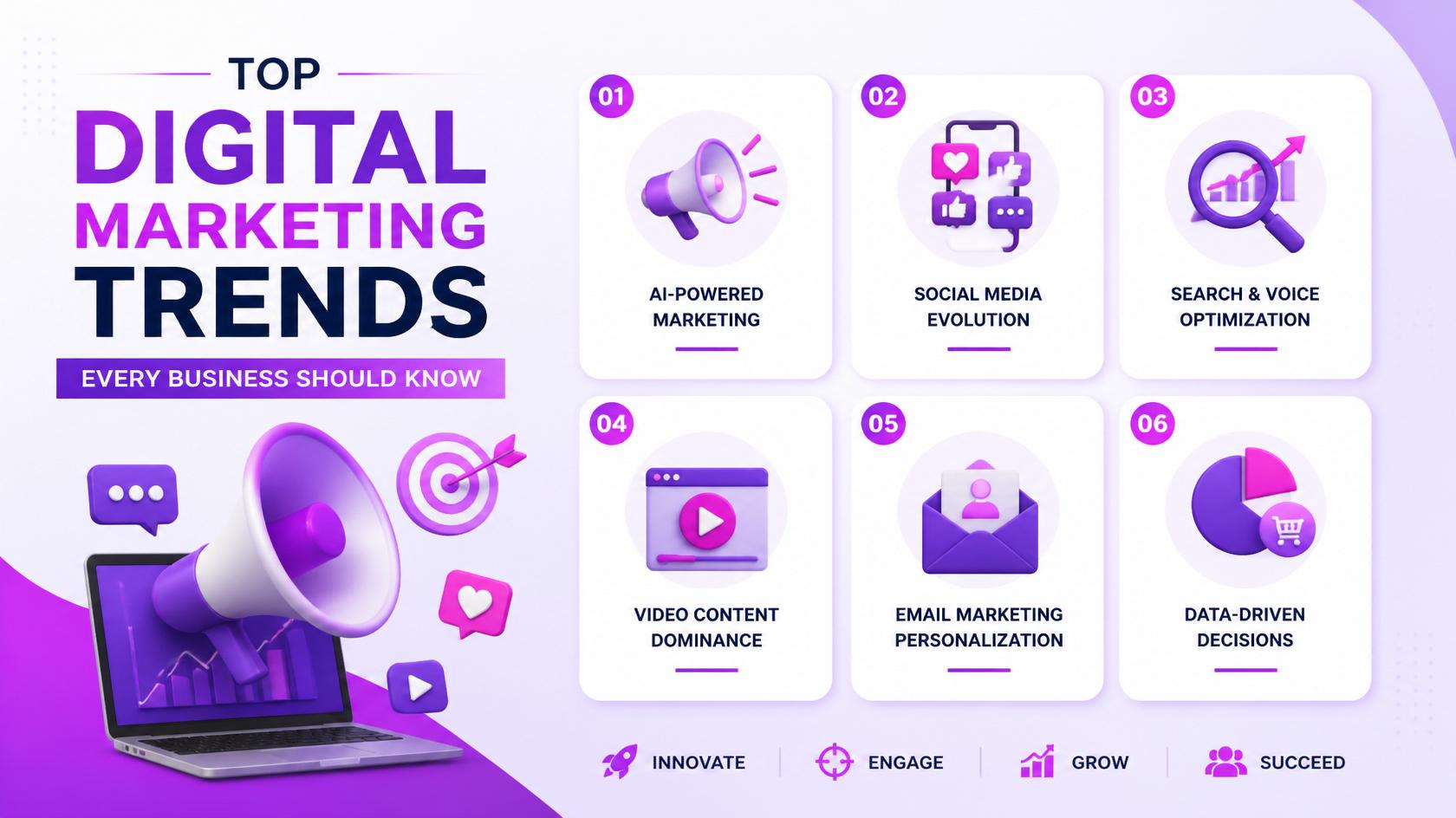
Top Digital Marketing Trends Every Business Should Know in 2026
Every year, digital marketing shifts a little more — new platforms rise, algorithms change, and customer habits evolve. If you’re a business owner, marketer, or startup founder, keeping up with the top digital marketing trends isn’t optional anymore. It’s the difference between a brand that grows steadily and one that gets left behind.
In 2026, the pace of change has only picked up. Artificial intelligence is rewriting how content gets created and discovered, search behavior is moving away from clicks and toward instant answers, and customers expect brands to show up wherever they are — on social media, in search results, on WhatsApp, and inside their inbox.
This guide breaks down the digital marketing trends that matter most this year, explains why they matter, and gives you practical steps to put them to work. Whether you run a small local shop or manage marketing for a growing company, you’ll walk away with a clear roadmap for 2026 and beyond.
Why Following Digital Marketing Trends Matters
Trends aren’t just buzzwords — they reflect real shifts in how people search, shop, and engage with brands online. Businesses that adapt early usually capture the biggest gains, while those that wait often end up playing catch-up at a higher cost.
Here’s what staying current with digital marketing trends actually delivers for your business:
- Better ROI — modern tools and channels are often more efficient than outdated tactics, so your marketing budget stretches further.
- More customers — showing up where your audience already spends time means more discovery and more leads.
- Stronger branding — consistent, up-to-date marketing builds trust and recognition over time.
- Higher conversions — trend-aware strategies (like personalization and interactive content) are proven to convert better than generic campaigns.
- Competitive advantage — early adopters of a trend often dominate search rankings and social visibility before competitors catch on.
Top Digital Marketing Trends in 2026
Let’s go through the digital marketing trends shaping 2026, one by one, with practical tips you can apply right away.
1. AI-Powered Marketing
Artificial intelligence has moved from an experimental tool to a core part of everyday marketing. Businesses of every size now use AI to save time, personalize experiences, and make smarter decisions.
Where AI is making the biggest impact:
- AI content creation — drafting blog outlines, ad copy, and social captions faster than ever.
- AI chatbots — answering customer questions instantly, any time of day.
- AI customer service — handling routine support tickets so human agents can focus on complex issues.
- AI analytics — spotting patterns in customer behavior that would take humans weeks to find.
- AI personalization — tailoring product recommendations and messaging to each visitor.
The challenge with AI is balance: over-relying on it without a human review step can lead to generic, error-prone content. The businesses winning with AI in 2026 use it to speed up the first draft, then add a human layer of brand voice, accuracy checks, and original insight.
2. Zero-Click Searches
A zero-click search happens when a searcher gets their answer directly on the results page — through a featured snippet, a knowledge panel, or an AI-generated overview — without clicking through to any website.
This matters because a growing share of searches now end without a single click. If your content isn’t structured to appear in these answer boxes, you can lose visibility even while ranking well.
How to optimize for zero-click visibility:
- Answer questions directly and concisely near the top of your page, so featured snippets can pull your content.
- Use structured data (schema markup) so search engines understand your content clearly.
- Target ‘People Also Ask’ questions with clear, well-formatted answers.
- Use bullet points, numbered steps, and tables — formats search engines love to feature.
3. Voice Search Optimization
Smart speakers and voice assistants have made spoken search a daily habit for millions of people. Voice queries tend to be longer and more conversational than typed searches, which changes how you should approach keyword targeting.
- Smart speakers — optimize for natural, spoken-language queries rather than short keyword phrases.
- Conversational keywords — target question-based phrases like ‘what is’ and ‘how do I’.
- Local SEO — a large share of voice searches are local (‘near me’ searches), so location pages matter more than ever.
- FAQ optimization — a well-structured FAQ section is one of the easiest ways to capture voice search traffic.
4. Video Marketing Dominance
Video continues to be one of the most engaging content formats across every platform, and short-form video in particular has become the default way younger audiences discover new brands.
- Short-form videos — quick, scroll-stopping content built for platforms like Reels, Shorts, and TikTok.
- YouTube SEO — optimizing titles, descriptions, and thumbnails to rank inside YouTube’s own search engine.
- Live streaming — real-time engagement that builds trust and urgency (product launches, Q&As, behind-the-scenes).
- Video ads — often outperform static image ads for engagement and recall.
- Customer testimonials — video reviews build more trust than written ones because viewers can see genuine reactions.
5. Personalization in Marketing
Generic, one-size-fits-all marketing no longer cuts through the noise. Customers expect brands to recognize their preferences and history, and personalized experiences consistently drive higher engagement and loyalty.
- Personalized emails — using purchase history and browsing behavior to tailor subject lines and offers.
- Product recommendations — ‘customers also bought’ style suggestions that boost average order value.
- Dynamic website content — pages that adjust based on visitor location, device, or past visits.
- Customer segmentation — grouping your audience by behavior so each group gets relevant messaging.
Key Takeaways Checklist
Before moving on, use this checklist to capture the core action points from this guide:
- AI should support your marketing team, not replace human judgment and brand voice entirely.
- Content needs to be structured for zero-click visibility, not just traditional rankings.
- Voice and local search go hand in hand for businesses that serve a physical area.
- Video, especially short-form, deserves a dedicated slot in your content calendar.
- Personalization and first-party data work together — the more you own your customer relationships, the more relevant you can be.
- Automation frees up time for the strategic work that actually grows the business.
- SEO and analytics are long-term investments that compound rather than one-off projects.
Privacy and transparency are now part of good marketing, not just legal compliance
Benefits of Following Digital Marketing Trends
Bringing these trends together into a single strategy pays off in measurable ways:
- Better customer experience — customers feel understood and valued at every touchpoint.
- Increased sales — trend-aligned strategies typically convert better than outdated tactics.
- Higher ROI — modern channels and automation reduce wasted ad spend.
- Stronger brand authority — consistent, high-quality content builds long-term credibility.
- Business growth — new customer acquisition channels open up as you adopt new platforms early.
- Better engagement — interactive and personalized content keeps audiences coming back.
Common Mistakes Businesses Make
Even well-meaning businesses can undercut their own marketing efforts. Watch out for these common pitfalls:
- Ignoring SEO — treating it as a one-time task instead of an ongoing process.
- Posting without strategy — publishing content randomly instead of following a clear plan tied to business goals.
- No analytics — making decisions on guesswork instead of real performance data.
- Not using AI — missing out on real efficiency gains out of hesitation or unfamiliarity.
- Poor mobile optimization — losing visitors on a channel that now drives the majority of web traffic.
- Inconsistent branding — confusing customers with mismatched messaging across channels.
- Ignoring customer feedback — missing valuable signals about what’s actually working.
How Businesses Can Stay Ahead
Staying current with digital marketing trends doesn’t require a massive team or budget — it requires consistency. Here’s a practical approach:
- Commit to continuous learning — set aside time each month to review what’s changing in your industry.
- Test new platforms early — small, low-risk experiments help you find winners before competitors do.
- Monitor competitors — regularly review what similar businesses are doing well (and where they’re falling short).
- Follow industry blogs and newsletters — reliable sources save you time separating real trends from hype.
- Use AI tools thoughtfully — let automation handle repetitive work so your team can focus on strategy.
- Invest in SEO consistently — it compounds over time and remains one of the highest-ROI channels.
- Create quality content regularly — consistency builds authority faster than occasional bursts of activity.
Expert Tips
Here are ten actionable tips to help your business apply these trends effectively:
- Start with one or two trends that fit your business best, rather than trying to do everything at once.
- Audit your current marketing performance before adding new tactics, so you know your real starting point.
- Repurpose your best-performing content into video, social posts, and email — don’t reinvent the wheel every time.
- Build an email list from day one; it’s an asset you fully own, unlike social media followers.
- Use short-form video even if you’re a B2B brand — the format works across industries.
- Set up basic tracking (Google Analytics and conversion goals) before scaling up ad spend.
- Respond to every review and comment; engagement signals matter for both trust and rankings.
- Keep your Google Business Profile updated weekly if you rely on local customers.
- Review your website’s mobile experience every quarter — small friction points quietly cost conversions.
- Revisit your content strategy every 90 days to make sure it still matches current search and customer behavior.
Frequently Asked Questions (FAQ)
Q: What are the latest digital marketing trends?
A: The top digital marketing trends right now include AI-powered marketing, zero-click search optimization, voice search, video marketing, personalization, social commerce, and privacy-focused marketing, among others covered in this guide.
Q: Which digital marketing trend is most important?
A: There’s no single ‘most important’ trend — it depends on your business and audience. That said, SEO and AI-powered marketing tend to have the broadest impact across nearly every industry.
Q: How is AI changing digital marketing?
A: AI is speeding up content creation, improving personalization, powering chatbots and customer service, and helping marketers uncover insights from data far faster than manual analysis.
Q: What is Zero-Click Search?
A: A zero-click search is when a user gets their answer directly on the search results page — through a featured snippet or answer box — without clicking through to a website.
Q: Is SEO still important in 2026?
A: Yes. SEO remains one of the highest-ROI digital marketing channels, though the focus has shifted toward helpful content, topical authority, and technical performance rather than keyword stuffing.
Q: What is social commerce?
A: Social commerce refers to buying and selling products directly within social media platforms, such as Instagram Shopping, Facebook Shops, or TikTok Shop, without leaving the app.
Q: Why is video marketing growing?
A: Video, especially short-form video, captures attention faster than text or images and performs well across nearly every platform’s algorithm, making it a high-priority format for brands.
Q: How can small businesses benefit from digital marketing trends?
A: Small businesses can benefit significantly by focusing on cost-effective trends like local SEO, email marketing, and social media engagement, which often deliver strong ROI without large budgets.
Q: What role does automation play in digital marketing?
A: Marketing automation handles repetitive tasks like email sequences, lead nurturing, and follow-ups, freeing up time for strategy while ensuring customers get timely, relevant communication.
Q: How often should businesses update their marketing strategy?
A: Reviewing your strategy every quarter is a good baseline, though it’s wise to monitor key metrics monthly so you can catch shifts in performance or customer behavior early.
Conclusion
Digital marketing will keep evolving, but the businesses that thrive are the ones that treat these trends as an ongoing practice rather than a one-time update. From AI-powered marketing and zero-click search to social commerce and privacy-focused strategies, each trend covered here offers a real opportunity to connect with customers more effectively.
Take a moment to review your current marketing strategy against the trends in this guide. Pick one or two that align best with your goals, put a simple plan in place, and measure the results. Small, consistent improvements compound into significant growth over time.
Have questions about applying these trends to your business? Share your thoughts in the comments, subscribe to our newsletter for more insights, or reach out to our team for a