
Introduction
Type a question into Google today, and there’s a good chance you’ll get your answer without ever clicking a single link. The weather, a quick calculation, a celebrity’s age, a summarized AI Overview — Google hands it all over right on the results page. This is the world of zero-click searches, and it’s quietly reshaping how SEO works.
Google Search has changed dramatically over the past few years. What used to be a simple list of ten blue links has turned into a rich results page packed with featured snippets, knowledge panels, AI-generated summaries, maps, and more. Each of these features is designed to answer your question instantly, right where you are.
For website owners, marketers, and SEO professionals, this shift raises a real question: if people aren’t clicking through anymore, what happens to organic traffic? Should businesses panic, or is this simply a new landscape that requires a new strategy?
In this complete 2026 guide, you’ll learn exactly what zero-click searches are, why Google introduced them, how they affect SEO, and — most importantly — practical, actionable strategies to stay visible, build authority, and keep earning traffic even as more searches end without a click.
What Are Zero-Click Searches?
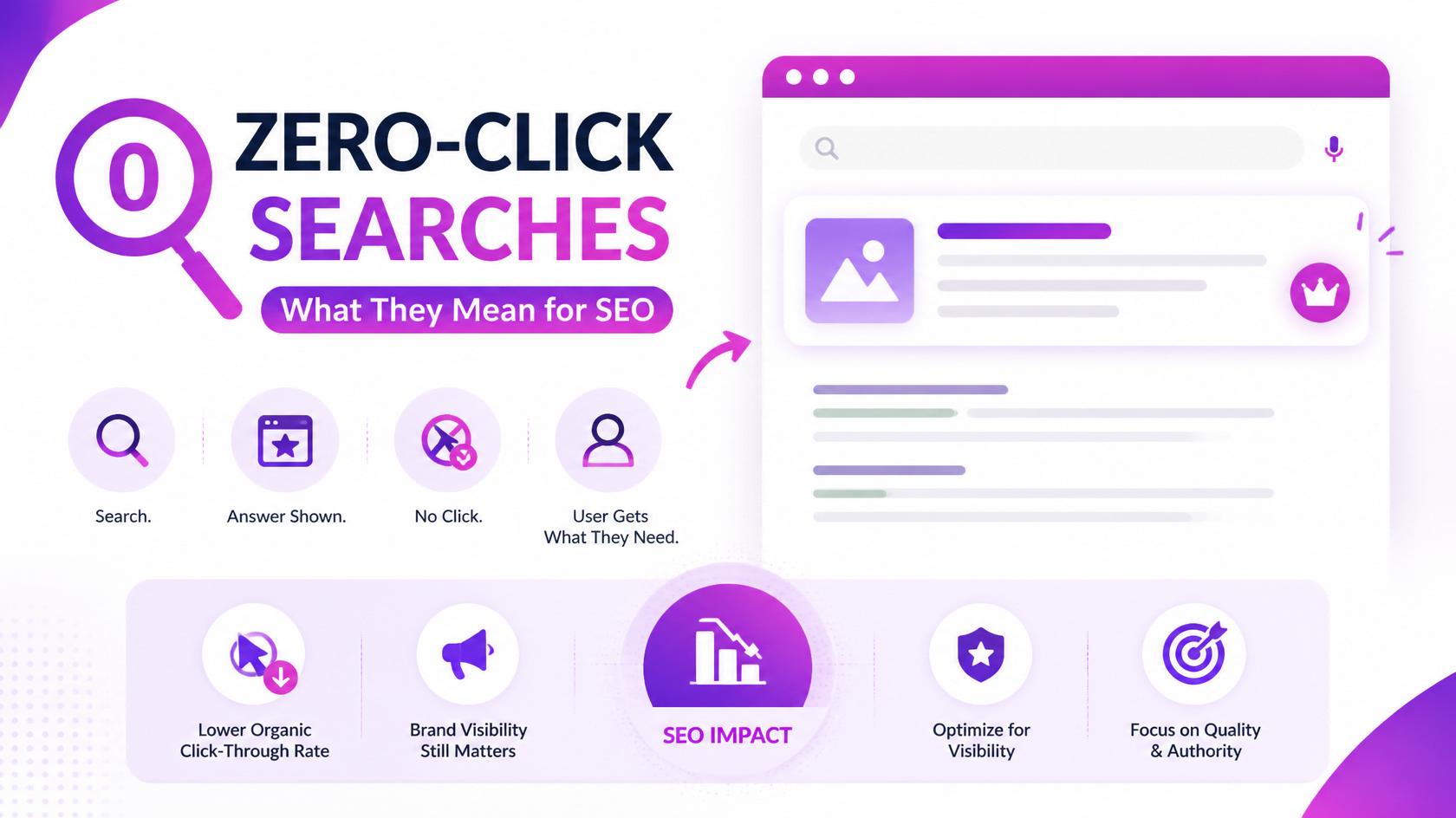
Zero-click searches happen when a user types a query into Google and gets their answer directly on the search results page, without clicking through to any website. The search itself satisfies the need, so the journey ends right there.
Featured Snippet Answer: What Is a Zero-Click Search?
A zero-click search is a Google search that ends without the user visiting any website, because the answer — such as a definition, calculation, or AI-generated summary — appears directly on the results page.
Why They Happen
Zero-click searches happen because Google has gotten very good at understanding exactly what users want and pulling the answer straight from the web or its own knowledge systems, then displaying it instantly.
The Evolution of Google Search
Google Search has evolved from a simple list of links into an answer engine. Featured snippets came first, followed by knowledge panels, local packs, and now AI Overviews that summarize entire topics using generative AI, pulling from multiple sources at once.
How Zero-Click Searches Work
Zero-click results come in many formats, each designed to satisfy a specific type of query instantly.
AI Overview: An AI-generated summary that appears at the top of results, synthesizing information from multiple sources into one answer. Example: searching “how does compound interest work” may show a full AI-written explanation.
Featured Snippets: A highlighted box pulling a direct answer, list, or table from a ranking webpage. Example: searching “how to tie a tie” often shows numbered steps pulled from a blog post.
Knowledge Panels: Information boxes about people, places, or organizations, usually sourced from the Knowledge Graph. Example: searching a celebrity’s name shows their age, birthplace, and career facts.
Maps: Interactive map results for location-based queries. Example: searching “gas stations near me” shows a map with pins.
People Also Ask: An expandable list of related questions with short answers. Example: searching “benefits of yoga” shows related questions like “Is yoga good for weight loss?”
Why Google Introduced Zero-Click Searches
- Better user experience: Instant answers save users time and effort.
- Faster answers: Many queries have simple, factual answers that don’t require a full website visit.
- Mobile search: Small screens benefit from concise, instant answers rather than scrolling through pages.
- AI integration: Generative AI allows Google to synthesize information from multiple sources into a single, coherent answer.
- User satisfaction: Google’s core goal is to keep users happy and returning, and instant, accurate answers support that goal.
How Zero-Click Searches Affect SEO
Zero-click searches bring both challenges and opportunities for SEO. Here’s a balanced look at the impact.
The Challenges
- Reduced clicks: Fewer users land on your website even when your content answers their query.
- Lower CTR: Click-through rates for many informational keywords have declined as more answers appear directly on the results page.
The Opportunities
- Brand visibility: Appearing in a featured snippet or AI Overview puts your brand name in front of users, even without a click.
- Higher impressions: Your content can appear more often in search results, building familiarity over time.
Better authority: Being cited as a source in an AI-generated answer signals trust and relevance to both users and search engines.
Are Zero-Click Searches Bad for SEO?
Not necessarily. While a drop in click-through rate can feel discouraging, zero-click results often bring branding value that’s easy to overlook.
When your business appears in a featured snippet, knowledge panel, or AI Overview, users see your brand name and message even if they don’t click. Over time, this repeated visibility builds trust and recognition, which can lead to direct visits, branded searches, and conversions later on.
Types of Zero-Click Search Results
Featured Snippets
A highlighted answer box pulled from a ranking page, often shown as a paragraph, list, or table. Example: “What is the capital of France?” shows a direct one-line answer.
AI Overviews
AI-generated summaries that combine information from several sources into one comprehensive answer, often with linked citations.
Knowledge Graph
A panel of structured facts about a specific entity, such as a person, place, or organization, displayed alongside search results.
Local Pack
A group of three local business results shown for location-based searches, complete with ratings, hours, and directions.
Shopping Results
Product listings with images, prices, and retailer names shown directly for shopping-related queries.
How to Optimize for Zero-Click Searches
- Target featured snippet opportunities by directly answering common questions in 40–60 words.
- Implement schema markup, including FAQ, HowTo, and Article schema, to help search engines understand your content.
- Use structured data consistently across key pages.
- Write clear, descriptive headings that mirror how users phrase their questions.
- Use numbered lists and bullet points to make step-by-step content easy to extract.
- Include comparison tables where relevant, since these are often pulled into rich results.
- Create question-based content that mirrors natural search queries.
- Strengthen internal linking to help search engines understand topical relationships across your site.
- Build EEAT signals by showcasing real experience, expertise, and credible sourcing.
- Focus on genuinely helpful content that fully satisfies user intent.
Best SEO Strategies for 2026
- Topic clusters: Organize content around core topics with supporting subtopics linked together.
- Topical authority: Build deep, comprehensive coverage of your niche rather than scattered, shallow content.
- Helpful content: Prioritize genuinely useful information over content designed purely to rank.
- Brand building: Invest in brand recognition, since branded visibility matters more in a zero-click world.
- Video SEO: Optimize video content, since video carousels increasingly appear in search results.
- Image SEO: Use descriptive file names and ALT text, since image packs drive visibility for visual queries.
- Voice search: Optimize for conversational, question-based queries used with voice assistants.
- Local SEO: Strengthen your Google Business Profile and local listings for location-based visibility.
- Entity SEO: Clearly establish your brand and key topics as recognized entities.
- AI optimization: Structure content so it can be easily understood and cited by AI-generated answers.
Common Mistakes to Avoid
- Ignoring featured snippet opportunities entirely.
- Failing to implement schema markup and structured data.
- Writing long, unfocused introductions before answering the actual question.
- Neglecting brand-building efforts in favor of clicks alone.
- Overlooking Google Business Profile optimization for local queries.
- Focusing only on exact-match keywords instead of semantic depth.
- Ignoring EEAT signals like authorship and credible sourcing.
- Failing to track impressions and visibility, not just clicks.
- Skipping FAQ sections that align with common user questions.
- Not monitoring how AI Overviews are citing or summarizing your content.
Real-Life Examples
Healthcare
A medical information site optimized its symptom-related FAQ pages with clear, concise answers, earning featured snippets that built trust even when users didn’t click through immediately.
Finance
A personal finance blog restructured its guides with direct definitions and comparison tables, increasing citations in AI-generated financial summaries.
Ecommerce
An online retailer optimized product FAQs with schema markup, improving visibility in shopping-related zero-click results and driving branded search growth.
Education
An online learning platform created detailed, question-based course guides, gaining visibility in People Also Ask sections for related topics.
Travel
A travel website optimized destination guides with local pack and map-friendly content, increasing visibility for location-based zero-click queries.
Future of SEO
- AI search: Conversational, AI-driven search experiences are becoming a primary discovery channel.
- Google AI Overview: Expanding coverage across more query types and industries.
- Search generative experience: AI-generated summaries continue reshaping how results are presented.
- Conversational search: Multi-turn, dialogue-style search interactions are becoming more common.
- Voice search: Continues growing alongside smart speakers and mobile assistants.
- Visual search: Searching using images rather than text is expanding, especially in shopping.
- Predictive search: Search engines are moving toward anticipating needs based on context and history.
Frequently Asked Questions (FAQ)
What is a zero-click search?
A zero-click search is a Google search where the user gets their answer directly on the results page, such as through a featured snippet, knowledge panel, or AI Overview, without needing to click through to any website. These results are designed to satisfy simple, factual, or quick informational queries instantly, which means the search journey ends before ever reaching an external site.
How does it affect SEO?
Zero-click searches reduce click-through rates for certain types of queries, since users get their answer without visiting a website. However, they also increase brand visibility and impressions, since appearing in a featured snippet or AI Overview puts your content in front of users. SEO strategy now needs to account for both traffic and visibility as separate success metrics.
Can websites still get traffic?
Yes, websites can absolutely still get organic traffic. Many queries, especially those requiring deeper research, comparisons, or purchases, still drive users to click through to full articles. Zero-click results tend to affect simple, factual queries more than complex or transactional ones, leaving plenty of opportunity for click-driven traffic to remain strong.
How do I optimize for AI Overview?
To optimize for AI Overview, focus on clear, well-structured content that directly answers common questions, use schema markup to help AI systems understand your content, build topical authority through comprehensive coverage, and strengthen EEAT signals like credible sourcing and demonstrated expertise, since AI Overviews tend to cite trustworthy, well-organized sources.
Are featured snippets worth targeting?
Yes, featured snippets are still worth targeting because they increase visibility, build brand recognition, and can sometimes drive more attention than a standard organic listing. While they may not always generate a click, appearing in position zero signals authority and keeps your brand top of mind for future searches.
Does zero-click search reduce organic traffic?
Zero-click search can reduce traffic for certain informational queries, particularly simple, factual ones. However, the overall impact varies by industry and content type, and many websites continue to see strong organic traffic for queries that require deeper information, comparisons, or transactions beyond a quick answer.
What industries are most affected?
Industries with high volumes of simple, factual queries, such as reference sites, dictionaries, weather services, and basic how-to content, tend to be most affected by zero-click searches. Industries requiring deeper research, like finance, healthcare, ecommerce, and B2B software, often retain stronger click-through behavior.
Is AI replacing SEO?
AI is changing SEO, not replacing it. Search engines still rely on well-structured, high-quality, authoritative content to generate accurate answers and summaries. SEO is evolving toward optimizing for AI comprehension and citation, rather than disappearing altogether, making foundational SEO skills more relevant, not less.
Will SEO disappear?
SEO is unlikely to disappear, but it is evolving significantly. As search becomes more AI-driven and conversational, SEO is shifting toward topical authority, structured data, and genuine helpfulness rather than simple keyword matching, meaning the skill set is changing rather than becoming obsolete.
How should businesses adapt?
Businesses should adapt by focusing on comprehensive, genuinely helpful content, strengthening brand authority, implementing structured data, and tracking visibility metrics like impressions alongside traditional traffic numbers. Diversifying visibility across featured snippets, AI Overviews, and traditional rankings helps businesses stay resilient as search continues evolving.
Conclusion
Zero-click searches aren’t a sign that SEO is dying — they’re a sign that search is evolving toward faster, more helpful answers. Google Search will keep prioritizing user experience, and that means featured snippets, AI Overviews, and knowledge panels are here to stay.
The businesses that thrive in this new era will be the ones that focus on genuine user intent, build real brand authority, and structure their content clearly enough for both humans and AI systems to understand and trust.
Rather than chasing clicks alone, shift your strategy toward earning visibility everywhere it counts: in featured snippets, AI-generated summaries, local packs, and organic rankings alike. Structured data, helpful content, and strong EEAT signals will carry your SEO strategy forward through 2026 and beyond.