
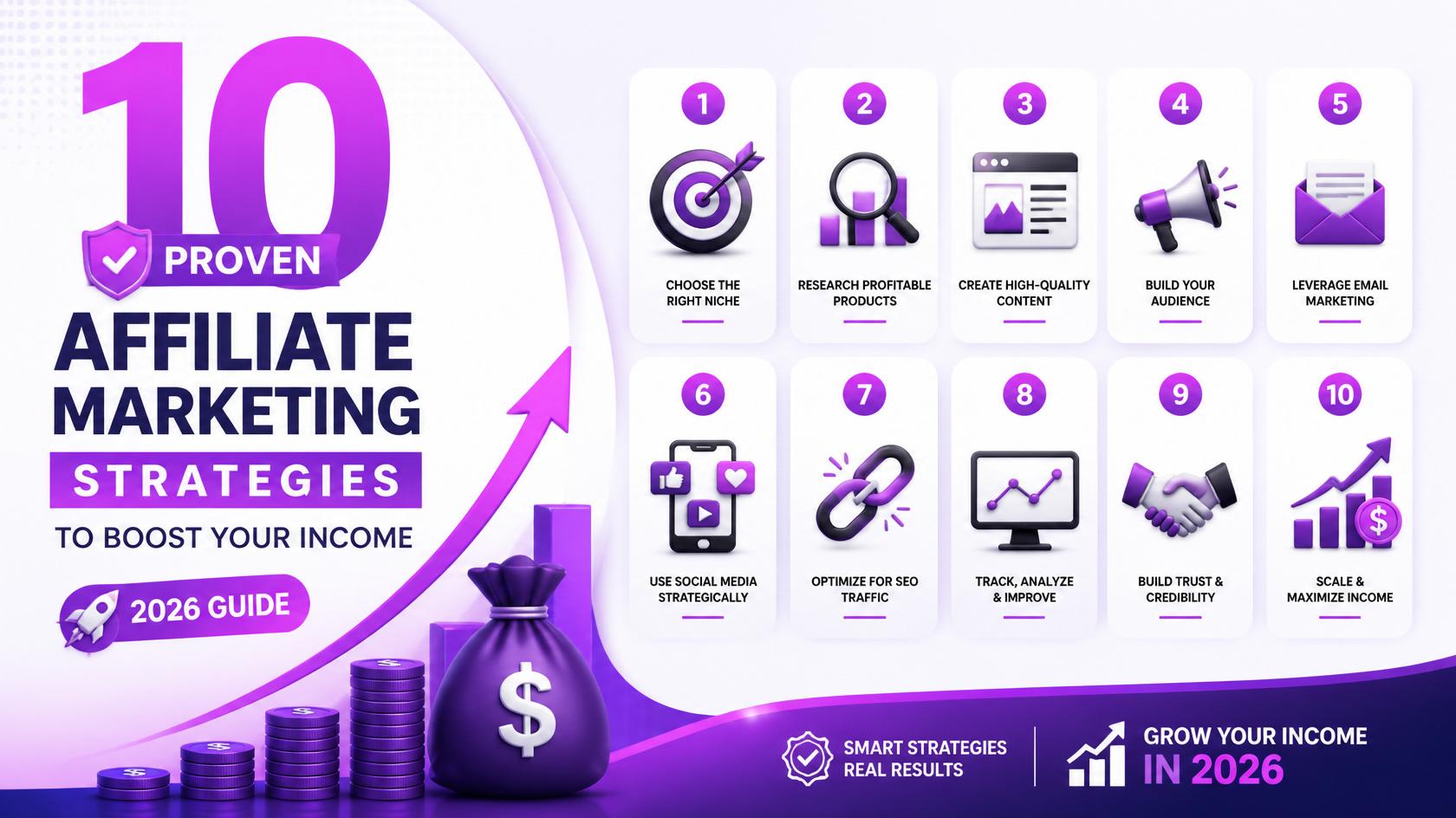
10 Proven Affiliate Marketing Strategies to Boost Your Income
1. Choose a Profitable Niche
Why it works: A focused niche helps you build authority faster, attract a specific audience, and rank higher on Google because your site demonstrates clear topical relevance.
Step-by-step implementation: 1. List 3–5 topics you’re genuinely interested in. 2. Check commercial demand using free tools like Google Trends and Search Console. 3. Confirm affiliate programs exist in that niche. 4. Analyze competitor websites to gauge difficulty. 5. Narrow down to one specific, focused niche (e.g., “home fitness equipment” instead of just “fitness”).
Example: Instead of a broad “technology” blog, a beginner might focus specifically on “budget laptops for students,” making it easier to rank and convert.
Beginner tip: Pick a niche you can talk about for years without getting bored.
Advanced tip: Look for “underserved” sub-niches within a popular category where competition is lower but demand still exists.
Common mistake: Choosing a niche based purely on high commissions without any personal interest, leading to burnout. Solution: Balance profitability with genuine curiosity.
Best tools: Google Trends, Google Keyword Planner, Semrush.
2. Build a High-Quality Website
Why it works: A well-structured, fast, and trustworthy website is the foundation for SEO rankings and reader trust — both essential for affiliate conversions.
Step-by-step implementation: 1. Choose a memorable, niche-relevant domain name. 2. Select reliable, fast hosting. 3. Install WordPress and a clean, mobile-friendly theme. 4. Set up essential pages: About, Contact, Privacy Policy, and Affiliate Disclosure. 5. Structure your navigation around your core content categories.
Example: A clean, simple review site with clear categories (e.g., “Reviews,” “Guides,” “Comparisons”) tends to outperform cluttered, ad-heavy sites in both rankings and user trust.
Beginner tip: Don’t overdesign — clarity and speed beat flashy visuals every time.
Advanced tip: Use a lightweight page builder like Elementor with optimized images to maintain design flexibility without sacrificing site speed.
Common mistake: Launching with a bloated theme full of unnecessary plugins that slow the site down. Solution: Stick to essential plugins only.
Best tools: WordPress, Elementor, hosting providers like Hostinger or Bluehost.
3. Create SEO-Optimized Content
Why it works: Search engines remain one of the largest sources of consistent, free, buyer-intent traffic — and well-optimized content compounds in value over time.
Step-by-step implementation: 1. Research keywords with clear buying intent. 2. Structure content with proper H1–H3 headings. 3. Write comprehensive, genuinely helpful answers. 4. Add internal links between related articles. 5. Optimize meta titles, descriptions, and image alt text.
Example: A detailed “Best Budget Laptops Under $600” article that compares specs, pros, cons, and includes affiliate links naturally within the recommendations.
Beginner tip: Focus on answering the exact question in the search query as clearly as possible.
Advanced tip: Build “content clusters” — a main pillar page linked to several supporting articles — to establish topical authority.
Common mistake: Writing thin, generic content that doesn’t fully answer the reader’s question. Solution: Aim for depth and completeness over word count alone.
Best tools: Rank Math, Yoast SEO, Semrush, Ahrefs.
4. Target Long-Tail Keywords
Why it works: Long-tail keywords have lower competition and higher conversion rates because they capture very specific search intent.
Step-by-step implementation: 1. Start with a broad seed keyword. 2. Use keyword tools to find longer, more specific variations. 3. Prioritize keywords with clear commercial or informational intent. 4. Create dedicated content around each long-tail keyword. 5. Track rankings and refine over time.
Example: Instead of targeting “running shoes,” target “best running shoes for flat feet women” — far easier to rank for and highly relevant to a specific buyer.
Beginner tip: Long-tail keywords often contain 4+ words and sound like natural questions.
Advanced tip: Group related long-tail keywords into a single comprehensive article to capture multiple search queries at once.
Common mistake: Only targeting highly competitive, short keywords early on. Solution: Build authority with long-tail content first.
Best tools: Google Search Console, Semrush, AnswerThePublic.
5. Promote Products You Trust
Why it works: Authentic recommendations build reader trust, which directly improves click-through and conversion rates, and aligns with Google’s E-E-A-T guidelines.
Step-by-step implementation: 1. Test or thoroughly research the product before promoting it. 2. Be honest about both pros and cons. 3. Share personal experience or specific use cases. 4. Include real screenshots or results where possible. 5. Update reviews as products change.
Example: A genuine review that says “This tool saved me three hours a week, but the mobile app still needs work” converts better than a purely promotional review.
Beginner tip: Never promote a product solely because of a high commission if it doesn’t genuinely help your audience.
Advanced tip: Create comparison content between the product you recommend and its top competitor for stronger buyer-intent capture.
Common mistake: Promoting products without any real experience or research. Solution: Prioritize trust over short-term commission size.
Best tools: Personal testing, customer review sites, product demo access.
6. Build an Email List
Why it works: An email list is a stable, owned audience that isn’t dependent on search engine or social media algorithm changes.
Step-by-step implementation: 1. Create a valuable lead magnet (checklist, guide, or mini-course). 2. Add opt-in forms across your website. 3. Choose an email marketing platform. 4. Send consistent, value-first newsletters. 5. Include relevant affiliate recommendations naturally within emails.
Example: A “Free Affiliate Marketing Starter Checklist” opt-in can convert blog visitors into long-term subscribers.
Beginner tip: Focus on providing value in every email, not just promotions.
Advanced tip: Segment your list based on interests or behavior for higher-converting, targeted campaigns.
Common mistake: Only emailing subscribers when promoting a product. Solution: Maintain a healthy ratio of helpful content to promotional emails.
Best tools: ConvertKit, MailerLite, ActiveCampaign
7. Use Social Media Marketing
Why it works: Social platforms offer direct access to highly engaged audiences and can drive immediate traffic while your SEO content matures.
Step-by-step implementation: 1. Choose one or two platforms that fit your niche and audience. 2. Share valuable tips, not just promotional posts. 3. Include affiliate links in bios, Stories, or pinned posts. 4. Engage authentically with comments and questions. 5. Repurpose blog content into social posts.
Example: A Pinterest pin linking to a detailed blog comparison post can drive consistent, long-term traffic with minimal ongoing effort.
Beginner tip: Consistency matters more than posting on every platform at once.
Advanced tip: Use platform-native content formats (Reels, Pins, Threads) rather than simply cross-posting the same content everywhere.
Common mistake: Spreading effort too thin across too many platforms. Solution: Master one platform before expanding.
Best tools: Canva, Buffer, Later.
8. Leverage Video Marketing
Why it works: Video builds trust quickly through visual demonstration and remains one of the most engaging content formats for product reviews and tutorials.
Step-by-step implementation: 1. Choose a platform (YouTube is often best for long-term searchability). 2. Script a clear, helpful video around a specific product or problem. 3. Demonstrate the product in real use, if possible. 4. Add your affiliate link in the description and pinned comment. 5. Optimize your video title, thumbnail, and description for search.
Example: A “First 30 Days Using X Software” video builds authenticity and naturally showcases the product’s value.
Beginner tip: You don’t need expensive equipment — clarity and honesty matter more than production quality.
Advanced tip: Create structured playlists (e.g., “Beginner Tutorials,” “Product Reviews”) to increase watch time and channel authority.
Common mistake: Making videos overly promotional without addressing the viewer’s actual problem. Solution: Lead with value, mention the product naturally.
Best tools: YouTube, CapCut, Canva, a basic microphone.
9. Analyze and Optimize Performance
Why it works: Data-driven decisions help you double down on what’s working and fix what isn’t, rather than guessing.
Step-by-step implementation: 1. Connect Google Analytics and Search Console to your site. 2. Track click-through rates on affiliate links. 3. Identify your top-converting pages. 4. A/B test button placement, colors, and copy. 5. Update and refresh underperforming content regularly.
Example: Discovering that a comparison table outperforms a plain text list can guide how you format future reviews.
Beginner tip: Check your analytics monthly, not obsessively daily.
Advanced tip: Use heatmap tools to see exactly where readers click and scroll before adjusting your layout.
Common mistake: Never revisiting old content once published. Solution: Schedule regular content audits and updates.
Best tools: Google Analytics, Google Search Console, Hotjar.
Practical Examples
Real-world scenario: A stay-at-home parent starts a blog reviewing budget-friendly home organization products, growing it into a steady side income within a year through consistent SEO content and Pinterest traffic.
Sample affiliate blog ideas: – “Best Budget Web Hosting for New Bloggers” – “Top Productivity Apps for Remote Workers” – “Home Workout Equipment for Small Apartments”
Sample affiliate product review structure: 1. Introduction to the problem the product solves 2. Personal experience or research summary 3. Pros and cons 4. Comparison with alternatives 5. Clear recommendation and affiliate link
Case study: A niche software review site grew from zero to consistent monthly recurring commissions within 8 months by focusing exclusively on in-depth SaaS comparison articles.
Success story: A former teacher built a full-time income within 18 months by combining a fitness equipment blog with a companion YouTube channel showcasing real product tests.
Common Affiliate Marketing Mistakes
- Choosing a niche based only on commission size – Solution: balance profitability with genuine interest.
- Publishing thin, low-value content – Solution: prioritize depth and helpfulness.
- Ignoring SEO fundamentals – Solution: learn basic keyword research and on-page optimization.
- Not disclosing affiliate relationships – Solution: always include a clear disclosure statement.
- Overloading pages with too many affiliate links – Solution: place links naturally where they add value.
- Neglecting mobile optimization – Solution: test your site across devices regularly.
- Relying on a single traffic source – Solution: diversify between SEO, social, and email.
- Ignoring analytics – Solution: review performance data monthly to guide decisions.
- Promoting products without testing them – Solution: prioritize authentic, experience-based reviews.
- Giving up too early – Solution: commit to at least 6–12 months of consistent effort before judging results.
SEO Checklist for Affiliate Marketers
On-Page SEO – [ ] Keyword in title, URL, and first paragraph – [ ] Proper H1–H3 heading structure – [ ] Optimized meta description
Off-Page SEO – [ ] Quality backlinks from relevant sites – [ ] Guest posting on niche-relevant blogs – [ ] Brand mentions and citations
Technical SEO – [ ] XML sitemap submitted to Search Console – [ ] Clean, crawlable site structure – [ ] HTTPS enabled
Content SEO – [ ] Comprehensive, original content – [ ] Internal linking between related articles – [ ] Regular content updates
Link Building – [ ] Outreach to relevant niche websites – [ ] Broken link building opportunities – [ ] Digital PR or expert roundups
Site Speed – [ ] Compressed images – [ ] Caching enabled – [ ] Minimal unnecessary plugins
Mobile Optimization – [ ] Responsive design tested on multiple devices – [ ] Readable font sizes and tap targets
User Experience – [ ] Clear navigation – [ ] Fast-loading pages – [ ] Easy-to-find affiliate disclosures
Frequently Asked Questions
- How much can beginners earn from affiliate marketing? Earnings vary widely depending on niche, traffic, and effort, ranging from a few dollars a month to a significant income over time as content and trust compound.
- Is affiliate marketing free to start? Yes, most affiliate programs are free to join; your main costs are typically a domain name and website hosting.
- Which niche is most profitable? Niches like software, finance, and health tend to offer higher commissions, though beginner-friendly niches like fitness and lifestyle can also be highly profitable with lower competition.
- Can I do affiliate marketing without a website? Yes, many affiliates succeed using YouTube, Instagram, or TikTok, though a website adds long-term SEO stability and asset ownership.
- How long does it take to earn money? Most beginners see their first results within three to six months, with meaningful income often taking six to twelve months of consistent effort.
- What is the best affiliate network for beginners? Amazon Associates is often recommended for beginners due to its broad product range and relatively easy approval process.
- How do I choose which products to promote? Choose products you’ve personally used or thoroughly researched, and that genuinely solve a problem for your specific audience.
- Do I need SEO knowledge to succeed? Basic SEO knowledge significantly increases your chances of ranking content and earning consistent, free organic traffic.
- How many affiliate programs should I join? Starting with two to three complementary programs is generally more manageable than spreading yourself across too many at once.
- What’s the biggest reason affiliates fail? Inconsistency and unrealistic expectations of quick results are among the most common reasons beginners give up too early.
Conclusion
Affiliate marketing remains one of the most accessible and rewarding online business models in 2026 — but only for those who approach it strategically and consistently.
You now have ten proven affiliate marketing strategies, real examples, tool recommendations, and a complete SEO checklist to guide your next steps.
Choose one strategy from this guide today, apply it consistently, and focus on genuinely helping your audience rather than just selling to them. The commissions will follow naturally as trust and traffic grow.
Start now — your future self will thank you for the content you publish today.