
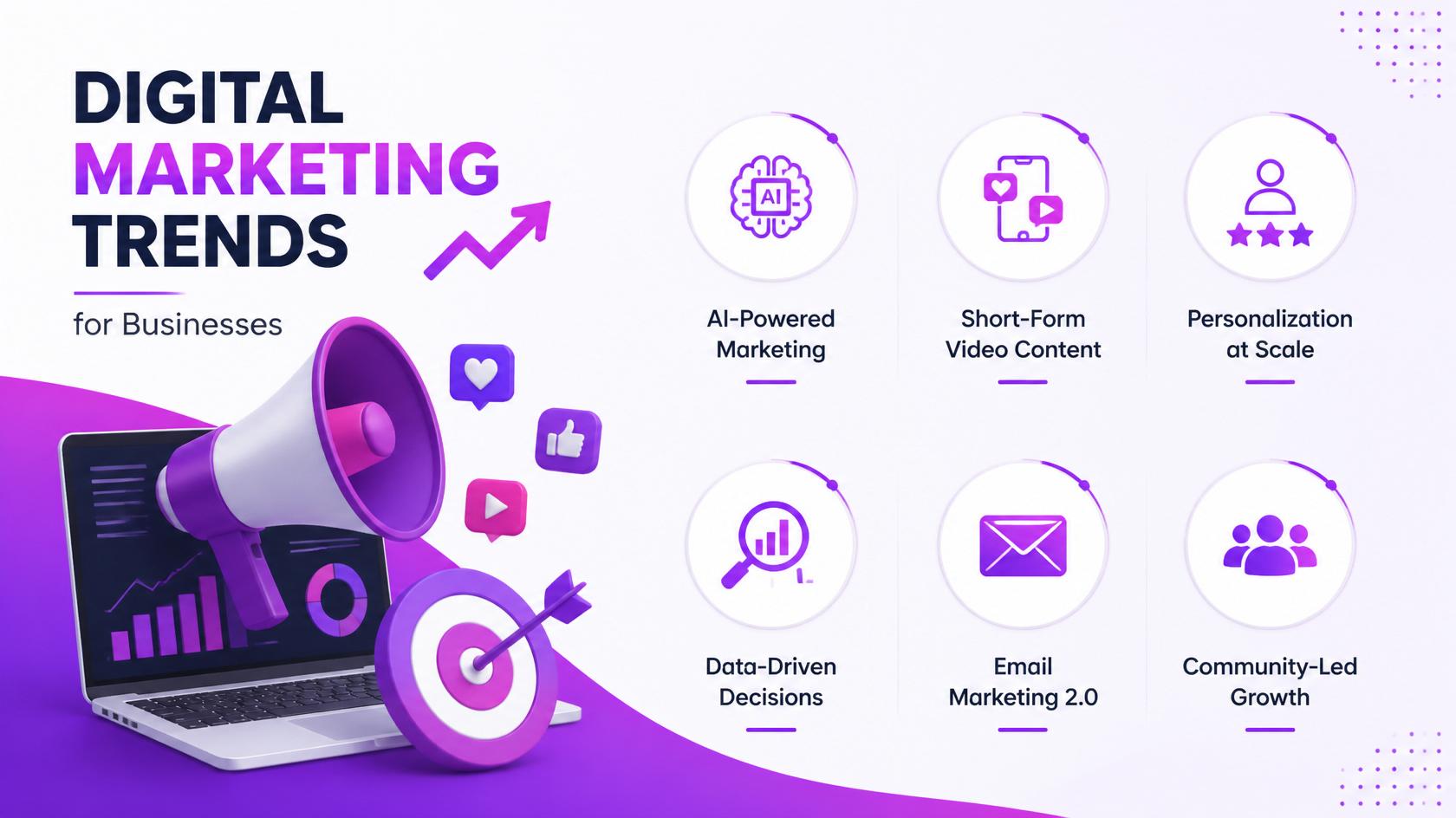
Introduction
Digital marketing no longer moves in yearly cycles. It moves in weeks. Search engines rewrite their algorithms, social platforms change how content gets seen, and artificial intelligence tools reshape entire workflows almost overnight. For business owners, marketers, startups, and entrepreneurs, this pace of change is not a side note — it is the main story of 2026.
A few years ago, a solid SEO strategy and a consistent posting schedule were enough to keep a brand visible. That is no longer true. AI-powered search results, voice assistants, short-form video, and privacy-first data rules have changed how customers discover, evaluate, and buy from businesses. Companies that adapt early capture attention and market share. Companies that wait get left behind, often without realizing it until their traffic and sales numbers tell the story.
This guide breaks down the digital marketing trends for businesses that matter most in 2026 — from AI in marketing and SEO for AI search engines, to video, social media, email automation, personalization, and local SEO. You will also find a practical strategy framework, a 30-day action plan, common mistakes to avoid, a comparison table of the top trends, and a detailed FAQ section built for both readers and search engines.
Whether you run a small local business, manage marketing for a growing startup, or lead a marketing team at an established company, this article gives you a clear, actionable roadmap for building a digital marketing strategy that works in 2026 and beyond.
What Are Digital Marketing Trends?
Digital marketing trends are the shifts in technology, consumer behavior, and platform algorithms that change how businesses reach, engage, and convert customers online. They span everything from new AI tools and search engine updates to changes in how people use social media, video, and messaging apps.
Why These Trends Matter
Trends matter because they reflect where your customers’ attention is actually going. A business that keeps using 2022 tactics in 2026 is talking to an audience that has already moved on. Following digital marketing trends for businesses is not about chasing every shiny new tool — it is about understanding which shifts are structural (like AI search) and which are temporary fads.
Key Benefits of Following Digital Marketing Trends
- Higher visibility in search engines and AI-powered answer engines
- Better customer engagement through personalized, relevant content
- Improved return on ad spend (ROAS) through smarter targeting
- Stronger brand trust through transparency and authentic content
- A competitive edge over businesses that are slower to adapt
In short, digital marketing trends are signals. Reading them correctly helps you invest your time and budget where it will actually generate growth.
Why Businesses Must Follow Digital Marketing Trends in 2026
Several forces are converging in 2026 to make digital marketing trends more important than ever before.
1. The AI Revolution
Generative AI has moved from novelty to infrastructure. Marketing teams now use AI for research, content drafts, ad copy variations, image generation, and customer support. Businesses that ignore AI spend more time and money to get the same or worse results as competitors who use it well.
2. Changing Consumer Behavior
Customers research products differently than they did even two years ago. Many now start their buying journey with an AI chatbot, a short-form video, or a voice assistant instead of a traditional search bar. Marketing strategies built only around classic search behavior miss a growing share of the audience.
3. Search Engine Changes
Search engines increasingly generate direct, AI-written answers instead of just showing ten blue links. This shift, often called AI Overviews or the Search Generative Experience, changes what it means to rank — visibility now includes being cited or summarized by an AI answer, not just appearing on page one.
4. Privacy Regulations and the Cookie-less Shift
Third-party cookies are being phased out, and privacy laws around the world are tightening. Businesses that rely on old tracking methods are losing data accuracy, which makes first-party data collection and consent-based marketing essential, not optional.
5. Rising Competition
More businesses are online than ever before, and many are experimenting with AI tools to move faster. Standing still is the same as falling behind, because your competitors are actively testing new channels, formats, and automation.
Top Digital Marketing Trends for Businesses in 2026
Below are the 15 digital marketing trends shaping strategy for businesses of every size in 2026. Each trend includes what it means in practice, its benefits, its challenges, and best practices you can apply right away.
1. Artificial Intelligence (AI) in Marketing
AI has become the backbone of modern marketing operations. Instead of replacing marketers, it removes repetitive work and speeds up decision-making.
AI Tools and Use Cases
- AI content assistants for drafting blogs, ads, and product descriptions
- AI chatbots that handle customer questions around the clock
- AI automation for scheduling posts, sending emails, and tagging leads
- AI personalization engines that tailor offers to each visitor
Benefits
- Faster content production without sacrificing quality when reviewed by humans
- Lower customer service costs through automated first-response support
- More precise targeting based on behavior patterns
Challenges
- Generic, unedited AI content can feel repetitive and hurt trust
- Over-reliance on AI without human review can introduce factual errors
Best Practices
- Use AI for first drafts, then edit with real expertise and examples
- Keep a human reviewing every customer-facing message before it goes out
- Track which AI-assisted campaigns actually perform better, and refine from there
2. SEO for AI Search Engines
Search is no longer just about ranking in a list of links. AI Overviews and generative search experiences summarize answers directly on the results page, often pulling from a small number of trusted sources.
What This Means for Your Content
- Clear, well-structured answers are more likely to be cited by AI Overviews
- Google’s EEAT standard — Experience, Expertise, Authoritativeness, Trustworthiness — matters more than ever
- Helpful, original content outperforms thin, keyword-stuffed pages
Optimization Tips
- Answer the core question in the first two sentences of a section
- Use structured headings, bullet points, and tables that AI systems can parse easily
- Show real experience: case studies, data, and first-hand examples build authority
- Keep author bios and credentials visible to strengthen trust signals
3. Voice Search Optimization
Voice assistants built into phones, smart speakers, and cars continue to grow in daily use, especially for local and quick-answer queries.
Why Voice Search Is Growing
- It is faster than typing for simple questions
- It fits naturally into hands-free situations like driving or cooking
- Smart speakers and in-car assistants are now common in many households
How to Optimize
- Target long-tail, conversational keywords rather than short, robotic phrases
- Write content in a natural, question-and-answer format
- Build a strong FAQ section addressing exactly how customers speak, not just how they type
4. Video Marketing
Video remains one of the most effective ways to build trust and explain value quickly. In 2026, businesses are mixing short and long formats rather than choosing one over the other.
- Short videos: quick tips, behind-the-scenes clips, and trending audio for reach
- Long-form videos: in-depth tutorials, interviews, and thought leadership
- Live streaming: real-time Q&A sessions, product launches, and events
- Educational videos: how-to guides that build authority and answer buyer questions
- Product demos: showing the product in action to reduce buying hesitation
The businesses that win with video are consistent, not perfect. A simple, useful video published weekly usually outperforms a highly polished video published once a quarter.
5. Social Media Marketing Trends
Each platform now rewards a different type of content and behavior, so a single approach across all channels rarely works well.
- Instagram: Reels and carousel posts favoring visual storytelling and saves
- LinkedIn: thought leadership, company updates, and B2B relationship building
- Facebook: community groups and local business engagement
- YouTube: long-form and Shorts working together for discovery and depth
- Threads and X: real-time conversation, brand personality, and customer service
- Pinterest: strong for product discovery, especially in retail, home, and lifestyle niches
Algorithms across these platforms increasingly reward genuine engagement — comments, shares, and watch time — over vanity metrics like follower count alone.
6. Influencer Marketing
Influencer marketing has matured from celebrity endorsements into a data-driven channel built around trust and niche relevance.
- Nano influencers (1,000–10,000 followers): high trust, strong niche engagement, lower cost
- Micro influencers (10,000–100,000 followers): balanced reach and authenticity
- Brand ambassadors: long-term partnerships that build consistent brand association
- ROI tracking: using unique codes and links to measure actual sales impact, not just reach
Smaller, highly engaged audiences often convert better than large but less personal followings, which is why many businesses are shifting budget toward nano and micro partnerships.
7. Content Marketing
A strong content strategy remains the foundation of long-term organic growth.
- Blog strategy: publishing consistently around topics your customers actually search for
- Pillar pages: comprehensive guides that cover a broad topic in depth
- Topic clusters: supporting articles that link back to the pillar page, building topical authority
- Storytelling: framing information around real situations and outcomes, not just facts
- User-generated content: reviews, testimonials, and customer photos that build trust organically
8. Email Marketing Automation
Email remains one of the highest-ROI digital marketing channels when it is personalized and well-timed.
- Personalized campaigns: using purchase history and behavior to tailor messages
- Segmentation: grouping subscribers by interest, stage, or activity level
- Automation: welcome series, cart-abandonment emails, and re-engagement flows
- Customer journeys: mapping emails to each stage from first visit to loyal repeat buyer
9. Marketing Automation
Beyond email, broader marketing automation connects your tools so leads move smoothly from first contact to closed sale.
- CRM systems: centralizing customer data across sales and marketing
- Lead nurturing: automated sequences that build trust before a sales conversation
- AI workflows: automatically scoring and routing leads based on behavior
- Automated campaigns: triggering messages based on specific customer actions
10. Omnichannel Marketing
Customers move between devices and platforms constantly, and they expect a consistent experience wherever they land.
- Customer journey mapping: understanding every touchpoint from awareness to purchase
- Cross-platform marketing: coordinating messaging across email, social, ads, and website
- Unified branding: consistent tone, visuals, and offers across every channel
Biggest Challenges Businesses Face
Adopting new trends is easier said than done. Here are the challenges businesses run into most often, along with practical solutions for each.
Budget Constraints
Challenge: Limited marketing budgets make it hard to test new channels alongside existing ones.
Solution: Start with one or two high-impact trends, such as AI-assisted content and local SEO, before expanding into paid experimentation.
Competition
Challenge: More businesses are competing for the same attention, driving up ad costs and content saturation.
Solution: Differentiate through original expertise, real case studies, and a distinct brand voice rather than competing purely on ad spend.
AI Adoption
Challenge: Teams often don’t know which AI tools to trust or how to integrate them into existing workflows.
Solution: Pick one workflow (like content drafting or customer support) to automate first, measure results, then expand gradually.
Privacy Regulations
Challenge: Changing privacy laws and the loss of third-party cookies make tracking and targeting harder.
Solution: Invest in first-party data collection through email lists, loyalty programs, and on-site forms with clear consent.
Content Overload
Challenge: The sheer volume of content online makes it harder for any single piece to stand out.
Solution: Focus on depth and originality — real examples, data, and expertise — rather than publishing more content for its own sake.
Best Digital Marketing Strategy for Businesses in 2026
A strong strategy connects every channel around one clear goal instead of running each channel in isolation. Here is a step-by-step framework.
Step 1: Define Clear Goals and Audience
Start by identifying who you serve and what a successful outcome looks like, whether that’s leads, sales, or bookings.
Step 2: Build an SEO Foundation
- Audit your website for technical issues and page speed
- Target keywords with real search intent, including long-tail and voice-friendly phrases
- Create pillar pages and supporting content clusters around your core services
Step 3: Layer in PPC for Immediate Visibility
- Use paid search and social ads to fill the gap while organic SEO builds momentum
- Test small budgets across a few audiences before scaling what works
Step 4: Nurture Leads with Email
- Set up a welcome sequence for new subscribers
- Segment your list by interest and buying stage
Step 5: Use AI to Scale Content and Support
- Draft content faster with AI, then edit for accuracy and voice
- Deploy a chatbot for common customer questions
Common Mistakes Businesses Should Avoid
- Chasing every new trend instead of focusing on what fits your audience
- Publishing unedited AI content without a human review pass
- Ignoring mobile users when most traffic now comes from phones
- Treating social media and SEO as separate strategies instead of connected ones
- Neglecting local SEO, especially for service-based and brick-and-mortar businesses
- Sending the same generic email to every subscriber instead of segmenting
- Ignoring analytics and continuing to spend on underperforming channels
- Failing to build first-party data before third-party cookies disappear completely
- Overloading landing pages with too much text and not enough clear direction
- Underestimating how much consistency matters compared to occasional bursts of activity
Frequently Asked Questions (FAQ)
What are digital marketing trends?
Digital marketing trends are shifts in technology, consumer behavior, and platform algorithms that change how businesses reach and convert customers online, from AI tools to search engine updates and new content formats.
Which digital marketing trend is most important in 2026?
AI in marketing and SEO for AI search engines are the two most influential trends right now, since they affect how content is created and how it gets discovered.
Is AI replacing marketers?
No. AI is replacing repetitive tasks, not strategic thinking. Marketers who use AI to work faster and combine it with real expertise are outperforming those who avoid it and those who rely on it without human review.
How important is SEO for businesses in 2026?
SEO remains one of the highest-ROI channels because it builds long-term, low-cost visibility, and it now extends into being cited by AI-generated search answers, not just ranking in traditional listings.
What is omnichannel marketing?
Omnichannel marketing means delivering a consistent brand experience and message across every platform a customer might use, including your website, email, social media, and ads, so the journey feels connected rather than fragmented.
How does personalization improve sales?
Personalization increases relevance, which increases the likelihood that a customer engages with and acts on your message. Personalized emails and product recommendations typically convert better than generic, one-size-fits-all messaging.
Which trends work best for small businesses?
Local SEO, email automation, and AI-assisted content tend to offer the strongest return for small businesses because they require lower budgets and deliver measurable results relatively quickly.
How do I start implementing these trends?
Start with the 30-day action plan in this guide: audit your current setup, strengthen your SEO foundation, set up basic automation, and test one new channel at a time rather than changing everything at once.
Do I need a big budget to follow digital marketing trends?
No. Many high-impact trends, like local SEO, email segmentation, and organic content, cost more time than money. Paid channels can be added gradually once you see what is already working.
What is EEAT and why does it matter for SEO?
EEAT stands for Experience, Expertise, Authoritativeness, and Trustworthiness. Search engines use these signals to judge whether content deserves to rank or be cited in AI-generated answers, especially for topics that affect people’s decisions and wellbeing.
How often should a business post on social media?
Consistency matters more than frequency. Most businesses see better results posting a few times per week on two or three platforms than posting daily across every platform without a clear plan.
Conclusion
Digital marketing in 2026 rewards businesses that combine new tools with timeless fundamentals: understanding your audience, delivering genuine value, and staying consistent. AI, SEO for AI search engines, video, and personalization are not passing fads — they reflect real, lasting shifts in how people discover and choose the businesses they trust.
You don’t need to master every trend covered in this guide at once. Start with the 30-day action plan, focus on the channels that fit your audience and budget, and build from there. Track your results, adjust based on what the data tells you, and keep customer experience at the center of every decision.