
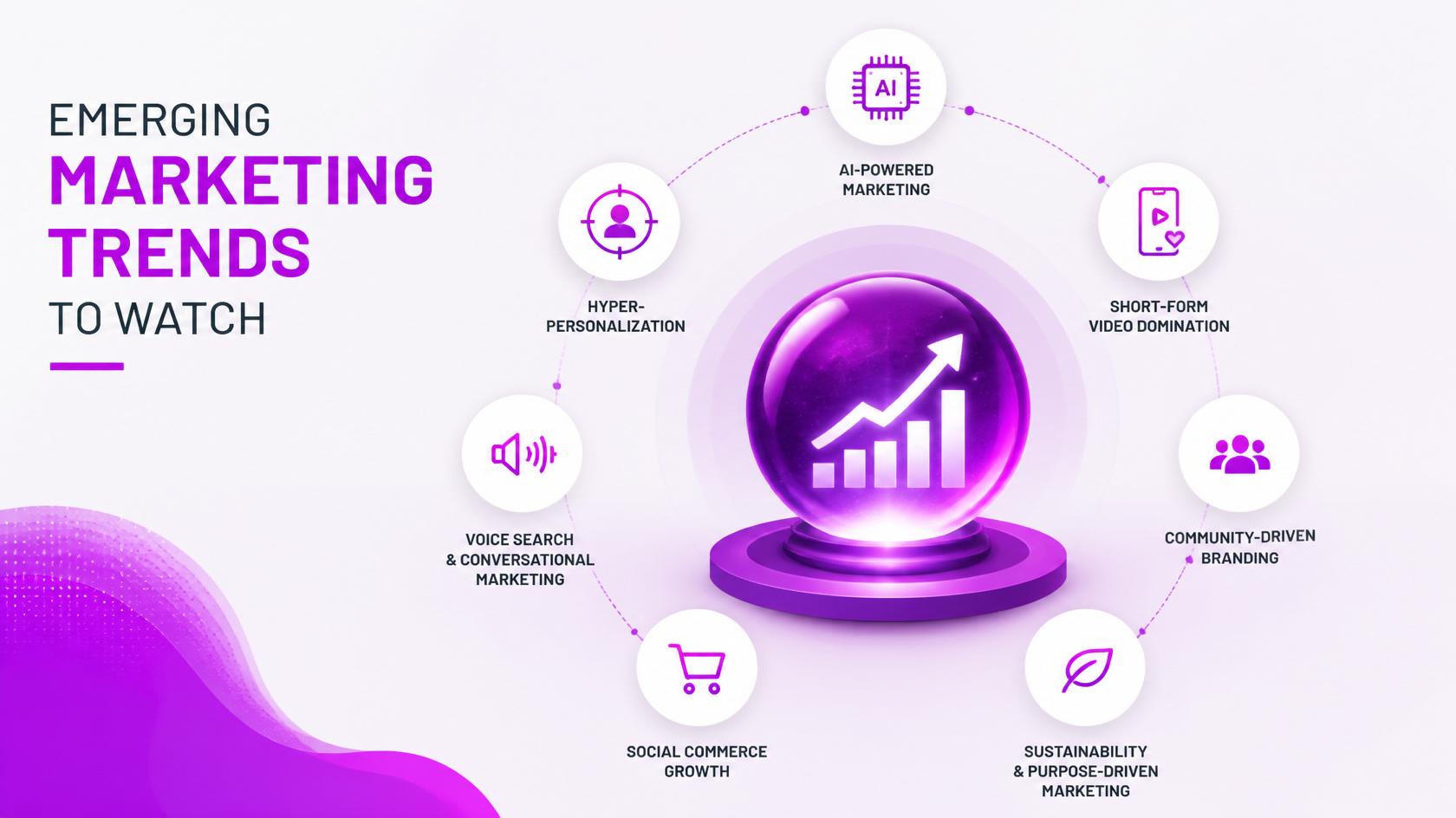
Introduction
Marketing doesn’t stand still, and 2026 is proving that more than most years before it. Emerging marketing trends — from AI-driven personalization to social commerce and voice search — are changing how customers find, evaluate, and buy from businesses, often within the same year they first appear.
A few years ago, ranking on Google and posting consistently on social media was often enough to stay competitive. Today, businesses are competing against AI-powered search summaries, short-form video algorithms, and customers who expect a personalized experience the moment they land on a website. Standing still is no longer a neutral choice — it’s a step backward relative to competitors who are moving forward.
Following emerging marketing trends matters because it directly affects growth, sales, and customer loyalty. Businesses that adapt early tend to capture attention before their market gets crowded. Businesses that wait usually end up paying more for the same results, if they get results at all.
In this guide, you’ll learn what emerging marketing trends actually are and why they matter in 2026, get a detailed breakdown of the 15 trends shaping marketing this year, see a comparison of the best marketing tools available, and walk away with a practical action plan you can apply whether you’re a beginner, a small business, a startup, or an enterprise.
We’ll also cover the biggest benefits of following these trends, common mistakes to avoid, a look at where marketing is headed beyond 2026, and a detailed FAQ section addressing the questions business owners and marketers ask most often about staying current in a fast-changing landscape.
What Are Emerging Marketing Trends?
Emerging marketing trends are new or rapidly evolving strategies, technologies, and consumer behaviors that are starting to reshape how businesses reach and engage their audiences. Unlike established best practices, emerging trends are still gaining traction — which means early adopters often get an outsized advantage.
Why Trends Change So Rapidly
Three forces drive the fast pace of change: technology (especially AI), shifting consumer expectations, and platform algorithm updates. Each of these evolves on its own timeline, and when they overlap — like AI-powered features rolling out on social platforms — the resulting shift in marketing tactics can happen within months, not years.
Why This Matters for Businesses
- Early adopters often see lower competition and lower costs for a new channel or tactic
- Staying current keeps your brand relevant to how customers actually behave today
- Understanding trends helps you avoid wasting budget on outdated tactics
- Trend awareness supports smarter, faster decision-making across your whole marketing plan
The goal isn’t to chase every new trend that appears — it’s to recognize which ones reflect lasting shifts in customer behavior versus which are short-lived fads, and to act accordingly.
Why Marketing Trends Matter in 2026
The AI Revolution
AI has moved from an experimental add-on to a core part of daily marketing work — from drafting content to analyzing customer data and automating ad decisions. Businesses that build AI into their workflow are consistently able to move faster than those still relying entirely on manual processes.
Changing Consumer Behavior
Customers increasingly research and shop through short videos, AI chatbots, and voice assistants instead of relying only on traditional search. A marketing strategy built solely around 2022-era customer habits misses a growing share of today’s buying journey.
Privacy Regulations
As third-party cookies fade and privacy laws tighten worldwide, businesses that haven’t invested in first-party data collection are losing the ability to track and target effectively.
Automation
Marketing automation now touches nearly every channel — email, social scheduling, lead scoring, and customer support — allowing smaller teams to manage workloads that once required much larger staff.
Competitive Advantage
In a crowded digital landscape, the businesses that adapt to emerging trends fastest typically capture disproportionate attention, simply because fewer competitors are there yet.
For example, a business that builds a strong first-party email list today will be far less affected by the ongoing loss of third-party cookies than a competitor still relying entirely on retargeting ads. The same logic applies across nearly every trend in this guide: early, deliberate action tends to compound into a lasting advantage.
Top Emerging Marketing Trends to Watch in 2026
Here’s a detailed look at the 15 trends most likely to shape marketing strategy and results this year.
1. Artificial Intelligence (AI) in Marketing
AI now touches nearly every part of the marketing workflow, from content creation to customer support.
- AI content: drafting blogs, ads, and product copy faster, with human editing for accuracy and voice
- AI ads: automated bidding and creative testing that optimizes in real time
- AI analytics: surfacing patterns in customer data that would take humans far longer to find manually
- Predictive marketing: forecasting which customers are likely to buy, churn, or respond to an offer
- AI chatbots: handling routine questions instantly, day or night
Benefits: faster execution, lower costs, and deeper insights. Challenges: the risk of generic output without human review, and the need for reliable data to train models on. Best tools: ChatGPT, Claude AI, and Google Gemini for content and research; Semrush and HubSpot for AI-assisted SEO and automation.
2. Hyper-Personalization
Personalization has moved beyond simply using a customer’s first name in an email.
- Personalized emails: content and offers tailored to purchase history and browsing behavior
- Product recommendations: dynamic suggestions based on real-time activity
- Dynamic websites: pages that change content or offers depending on the visitor
- Customer journeys: mapped and adjusted based on where each individual is in their decision process
3. Voice Search Optimization
Smart speakers and voice assistants continue to grow as a daily habit for quick answers and local searches.
- Smart speakers: increasingly common in homes and cars for hands-free searches
- Conversational keywords: longer, natural-language phrases replace short, robotic queries
- Voice SEO: structuring content to directly answer spoken questions
- Local search optimization: voice queries often include “near me” and location-based phrasing
4. Video Marketing Evolution
Video continues to diversify rather than consolidate into one dominant format.
- Short-form videos: quick, algorithm-friendly content for reach and discovery
- Live streaming: real-time engagement for launches, Q&As, and behind-the-scenes content
- Interactive videos: clickable elements that let viewers choose their own path
- Educational videos: how-to content that builds authority and answers buyer questions
- YouTube SEO: optimizing titles, descriptions, and thumbnails for discoverability
- Video advertising: short, targeted ads across social and streaming platforms
5. Influencer Marketing 2.0
Influencer marketing has matured into a more measured, ROI-focused channel.
- Nano influencers: small, highly engaged audiences with strong trust
- Micro influencers: a balance of reach and authenticity
- Brand collaborations: longer-term partnerships instead of one-off posts
- ROI measurement: tracking actual sales impact through codes and dedicated links, not just impressions
6. Social Commerce
Shopping and social media have merged into a single experience on many platforms.
- Instagram Shopping: browsing and buying without leaving the app
- Facebook Shops: storefronts built directly into a brand’s Facebook presence
- TikTok Shop: product discovery through short-form video and live selling
- Live shopping: real-time product demonstrations paired with instant purchase options
- Social selling: building relationships and trust that lead naturally to a sale
7. First-Party Data Strategy
As tracking through third-party cookies fades, owning your customer data directly becomes essential.
- Cookie-less future: reduced reliance on third-party tracking across the web
- Data privacy: being transparent and compliant about what you collect and why
- Customer trust: transparency builds long-term willingness to share data
- Email marketing: one of the most reliable first-party data channels available
- CRM: centralizing customer information for consistent, informed marketing decisions
8. Marketing Automation
Automation connects tools and channels so leads move smoothly without manual handoffs.
- Automation workflows: trigger-based sequences across email, ads, and CRM
- CRM automation: automatically scoring and routing leads based on behavior
- Email automation: welcome series, cart-abandonment flows, and re-engagement campaigns
- Lead nurturing: building trust with prospects before a sales conversation happens
9. Conversational Marketing
Customers increasingly prefer messaging over phone calls or long contact forms.
- Live chat: instant answers directly on your website
- WhatsApp marketing: order updates and personalized offers in regions where it’s widely used
- Chatbots: handling FAQs instantly, escalating complex issues to a human
- Messenger marketing: automated replies and promotions through social messaging apps
10. SEO Evolution
SEO in 2026 extends beyond ranking in a list of links — it now includes being cited in AI-generated answers.
- AI SEO: optimizing content so it can be understood and summarized by AI search tools
- Search intent: matching content precisely to what the searcher actually wants to accomplish
- Helpful content: prioritizing genuine value over keyword density
- Topical authority: covering a subject comprehensively across multiple connected pages
- Core Web Vitals: page speed and user experience metrics that affect rankings
- EEAT: demonstrating real Experience, Expertise, Authoritativeness, and Trustworthiness
- Voice SEO: structuring answers for spoken, conversational queries
- Entity SEO: helping search engines understand your brand as a distinct, trusted entity
Benefits of Following Marketing Trends
- Better ROI: smarter targeting and timing reduce wasted spend
- Higher engagement: content that matches current behavior gets more attention
- More traffic: staying current with SEO and content trends improves visibility
- Better conversions: personalized, relevant experiences convert more visitors into customers
- Stronger branding: consistent, modern messaging builds recognition and trust
- Increased sales: all of the above combine into measurable revenue growth
- Competitive advantage: adapting early keeps you ahead of slower-moving competitors
Common Marketing Mistakes
- Ignoring SEO in favor of only paid or social channels
- Overusing AI without human review, leading to generic or inaccurate content
- Lack of personalization, sending the same message to every customer
- Poor content quality, prioritizing volume over genuine value
- Not analyzing data regularly, so underperforming campaigns keep running
- Ignoring mobile users, even though most traffic now comes from phones
- Inconsistent branding across channels, which confuses and weakens trust
Future of Marketing Beyond 2026
- AI agents: autonomous systems capable of planning and running entire campaigns
- Predictive marketing: anticipating customer needs before they actively search
- Zero-click search: more answers delivered directly on the search results page
- Voice commerce: purchasing products directly through voice assistants
- AR shopping: virtual try-before-you-buy experiences becoming mainstream
- Automated customer journeys: seamless, AI-managed paths from first visit to loyal customer
Businesses that build flexible systems now — rather than rigid, single-channel strategies — will adapt most easily as these shifts continue to unfold.
Action Plan for Businesses
Use the roadmap below based on where your business currently stands.
Beginner
- Set up Google Analytics and Google Search Console
- Claim your Google Business Profile if you serve local customers
- Start an email list and send one consistent newsletter per month
Small Business
- Build a simple content calendar targeting 5–10 core keywords
- Set up basic email automation, like a welcome series
- Test one AI tool for content drafting or customer support
Startup
- Prioritize first-party data collection from day one
- Use AI-driven ad testing to find your best-performing audiences quickly
- Build a lightweight community, such as a Discord server or LinkedIn group, around your niche
Enterprise
- Integrate marketing automation across CRM, email, and paid channels
- Invest in topical authority content and structured data across your site
- Pilot AR/VR or advanced personalization for flagship products or campaigns
Frequently Asked Questions (FAQ)
What are emerging marketing trends?
Emerging marketing trends are new or rapidly evolving strategies, tools, and consumer behaviors that are starting to change how businesses reach and engage customers, such as AI-driven personalization, social commerce, and voice search.
Why are marketing trends important?
Trends matter because they reflect where customer attention and behavior are actually heading. Following them helps businesses stay relevant, avoid wasted spend, and capture opportunities before competitors do.
How is AI changing marketing?
AI is speeding up content creation, improving targeting through predictive analytics, automating customer support with chatbots, and helping marketers make faster, more data-informed decisions.
What is omnichannel marketing?
Omnichannel marketing means delivering a consistent brand message and experience across every channel a customer might use, including your website, email, social media, and ads.
What are the biggest digital marketing trends in 2026?
The most influential trends include AI in marketing, hyper-personalization, SEO evolution for AI search engines, social commerce, and first-party data strategy.
How can small businesses adopt new marketing trends?
Small businesses should start small: pick one or two trends that fit their audience and budget, such as email automation or AI-assisted content, before expanding into more advanced tactics.
What is first-party data?
First-party data is information collected directly from your own customers, such as email signups, purchase history, and on-site behavior, rather than relying on third-party tracking.
Is influencer marketing still effective?
Yes. Influencer marketing has matured into a more measured channel, with nano and micro influencers often delivering stronger engagement and trust than large-scale celebrity endorsements.
How does voice search affect SEO?
Voice search favors longer, conversational keywords and direct, well-structured answers, which means content needs to address questions the way people naturally speak, not just how they type.
What marketing tools should businesses use?
The right tools depend on your goals, but most businesses benefit from a combination of an analytics platform, an SEO tool, an email marketing platform, and at least one AI content or automation tool.
Conclusion
Marketing in 2026 is being reshaped by AI, personalization, social commerce, and a growing demand for authentic, trustworthy brand experiences. These emerging marketing trends aren’t temporary fads — they reflect real, lasting shifts in how customers discover, evaluate, and choose the businesses they support.
You don’t need to implement all 15 trends covered in this guide at once. Start with the action plan that matches your current stage, focus on the channels that genuinely fit your audience, and build from there. Track your results consistently, and let the data guide where you invest next.