
Introduction
Picture this: you just published a beautiful website. The design is clean, the copy is sharp, and you’re proud of what you built. A week goes by. Then a month. And… nothing. No visitors, no leads, no sales. Sound familiar?
This is the moment when almost every website owner discovers the same truth — having a website isn’t enough. You need people to find it. That’s where SEO (Search Engine Optimization) comes in, and it’s exactly why you’re reading this SEO guide for beginners.
Google has changed dramatically over the past few years. Between AI Overviews, zero-click searches, and increasingly sophisticated ranking systems, many beginners wonder: “Does SEO even work anymore in 2026?”
The short answer is yes — SEO is more important than ever. It has simply evolved. Search engines today reward websites that genuinely help people, load fast, work perfectly on mobile, and demonstrate real expertise. The tactics that used to work — stuffing keywords, buying spammy links — no longer do. But the fundamentals of Search Engine Optimization remain the same: understand what your audience is searching for, and give them the best possible answer.
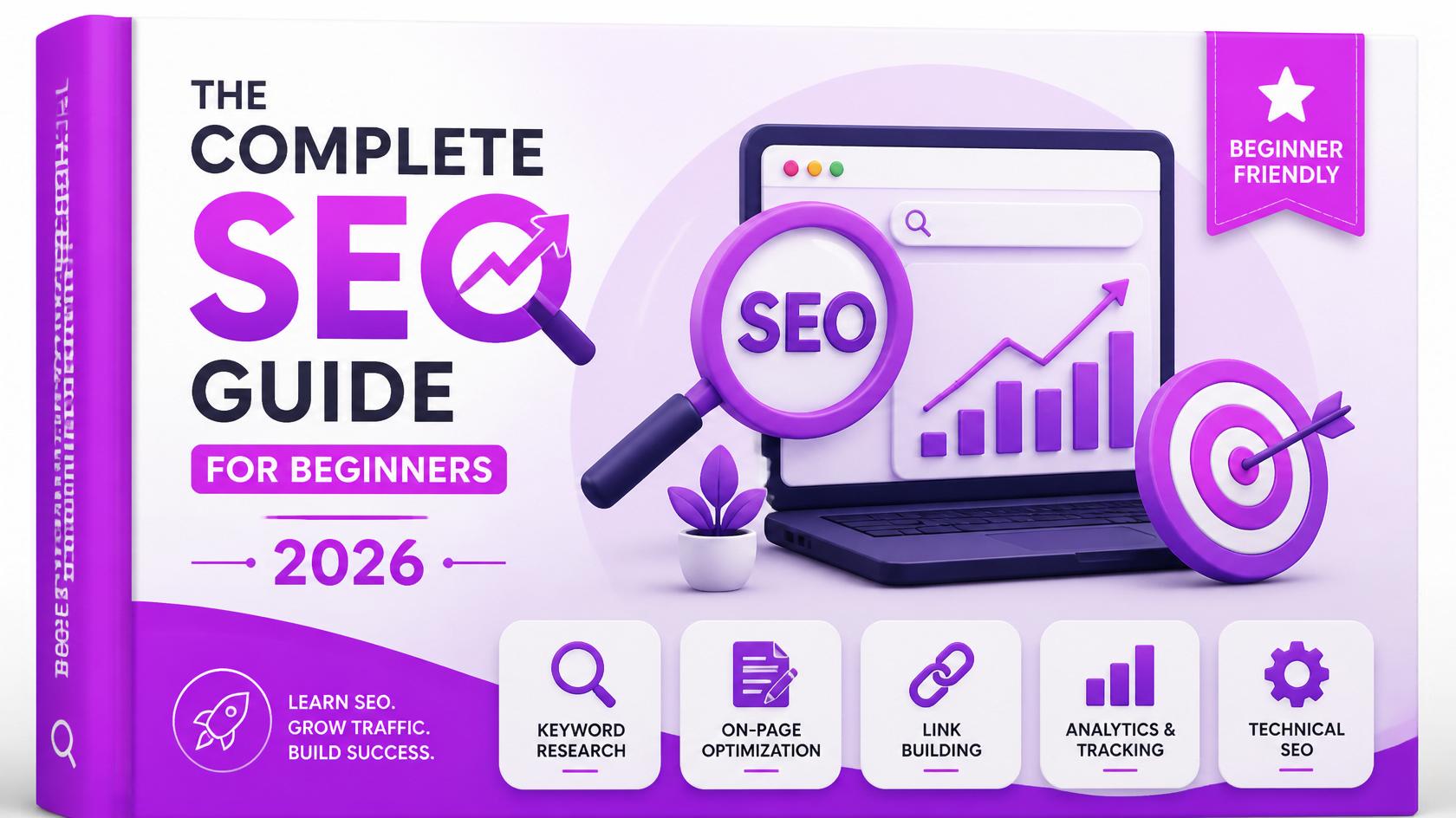
This complete beginner SEO guide will walk you through everything — from the basics of what SEO is, to on-page, off-page, technical, and local SEO, to keyword research, AI search optimization, and a step-by-step roadmap you can start using today. No jargon overload, no fluff — just a clear path from zero SEO knowledge to confidently optimizing your own website.
Let’s get started.
What is SEO?
SEO stands for Search Engine Optimization — the practice of improving your website so it ranks higher in search engines like Google, Bing, and increasingly, AI-powered search tools like Google AI Overviews and Perplexity.
How SEO Works
When someone types a question into Google, the search engine scans billions of web pages and picks out the ones it believes answer that question best. SEO is the set of strategies you use to convince Google (and the searcher) that your page is the best answer.
Why SEO Matters
- It’s the number one driver of website traffic for most businesses.
- It builds long-term, compounding results (unlike ads, which stop the moment you stop paying).
- It builds trust — users trust organic results more than paid ads.
- It’s cost-effective compared to paid advertising over time.
Benefits of SEO
- Increased organic visibility
- Higher-quality, intent-driven traffic
- Better user experience
- Long-term brand authority
- Higher conversion rates
Lorem ipsum dolor sit amet, consectetur adipiscing elit. Ut elit tellus, luctus nec ullamcorper mattis, pulvinar dapibus leo.
How Search Engines Work
To understand Search Engine Optimization, you first need to understand how search engines actually operate. It comes down to three core stages:
- Crawling – Search engines use automated bots (called “spiders” or “crawlers”) that travel across the web, following links from page to page, discovering new and updated content.
- Indexing – Once a page is crawled, Google analyzes its content and stores it in a massive database called the index — essentially a giant library of the internet.
- Ranking – When someone searches a query, Google’s algorithm scans the index and ranks pages based on hundreds of factors — relevance, quality, authority, page experience, and search intent.
Simple Workflow
User searches a query
↓
Google checks the Index
↓
Algorithm ranks matching pages
↓
Best-matching pages appear in results
Search Intent
Every search has an underlying intent. Understanding it is one of the most overlooked parts of SEO:
- Informational – “what is SEO”
- Navigational – “Google Search Console login”
- Transactional – “buy SEO course”
- Commercial Investigation – “best SEO tools 2026”
Google Algorithm
Google’s algorithm isn’t one single formula — it’s a combination of hundreds of interconnected systems (helpful content systems, spam-detection systems, page experience signals, and AI-based understanding models) that work together to evaluate quality and relevance.
Types of SEO
There are four major categories every beginner should understand: On-Page, Off-Page, Technical, and Local SEO.
On-Page SEO
On-page SEO refers to everything you control directly on your web pages.
- Title Tags – The clickable headline shown in search results. Keep it under 60 characters and include your primary keyword near the front.
- Meta Description – A short summary under the title that influences click-through rate. Keep it under 155 characters.
- URLs – Short, descriptive, keyword-rich URLs perform better (e.g., /seo-guide-for-beginners).
- Headings – Use one H1 per page, and a logical H2/H3 structure to organize content.
- Keyword Placement – Use your primary keyword naturally in the title, first paragraph, a subheading, and throughout the body — never forced.
- Internal Links – Links to other pages on your own site that help users (and Google) discover more content.
- External Links – Links to trustworthy, authoritative outside sources that support your claims.
- Image Optimization – Compressed, appropriately named image files.
- Alt Text – Descriptive text for images that helps accessibility and image search rankings.
- Schema Markup – Structured data that helps search engines understand your content and can unlock rich snippets.
Common Mistake: Cramming your keyword into every sentence. Google’s systems are built to detect and penalize unnatural keyword stuffing.
Off-Page SEO
Off-page SEO covers everything that happens outside your website but still affects your rankings.
- Backlinks – Links from other websites pointing to yours. They act like votes of confidence.
- Guest Posting – Writing content for other reputable websites in exchange for a backlink and exposure.
- Digital PR – Getting featured in online publications, news sites, or industry blogs.
- Social Signals – Shares, likes, and mentions across social platforms (indirect ranking influence, but great for visibility).
- Brand Mentions – Even unlinked mentions of your brand name can build authority signals.
- Link Building – The active process of earning quality backlinks through outreach, partnerships, and great content.
Technical SEO
Technical SEO ensures search engines can properly crawl, understand, and index your site.
- XML Sitemap – A file listing all important pages, helping search engines discover your content faster.
- txt – A file that tells search engine bots which pages they can or cannot crawl.
- HTTPS – Secure websites are prioritized over non-secure ones.
- Canonical Tags – Prevent duplicate content issues by specifying the “master” version of a page.
- Structured Data – Machine-readable code (schema) that enhances how your pages appear in search results.
- Mobile Friendliness – Since Google uses mobile-first indexing, your mobile site version is what actually gets ranked.
- Page Speed – Faster-loading pages rank better and convert better.
- Core Web Vitals – Google’s specific metrics for loading speed, interactivity, and visual stability (see below).
- Crawl Budget – The number of pages a search engine will crawl on your site within a given timeframe — important for larger websites.
Local SEO
If you run a local business, local SEO helps you show up in “near me” searches and Google Maps results.
- Google Business Profile – A free listing that displays your business info directly in Google Search and Maps.
- Local Citations – Mentions of your business name, address, and phone number across directories.
- Reviews – Customer reviews strongly influence local rankings and trust.
- NAP Consistency – Keeping your Name, Address, and Phone number identical across every platform.
- Local Keywords – Targeting phrases like “SEO agency in [city]” instead of generic terms.
Content SEO
Great content is still the backbone of SEO success in 2026. But “great” now means something specific.
- Helpful Content – Google’s helpful content systems reward material written primarily for people, not search engines.
- EEAT – Experience, Expertise, Authoritativeness, and Trustworthiness — the framework Google’s quality raters use to judge content.
- Topical Authority – Covering a subject deeply and broadly, rather than publishing one isolated article.
- Content Clusters – Grouping related articles around a central “pillar” topic, all interlinked.
- Pillar Pages – Comprehensive cornerstone pages (like this one) that link out to more specific supporting articles.
- Semantic SEO – Writing content around concepts and related terms, not just exact-match keywords.
- NLP Keywords – Natural language terms and synonyms that help search engines understand context more fully.
Pro Tip: Write for the person first. If the content genuinely helps a beginner understand SEO, the rankings tend to follow.
On-Page SEO Checklist
- ☐ Unique, keyword-optimized title tag under 60 characters
- ☐ Compelling meta description under 155 characters
- ☐ Clean, descriptive URL slug
- ☐ Single H1 with primary keyword
- ☐ Logical H2/H3 heading structure
- ☐ Primary keyword in the first 100 words
- ☐ Natural keyword usage throughout (no stuffing)
- ☐ Internal links to related pages
- ☐ External links to authoritative sources
- ☐ Optimized images with descriptive alt text
- ☐ Schema markup added where relevant
- ☐ Short, scannable paragraphs
Technical SEO Checklist
- ☐ XML sitemap submitted to Google Search Console
- ☐ Robots.txt configured correctly
- ☐ HTTPS enabled site-wide
- ☐ Canonical tags implemented properly
- ☐ Structured data validated (no schema errors)
- ☐ Mobile-friendly, responsive design
- ☐ Fast page load speed
- ☐ Core Web Vitals passing
- ☐ No broken links or 404 errors
- ☐ Crawl budget optimized (no unnecessary duplicate pages)
Off-Page SEO Checklist
- ☐ Consistent, high-quality backlink outreach
- ☐ Guest posting on relevant, reputable sites
- ☐ Active digital PR and media outreach
- ☐ Social media sharing and engagement
- ☐ Monitoring brand mentions
- ☐ Removing or disavowing toxic backlinks
Local SEO Checklist
- ☐ Google Business Profile fully completed and verified
- ☐ NAP consistency across all directories
- ☐ Active review generation and response strategy
- ☐ Local keyword targeting in content
- ☐ Local business schema markup added
Image SEO
Images affect both user experience and SEO performance.
- File Name – Use descriptive, keyword-relevant file names (e.g., seo-guide-checklist.jpg, not jpg).
- Alt Text – Clearly describe what’s in the image for accessibility and image-search visibility.
- Compression – Reduce file size without sacrificing visible quality to improve load speed.
- WebP – A modern image format that offers smaller file sizes than JPEG or PNG at similar quality.
- Lazy Loading – Loads images only as users scroll to them, speeding up initial page load.
Mobile SEO
Since most searches now happen on mobile devices, mobile optimization is non-negotiable.
- Responsive Design – Your site should automatically adapt to any screen size.
- Mobile Usability – Buttons, menus, and text must be easy to tap and read on small screens.
- Mobile Speed – Mobile pages should load in under a few seconds; slow mobile speed directly hurts rankings.
AI SEO in 2026
AI has fundamentally reshaped how people search — and how SEO professionals must think.
- AI Search – Search behavior increasingly includes conversational, multi-turn queries across AI-powered tools.
- Google AI Overviews – AI-generated summaries that appear above traditional search results, often answering queries directly.
- ChatGPT Search – Users increasingly research and shop using conversational AI search interfaces.
- Gemini Search – Google’s AI assistant is now deeply integrated into Search, pulling from real-time web data.
- Perplexity AI – An AI-native search engine that cites sources directly in its answers.
- AI Content Optimization – Structuring content clearly, with strong headings and direct answers, so AI systems can easily extract and cite it.
- AI Tools – Using AI responsibly to speed up research, outlines, and editing — while keeping genuine human expertise and EEAT at the core.
Pro Tip: Don’t try to “trick” AI search systems. The same principles that earn trust with human readers — clarity, accuracy, and genuine expertise — are what earn citations from AI Overviews and tools like Perplexity.
Frequently Asked Questions
- What is SEO? SEO (Search Engine Optimization) is the practice of improving a website so it ranks higher in search engine results, increasing organic visibility and traffic.
- Is SEO free? The core practice of SEO is free — it mainly costs time and effort. Many paid tools can accelerate the process, but they aren’t required to get started.
- How long does SEO take? Most websites start seeing meaningful movement within three to six months, with stronger results building over six to twelve months.
- Is SEO difficult? SEO has a learning curve, but the fundamentals are approachable for beginners. Consistency matters more than perfection.
- Can ChatGPT help with SEO? Yes — AI tools like ChatGPT can help brainstorm topics, outline content, and speed up research, though human expertise and originality still drive real rankings.
- What are backlinks? Backlinks are links from other websites pointing to your site. They act as votes of confidence that can improve your authority and rankings.
- Does SEO still work in 2026? Yes. SEO has evolved with AI search and changing algorithms, but the core goal — helping users find genuinely useful content — remains as relevant as ever.
- Is AI replacing SEO? No. AI is changing how people search, but SEO principles like relevance, quality, and trust are more important than ever for both traditional and AI-powered search.
- What is Local SEO? Local SEO is the practice of optimizing a business’s online presence to attract more customers from relevant local searches, such as “near me” queries.
- What is Technical SEO? Technical SEO focuses on the backend elements of a website — crawlability, indexing, speed, and structure — that help search engines access and understand your site.
Conclusion
SEO in 2026 isn’t about gaming an algorithm — it’s about genuinely understanding your audience and consistently giving them the best possible answer, faster and more clearly than anyone else. Whether you’re just starting a blog, running a small business, or managing a growing website, the fundamentals in this SEO guide for beginners — keyword research, on-page optimization, technical health, off-page authority, and now AI search readiness — give you everything you need to start climbing the rankings.
The most important step is simply to begin. Pick one section from this guide, apply it to your website today, and build from there.
Found this guide helpful? Share it with someone just starting their SEO journey, subscribe for more actionable SEO resources, and explore our related guides on keyword research, technical SEO, and link building to keep leveling up.