
Introduction
Only one website can hold the #1 spot on Google for any given search term — and it captures nearly a third of all clicks for that query. Everyone else, no matter how good their product or content is, fights over the scraps. That single fact is why how to rank #1 on Google is one of the most searched, most valuable questions in digital marketing.
Here’s the hard truth: most websites never get there. Not because their content is bad, but because they’re missing pieces of the puzzle — weak technical foundations, unclear search intent targeting, thin backlink profiles, or content that reads like it was written for robots instead of people. Google’s own systems are now explicitly built to reward the opposite: genuinely helpful content, backed by real EEAT (Experience, Expertise, Authoritativeness, Trustworthiness), delivered on a fast, mobile-friendly, technically sound website.
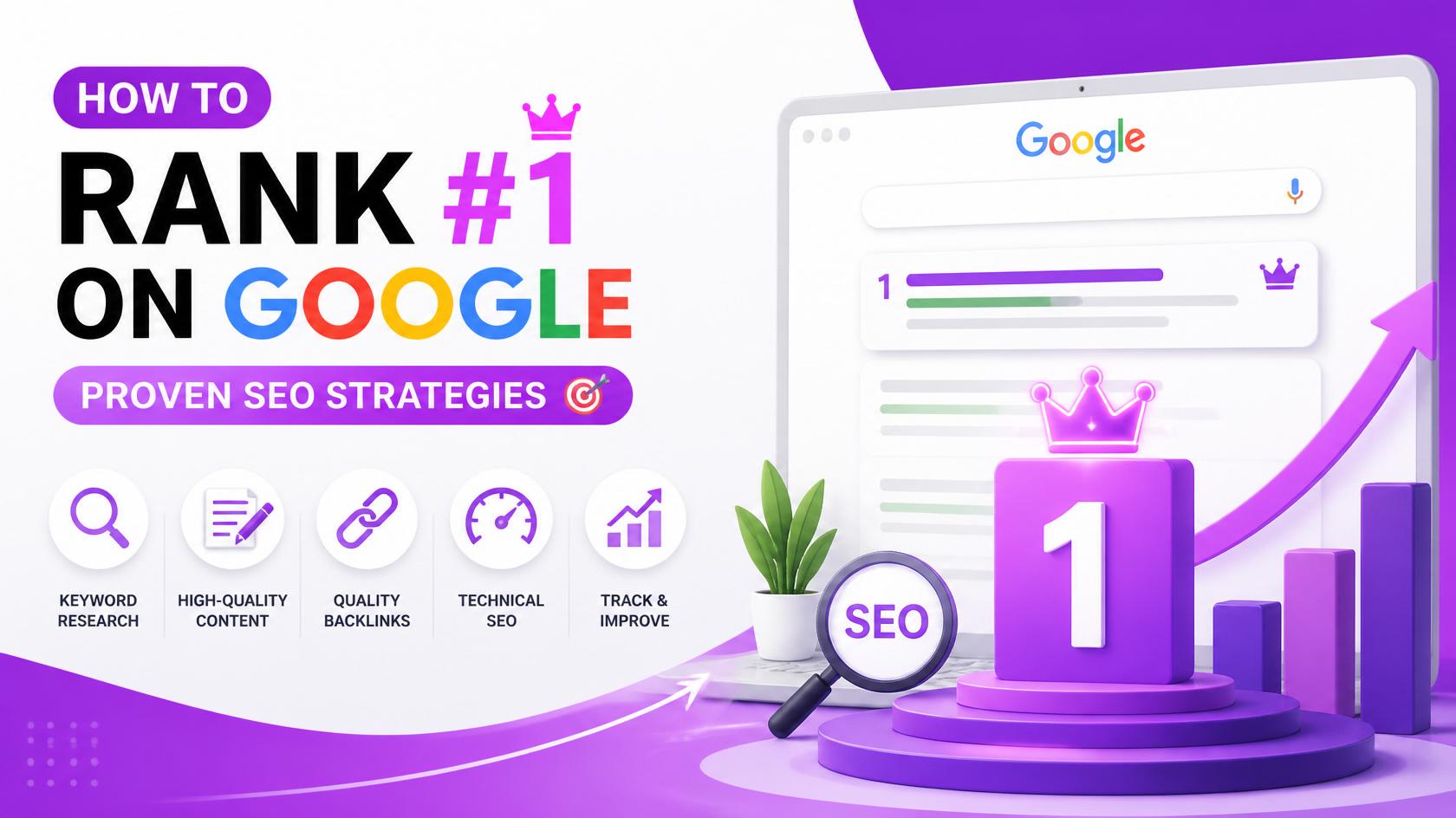
In this guide, you’ll learn exactly what it takes to compete for that top spot in 2026 — from the fundamentals of how Google’s algorithm works, to 25 proven, actionable SEO strategies, complete on-page, off-page, and technical checklists, the best SEO tools available today, the most common mistakes holding websites back, and where SEO is heading next with AI-powered search. By the end, you’ll have a clear, practical roadmap you can start applying today.
What Does Ranking #1 on Google Mean?
Before chasing the top spot, it helps to understand exactly what “ranking #1” looks like on a modern search results page (SERP), because Google’s results page today looks very different from a decade ago.
- Organic Results – The traditional, unpaid list of ranked web pages. This is what most people mean by “SEO rankings.”
- Paid Ads – Sponsored listings at the top or bottom of the page, marked “Sponsored.” These are bought, not earned, and operate separately from organic SEO.
- Featured Snippets – A highlighted answer box (sometimes called “position zero”) that appears above the standard organic results, pulled directly from a well-structured page.
- Knowledge Panel – An information box, usually on the right side, summarizing facts about a well-known entity, brand, or person.
- AI Overviews – Google’s AI-generated summary that answers a query directly at the top of the page, often citing multiple sources.
- People Also Ask (PAA) – An expandable box of related questions, offering another major opportunity to appear in search results beyond the standard #1 spot.
Ranking #1 today doesn’t just mean owning the top blue link — it increasingly means being present across several of these formats: the organic result, the featured snippet, and the AI Overview citation, all for the same query.
How Google’s Ranking Algorithm Works
Google’s algorithm is not one single formula. It’s a combination of hundreds of interconnected systems working together. Understanding the basic pipeline helps you optimize more effectively.
- Crawling – Googlebot discovers your pages by following links and reading your XML sitemap.
- Indexing – Your content is analyzed and stored in Google’s massive database, the Index.
- Ranking – When someone searches, Google’s algorithms sort indexed pages using hundreds of ranking signals.
Core Ranking Factors
- Search Intent – Does your page match what the searcher actually wants (informational, navigational, transactional, or commercial investigation)?
- Relevance – How closely does your content’s topic and language match the query?
- Authority – Does your site and page demonstrate trustworthiness through backlinks, citations, and reputation?
- Quality Signals – Depth, accuracy, originality, and helpfulness of the content.
- User Experience – Page speed, mobile-friendliness, and Core Web Vitals.
- Freshness – Recently updated or published content often gets a temporary boost for time-sensitive queries.
Pro Tip: Google’s Helpful Content system specifically evaluates whether content was created primarily to help people, or primarily to attract search traffic. Writing for your reader first is now a ranking strategy, not just good ethics.
Why Most Websites Fail to Rank
Industry studies consistently show that the majority of new pages never reach the first page of Google, and a large share never earn a single backlink at all. This isn’t because SEO is impossible — it’s because most websites make the same avoidable mistakes:
- They target keywords that are far too competitive for a brand-new domain.
- They publish content that technically mentions a topic but doesn’t actually answer the searcher’s question in depth.
- They ignore technical health, so even great content never gets properly crawled or indexed.
- They give up after a few weeks, when SEO results typically take months to materialize.
Understanding this pattern is half the battle. The other half is applying the proven strategies below, consistently, over time.
Top 15 Proven SEO Strategies to Rank #1
1. Keyword Research
Identify what your audience is actually typing into Google. Use tools to find a mix of high-volume and long-tail keywords. Example: Instead of “SEO,” target “how to rank #1 on Google for small business.” Common mistake: Chasing only broad, highly competitive keywords with no realistic path to ranking.
2. Search Intent Optimization
Match your content format to intent. If the top results are all listicles, a single-product page probably won’t rank. Best practice: Always study the current top 10 results before writing.
3. Create Helpful Content
Write content that genuinely solves the reader’s problem, not content built purely to satisfy an algorithm. Tip: Ask “would this page still be useful if search engines didn’t exist?”
4. Optimize Title Tags
Keep titles under 60 characters, place your focus keyword near the front, and make it compelling enough to earn clicks. Mistake to avoid: Duplicate title tags across multiple pages.
5. Write Better Meta Descriptions
A strong meta description (under 155 characters) won’t directly boost rankings but significantly improves click-through rate, an important secondary signal.
6. Improve Page Speed
Compress images, use caching, and minimize unnecessary scripts. Tool tip: Test with PageSpeed Insights and fix the highest-impact issues first.
7. Mobile Optimization
Since Google uses mobile-first indexing, your mobile experience is what actually gets evaluated for ranking, not your desktop version.
8. Core Web Vitals
Optimize for Largest Contentful Paint (loading), Interaction to Next Paint (responsiveness), and Cumulative Layout Shift (visual stability).
9. Internal Linking
Link relevant pages together using descriptive anchor text. This spreads authority across your site and helps Google understand page relationships.
10. Build High-Quality Backlinks
Earn links from relevant, authoritative sites through great content, digital PR, and genuine outreach — never through spammy link schemes.
11. Image SEO
Use descriptive file names, compress files, add alt text, and consider modern formats like WebP to keep pages fast.
12. Schema Markup
Add structured data (Article, FAQ, How-To, Breadcrumb) to help Google understand your content and qualify for rich snippets.
13. Improve User Experience
Clean navigation, readable fonts, minimal intrusive pop-ups, and clear calls-to-action all contribute to how Google’s systems evaluate page experience.
14. Long-Form Content
Comprehensive, in-depth content tends to naturally cover more subtopics and long-tail keywords, often correlating with stronger rankings — but only when every section adds real value.
15. Content Freshness
Regularly update statistics, examples, and outdated information, especially on pages targeting fast-changing topics like SEO itself.
SEO Mistakes That Stop You Ranking #1
- Ignoring search intent
- Keyword stuffing
- Thin, low-value content
- Duplicate title tags and meta descriptions
- Slow page speed
- Poor mobile experience
- Weak or missing internal linking
- Buying low-quality backlinks
- Ignoring Core Web Vitals
- Missing or broken schema markup
The Future of SEO
- AI Search – Multi-turn, conversational queries are becoming standard across search platforms.
- Google AI Overviews – AI-generated answers increasingly appear above traditional organic results.
- Voice Search – Smart assistants continue to drive longer, more conversational queries.
- Visual Search – Image-based search is expanding, especially for shopping and product discovery.
- Zero-Click Searches – A growing share of searches are answered directly on the results page, without a click.
- Entity SEO – Google increasingly understands topics as connected entities rather than isolated keywords.
- Topical Authority – Comprehensive coverage of a subject continues to outperform isolated, one-off articles.
- EEAT – Experience, Expertise, Authoritativeness, and Trustworthiness remain central to how content is evaluated, in both traditional and AI search.
Pro Tip: The websites winning in this new landscape treat AI Overviews and zero-click results as an extension of their SEO strategy, not a threat — optimizing content to be clearly citable, well-sourced, and structured for direct extraction.
Preparing Your Website for What’s Next
You don’t need to overhaul your entire strategy to prepare for the future of search — a few adjustments go a long way:
- Structure content for direct answers. Lead key sections with a clear, concise answer before expanding into detail, since this is exactly the format AI systems and featured snippets tend to pull from.
- Strengthen your author and brand signals. Clear author bios, transparent sourcing, and consistent publishing under a recognizable brand all feed into EEAT and citation-worthiness.
- Diversify beyond text. Images, short videos, and structured data give search engines and AI systems more ways to understand and surface your content.
- Keep measuring what matters. As zero-click searches grow, track brand visibility and citations alongside traditional click-through traffic, since not every valuable impression results in a visit.
Frequently Asked Questions
- How can I rank #1 on Google? Ranking #1 requires a combination of strong technical SEO, content that matches search intent, quality backlinks, and genuine EEAT signals, applied consistently over time.
- How long does it take to rank #1 on Google? It varies by competition, but most sites see meaningful progress within three to six months, with stronger results building over six to twelve months.
- What is the most important Google ranking factor? There isn’t a single “most important” factor — relevance, quality content, technical health, and authority all work together, though matching search intent is often the biggest lever for beginners.
- Do backlinks still matter in 2026? Yes. Quality backlinks remain one of the strongest trust and authority signals, though quality matters far more than quantity.
- Can I rank #1 without backlinks? It’s possible for low-competition, long-tail keywords, but for competitive terms, backlinks are usually still necessary.
- What is EEAT? EEAT stands for Experience, Expertise, Authoritativeness, and Trustworthiness — the framework Google’s quality raters use to assess content credibility.
- What is Helpful Content? Helpful Content refers to Google’s systems that reward content created primarily to help readers, rather than content created primarily to manipulate search rankings.
- Does AI-generated content hurt rankings? Not inherently — Google evaluates content quality and helpfulness regardless of how it was produced, but generic, unoriginal AI content tends to underperform.
- How important is page speed for rankings? Very important. Page speed is a confirmed ranking factor and also directly affects user experience and conversion rates.
- What are Core Web Vitals? Core Web Vitals are Google’s specific metrics for loading speed, interactivity, and visual stability, used as part of page experience signals.
Conclusion
Ranking #1 on Google isn’t about one clever trick — it’s the result of consistently doing the fundamentals well: understanding your audience’s search intent, building genuinely helpful content, maintaining a fast and technically sound website, and earning real authority through quality backlinks and trust signals. The strategies, checklists, and tips in this guide give you everything you need to start closing the gap between where your website is today and the #1 spot you’re aiming for.
The path from page 5 to page 1, as our case study showed, rarely happens overnight — but it does happen, consistently, for websites willing to apply these fundamentals patiently and correctly.
Ready to put this into action? Start with a single strategy from this guide today, share this article with a colleague working on their own SEO, and subscribe for more in-depth SEO guides as search continues to evolve in 2026 and beyond.