
Introduction
SEO in 2026 is more competitive — and more automated — than it’s ever been. Google’s algorithms now lean heavily on AI to interpret content, backlink profiles are scrutinized more carefully than ever, and Core Web Vitals, semantic SEO, and entity understanding all demand data most marketers simply can’t track by hand. Trying to compete without the right tools today is a bit like trying to navigate a new city without a map — technically possible, but far slower and far less accurate than it needs to be.
At the same time, AI itself has become part of the toolkit. Tools like ChatGPT, Claude, and Gemini now sit alongside traditional SEO platforms, reshaping how marketers do keyword research, build content briefs, and even predict ranking opportunities. Choosing the right combination of tools — not too many, not too few — has become its own skill.
This guide is designed to be the only resource you need on SEO tools every digital marketer should use in 2026. You’ll learn what SEO tools actually do, why they matter more than ever, every major category of tool available, detailed breakdowns of the top platforms, free vs paid comparisons, how AI is changing the toolkit, how to choose the right stack for your specific situation, and the most common mistakes marketers make when relying on tools. Let’s dive in.
What Are SEO Tools?
SEO tools are software platforms that help marketers research, analyze, optimize, and track a website’s search engine performance — covering everything from keyword discovery to technical audits, backlink analysis, and rank tracking.
Why They Matter
- They replace manual guesswork with real data.
- They save enormous amounts of time on repetitive analysis.
- They reveal opportunities — and problems — competitors and clients would otherwise never see.
- They allow marketers to measure results and prove ROI clearly.
How They Help Marketers
A good SEO tool doesn’t just report data — it turns that data into a clear next action, whether that’s fixing a broken link, targeting an untapped keyword, or building a backlink outreach list.
A Quick Real-World Scenario
Imagine two marketers launching similar blogs on the same day. One writes purely by instinct, guessing at topics and titles. The other spends thirty minutes in a keyword research tool, checks Google Search Console weekly, and runs a technical audit before publishing anything major. Six months later, the second marketer typically isn’t just ranking higher — they’re doing it with less wasted effort, because every piece of content was built around actual data instead of guesswork. That gap is exactly what the right SEO tools are designed to close.
Why SEO Tools Are Essential in 2026
- AI Search – Understanding how your content performs in AI Overviews requires tracking beyond traditional rankings.
- Google Updates – Frequent algorithm changes make ongoing monitoring essential, not optional.
- Core Web Vitals – Page experience metrics require dedicated technical tools to diagnose and fix.
- Voice Search – Conversational query tracking needs tools built for long-tail, question-based keywords.
- Semantic & Entity SEO – Modern content tools help ensure topical completeness, not just keyword coverage.
- Automation – Reporting, rank tracking, and auditing at scale simply aren’t feasible manually anymore.
- Data Analysis – Understanding user behavior requires dedicated analytics platforms.
- Content Optimization – Tools that benchmark your content against top-ranking competitors save significant guesswork.
Competitor Research – Understanding what’s already working for competitors shortcuts your own strategy significantly.
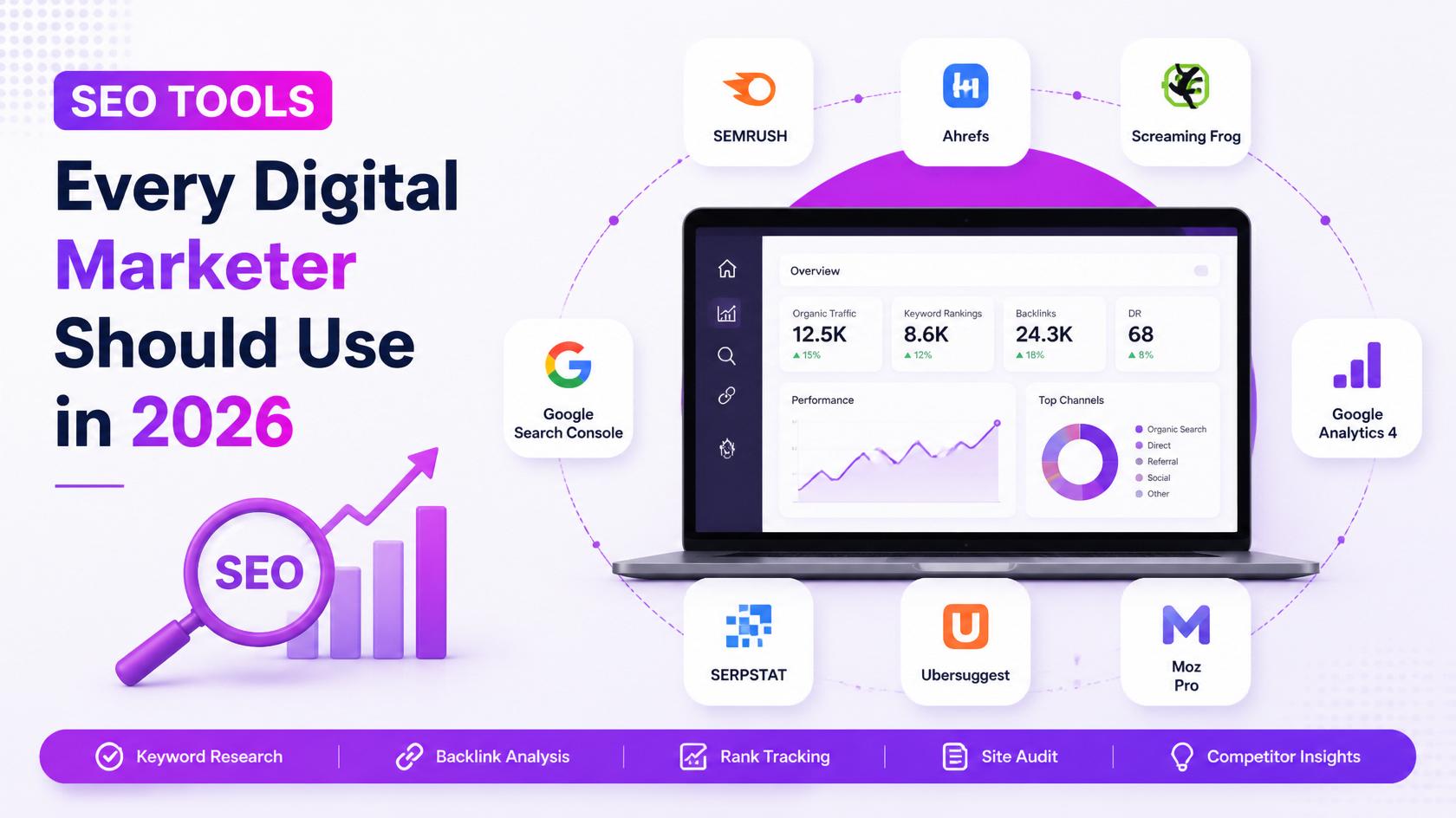
Top SEO Tools Every Digital Marketer Should Use
Google Search Console
Overview: Google’s free, direct window into how your site performs in search. Features: Indexing status, performance reports, manual actions, Core Web Vitals data. Best For: Every website owner, regardless of size or budget. Pros: Free, direct from Google, essential diagnostic data. Cons: Limited keyword volume data, no competitor insights. Pricing: Free. Rating: 5/5 for essential monitoring. Alternatives: Bing Webmaster Tools. > Expert Tip: Check the Coverage and Core Web Vitals reports monthly — they’re often the first place ranking problems show up.
Google Analytics 4
Overview: Google’s traffic and behavior analytics platform. Features: User behavior tracking, conversion tracking, audience insights. Best For: Understanding what happens after a visitor lands on your site. Pros: Free, deeply integrated with Google Ads and Search Console. Cons: Steeper learning curve than the older Universal Analytics. Pricing: Free (paid GA360 tier for enterprises). Rating: 4.5/5. Alternatives: Plausible, Matomo.
Ahrefs
Overview: A leading all-in-one SEO platform, especially strong for backlink analysis. Features: Site Explorer, Keywords Explorer, Content Explorer, Site Audit. Best For: Off-page SEO, competitor backlink research. Pros: Extremely detailed backlink database, powerful competitor research. Cons: Premium pricing, learning curve for beginners. Pricing: Paid, starting at a mid-tier monthly plan. Rating: 4.8/5. Alternatives: Semrush, Majestic. > Expert Tip: Use the Content Gap tool to find keywords competitors rank for that you don’t yet target.
Semrush
Overview: A comprehensive all-in-one SEO and digital marketing suite. Features: Keyword research, site audits, rank tracking, PPC and content tools. Best For: Agencies managing multiple clients and channels. Pros: Extremely broad feature set beyond just SEO. Cons: Can feel overwhelming for solo bloggers or beginners. Pricing: Paid, tiered plans for freelancers through enterprises. Rating: 4.7/5. Alternatives: Ahrefs, SE Ranking.
Moz Pro
Overview: A long-standing SEO platform known for Domain Authority metrics and beginner-friendly tools. Features: Keyword Explorer, Link Explorer, Site Crawl, MozBar browser extension. Best For: Beginners and intermediate marketers wanting an approachable interface. Pros: User-friendly, strong educational resources. Cons: Smaller backlink index compared to Ahrefs. Pricing: Paid, with limited free tools available. Rating: 4.3/5. Alternatives: Ahrefs, Semrush.
Screaming Frog SEO Spider
Overview: A desktop crawler that audits websites for technical SEO issues. Features: Crawls URLs, titles, metadata, redirects, broken links, duplicate content. Best For: In-depth technical SEO audits. Pros: Extremely thorough, one-time purchase option available. Cons: Requires technical knowledge to interpret results fully. Pricing: Free for up to 500 URLs; paid license for unlimited crawls. Rating: 4.7/5. Alternatives: Sitebulb, Ahrefs Site Audit. > Expert Tip: Run a crawl before and after any major site migration to catch broken redirects immediately.
Surfer SEO
Overview: A content optimization tool that scores pages against top-ranking competitors. Features: Content Editor, SERP Analyzer, Audit tool, AI content assistance. Best For: Writers optimizing content for specific target keywords. Pros: Clear, actionable content scoring. Cons: Can encourage over-optimization if followed too rigidly. Pricing: Paid, mid-range monthly plans. Rating: 4.5/5. Alternatives: Clearscope, Frase.
Clearscope
Overview: A premium content optimization platform focused on relevance and readability. Features: Content grading, keyword suggestions, readability scoring. Best For: Content teams prioritizing quality and topical relevance. Pros: Clean interface, strong content relevance scoring. Cons: Higher price point than comparable tools. Pricing: Paid, premium tier. Rating: 4.4/5. Alternatives: Surfer SEO, MarketMuse.
Frase
Overview: An AI-powered content research and optimization tool. Features: Content briefs, SERP analysis, AI writing assistance, FAQ extraction. Best For: Streamlining content briefs and research. Pros: Affordable compared to some competitors, strong brief generation. Cons: AI writing output still needs human editing. Pricing: Paid, budget-friendly entry tier. Rating: 4.3/5. Alternatives: Surfer SEO, MarketMuse.
ChatGPT
Overview: A general-purpose AI assistant widely used for SEO brainstorming and drafting. Features: Idea generation, outlining, drafting, editing assistance. Best For: Speeding up research and first drafts. Pros: Fast, versatile, widely accessible. Cons: Requires fact-checking; not a dedicated SEO data source. Pricing: Free tier available; paid tier for advanced features. Rating: 4.5/5 for content assistance. Alternatives: Claude AI, Gemini.
Best Paid SEO Tools
- Best Overall: Semrush — the broadest feature set across SEO, content, and PPC in one platform.
- Best for Agencies: Semrush or Ahrefs — both offer robust client reporting and multi-project management.
- Best for Freelancers: SE Ranking — strong feature set at a more accessible price point.
- Best for Bloggers: Surfer SEO — focused, practical content optimization without agency-level complexity.
- Best for Enterprises: Ahrefs Enterprise or Semrush Enterprise — built for scale, multiple users, and deep data needs.
- Best for Local SEO: Moz Local or BrightLocal-style citation management paired with Semrush’s local toolkit.
- Best AI SEO Tool: Claude AI or Surfer SEO’s AI features — depending on whether the priority is long-form content drafting or on-page scoring.
AI SEO Tools in 2026
AI has moved from a novelty to a core part of the SEO workflow. Here’s how the leading AI tools are typically used:
- Keyword Research – AI tools help cluster and expand keyword lists faster than manual brainstorming alone.
- Topic Clusters – AI assists in mapping pillar and supporting content relationships.
- Content Briefs – Tools like Frase and MarketMuse generate structured briefs based on top-ranking competitors.
- Meta Titles & Descriptions – AI can rapidly draft multiple variations for testing.
- Schema Generation – Some AI-powered plugins can draft structured data automatically.
- Internal Linking Suggestions – AI tools increasingly recommend relevant internal linking opportunities.
- Content Optimization – Surfer SEO and Clearscope use AI-driven scoring against top competitors.
- SEO Automation – Repetitive reporting and monitoring tasks are increasingly AI-assisted.
- Predictive SEO – Emerging tools attempt to forecast ranking potential before publishing.
Where each tool tends to shine: ChatGPT and Claude AI excel at drafting, research synthesis, and brainstorming; Gemini offers tight integration with Google’s own search data; Surfer SEO and Frase focus on data-driven on-page scoring; MarketMuse and Jasper lean toward content planning and larger-scale content operations.
Pro Tip: Use AI tools to accelerate research and structure, but always add genuine human expertise, fact-checking, and original insight before publishing — this remains one of the clearest EEAT signals in 2026.
How to Choose the Right SEO Tool
- Budget – Start with free tools (Search Console, Analytics) before investing in paid platforms.
- Business Size – Solo bloggers rarely need enterprise-level suites; agencies typically do.
- Features – Prioritize the categories most relevant to your current bottleneck (technical, content, or backlinks).
- Ease of Use – A powerful tool you never open provides zero value — choose one your team will actually use.
- Reporting – Agencies and client-facing marketers should prioritize tools with strong, exportable reporting.
- Automation – Look for tools that reduce manual repetitive work, not just add more dashboards.
- Customer Support – Especially important for technical tools where troubleshooting is common.
- Scalability – Choose tools that can grow with you, rather than requiring a full platform switch later.
A Simple Decision Framework
If you’re unsure where to start, work through these questions in order: What’s my single biggest SEO bottleneck right now — technical health, content quality, or backlink authority? What’s my realistic monthly budget for tools? Will I actually log in and use this weekly, or will it become another forgotten subscription? Answering these three questions honestly will narrow your options far faster than browsing feature lists alone.
Common SEO Tool Mistakes
- Relying on only one tool – Different tools reveal different blind spots; combine at least a few core categories.
- Ignoring Google Search Console – Even with premium tools, Search Console remains the most direct source of truth from Google itself.
- Not checking technical SEO – Content and keyword tools mean little if the site can’t be properly crawled or indexed.
- Buying expensive tools unnecessarily – Match tool investment to actual business size and needs, not aspirational scale.
Ignoring analytics – Rankings without conversion context can be misleading; always connect SEO data to real business outcomes
SEO Tool Stack for Different Users
- Beginner: Google Search Console, Google Analytics 4, Google Keyword Planner, Yoast SEO or Rank Math.
- Blogger: The beginner stack plus Surfer SEO or Frase for content optimization and Ubersuggest for affordable keyword research.
- Freelancer: SE Ranking or Semrush (single-project plan), Screaming Frog free version, ChatGPT or Claude AI for drafting.
- Agency: Semrush or Ahrefs (multi-project plans), Screaming Frog paid license, a dedicated reporting tool, and a content optimization platform like Clearscope.
- Enterprise: Ahrefs or Semrush Enterprise, Sitebulb for technical audits at scale, GA4 with advanced configurations, and MarketMuse for topical authority planning.
- Local Business: Google Business Profile, Moz Local-style citation management, Semrush’s local SEO toolkit.
The Future of SEO Tools
- AI SEO – Tools will continue integrating generative AI directly into research, drafting, and optimization workflows.
- Google AI Mode – SEO tools are adapting to track visibility within AI-driven search experiences, not just traditional rankings.
- Predictive SEO – Emerging capabilities aim to forecast ranking potential and traffic impact before content is even published.
- Machine Learning & Automation – Expect deeper automation of repetitive audits, reporting, and monitoring tasks.
- Voice & Visual Search – Tools will increasingly track conversational and image-based query performance.
Frequently Asked Questions
- What is the best SEO tool overall? There’s no single “best” tool for everyone — Semrush and Ahrefs are widely considered top all-in-one platforms, but the right choice depends on your budget and specific needs.
- Which SEO tool is free? Google Search Console, Google Analytics 4, and Google Keyword Planner are all completely free and essential starting points.
- Which SEO tool is best for beginners? Google Search Console and Google Analytics 4, paired with Yoast SEO or Rank Math, form an excellent free beginner stack.
- Is Ahrefs better than Semrush? Ahrefs is generally considered stronger for backlink analysis, while Semrush offers a broader all-in-one feature set — the better choice depends on your primary use case.
- Can ChatGPT replace SEO tools? No. ChatGPT and similar AI tools are excellent for research and drafting, but they don’t replace dedicated data sources like keyword volume, backlink databases, or rank tracking.
- Which SEO tool improves rankings directly? No tool improves rankings by itself — tools provide data and recommendations, but implementing the fixes and content improvements is what actually drives ranking changes.
- Which SEO tool is best for keyword research? Ahrefs, Semrush, and Google Keyword Planner are all strong choices, with Ubersuggest offering a more budget-friendly alternative.
- Which SEO tool helps with backlinks? Ahrefs and Majestic are particularly well-regarded for backlink analysis and monitoring.
- Do I need paid SEO tools? Not necessarily at first — many beginners can make significant progress with free tools before investing in paid platforms as their needs grow.
- How many SEO tools should I use? Most marketers do well with three to five core tools covering technical, content, and backlink analysis, rather than spreading effort across too many platforms.
Conclusion
The right SEO tools won’t replace strategy or expertise, but they will save you enormous time, reveal opportunities you’d otherwise miss, and help you prove real results. Whether you’re just starting with Google Search Console and Analytics, or building out a full agency-grade stack with Ahrefs, Semrush, and dedicated content optimization platforms, the key is matching your tools to your actual needs — not chasing every new platform that launches.
Start with the free essentials, add one or two paid tools that solve your biggest current bottleneck, and revisit your stack every six months as your site and goals grow.
Ready to build your ideal SEO tool stack? Explore the free tools first, test a paid platform’s trial before committing, and start turning the data you gather into real, consistent ranking improvements.