
Introduction
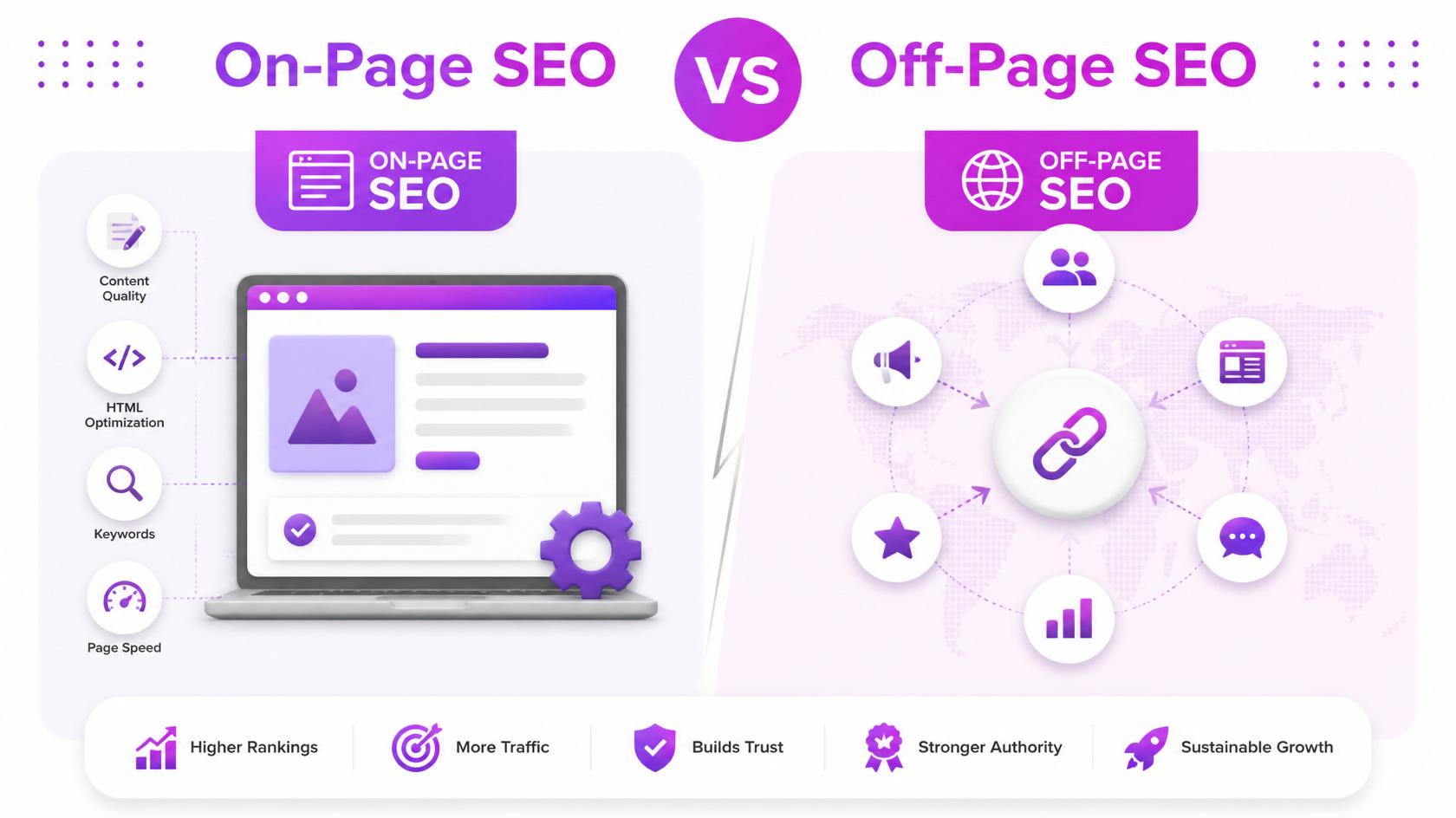
If you’ve spent any time researching SEO, you’ve probably run into two terms that seem to compete with each other: On-Page SEO and Off-Page SEO. Beginners often ask which one matters more, as if they had to pick a side. The truth is, they’re not rivals at all — they’re two halves of the same ranking equation, and Google needs both to trust your website enough to rank it at the top.
In 2026, this distinction matters more than ever. Google’s ranking systems have grown far more sophisticated, weighing not just what’s written on your page, but also what the rest of the internet says about your page. Get one right and ignore the other, and you’ll hit a ranking ceiling no matter how hard you try.
This complete guide breaks down on-page SEO vs off-page SEO in plain English — what each one actually means, the specific factors that make them up, practical checklists you can use today, a head-to-head comparison table, real examples of how they work together, common mistakes to avoid, the best tools for 2026, and the latest SEO trends shaping search right now. By the end, you’ll know exactly where to focus your time and effort.
What is SEO?
SEO (Search Engine Optimization) is the practice of improving a website so it ranks higher in search engine results, driving more organic (unpaid) traffic.
Why SEO Matters
Search remains one of the largest sources of website traffic for most businesses. Ranking well means consistent, high-intent visitors without paying for every click.
Types of SEO
SEO is generally broken into four categories:
- On-Page SEO – Optimizations made directly on your website’s pages.
- Off-Page SEO – Actions taken outside your website to build authority and trust.
- Technical SEO – The backend health of your site that affects crawling and indexing.
- Local SEO – Optimization for location-based searches, like “near me” queries.
How Google Ranks Websites
Google’s systems crawl, index, and then rank pages using hundreds of signals — relevance to the query, content quality, technical health, user experience, and the authority of the site and its backlink profile. On-page and off-page SEO each feed directly into different parts of this process, which is exactly why understanding both is essential.
Types of SEO
While this guide focuses on the on-page vs off-page comparison, it helps to see how all four types connect:
Type | What It Covers |
On-Page SEO | Content, HTML elements, site structure |
Off-Page SEO | Backlinks, brand signals, external authority |
Technical SEO | Crawlability, indexing, site speed, security |
Local SEO | Google Business Profile, local citations, reviews |
Technical SEO is often considered a subset of on-page SEO since it involves your own website, while local SEO borrows elements from both on-page (your Google Business Profile content) and off-page (local citations and reviews).
What is On-Page SEO?
On-page SEO refers to everything you can directly control and optimize within your own website — your content, HTML tags, internal structure, and technical setup.
Example: Optimizing a blog post’s title tag, headings, and internal links so it clearly targets a specific keyword and search intent.
Benefits of On-Page SEO
- Full control — no dependency on outside websites
- Improves relevance for target keywords
- Enhances user experience and readability
- Increases chances of earning featured snippets
- Provides the foundation that makes off-page efforts effective
Important On-Page SEO Factors
Keyword Research
Identify the exact terms your audience searches for, balancing search volume with realistic ranking difficulty.
Search Intent
Match your content format — guide, comparison, product page, listicle — to what’s already ranking for your target keyword.
Title Tags
Keep titles under 60 characters, with your focus keyword placed naturally near the front.
Meta Descriptions
160 character summary that earns the click, even though it isn’t a direct ranking factor.
Header Tags
Use one H1, followed by a logical H2/H3 hierarchy that organizes your content clearly for both readers and search engines.
URL Structure
Keep URLs short, descriptive, and keyword-relevant (e.g., /on-page-seo-vs-off-page-seo).
Internal Linking
Link to related pages on your own site using descriptive anchor text, helping both users and Google discover more content.
External Linking
Link out to authoritative, trustworthy sources to support your claims and strengthen credibility.
- ☐ Focus keyword in title tag, URL, H1, and first 100 words
- ☐ Compelling meta description with focus keyword
- ☐ Logical H2/H3 structure
- ☐ Natural keyword placement (no stuffing)
- ☐ Internal links to relevant pages
- ☐ External links to authoritative sources
- ☐ Optimized images with alt text
- ☐ Schema markup implemented
- ☐ Fast page speed and healthy Core Web Vitals
- ☐ Mobile-friendly, responsive layout
What is Off-Page SEO?
Off-page SEO refers to actions taken outside your own website that influence how search engines and users perceive its authority, relevance, and trustworthiness.
Example: Earning a backlink from a respected industry publication after they cite your original research.
Why Off-Page SEO Matters
Google treats external signals — especially backlinks — as votes of confidence. A page can be perfectly optimized on-page and still struggle to rank in a competitive niche without sufficient off-page authority.
Benefits of Off-Page SEO
- Builds domain and page authority
- Increases referral traffic from other sites
- Strengthens brand visibility and trust
- Helps competitive keywords rank that on-page work alone can’t unlock
Important Off-Page SEO Factors
Backlinks, Quality Links & Natural Links
Links from other websites remain one of the strongest off-page ranking signals — but quality and relevance matter far more than sheer quantity.
Guest Posting
Writing articles for other reputable sites in your niche, typically earning a link back to your own site.
Digital PR & Press Releases
Getting featured in news outlets or industry publications to build authority and visibility at scale.
Brand Mentions
Even unlinked mentions of your brand name across the web contribute to authority and entity recognition.
Influencer Marketing & Social Media Marketing
Partnering with niche influencers and maintaining active social profiles to expand reach and indirect authority signals.
Social Signals
Shares, likes, and engagement don’t directly boost rankings but strongly support visibility and link-earning potential.
Forum, Quora & Reddit Marketing
Participating genuinely in relevant online communities to build brand presence and occasional referral traffic.
Broken Link Building
Finding broken links on other sites and suggesting your relevant content as a replacement.
Competitor Backlink Analysis
Studying where competitors earn their links to uncover realistic new link-building opportunities.
What is Off-Page SEO?
Off-page SEO refers to actions taken outside your own website that influence how search engines and users perceive its authority, relevance, and trustworthiness.
Example: Earning a backlink from a respected industry publication after they cite your original research.
Why Off-Page SEO Matters
Google treats external signals — especially backlinks — as votes of confidence. A page can be perfectly optimized on-page and still struggle to rank in a competitive niche without sufficient off-page authority.
Benefits of Off-Page SEO
- Builds domain and page authority
- Increases referral traffic from other sites
- Strengthens brand visibility and trust
- Helps competitive keywords rank that on-page work alone can’t unlock
Important Off-Page SEO Factors
Backlinks, Quality Links & Natural Links
Links from other websites remain one of the strongest off-page ranking signals — but quality and relevance matter far more than sheer quantity.
Guest Posting
Writing articles for other reputable sites in your niche, typically earning a link back to your own site.
Digital PR & Press Releases
Getting featured in news outlets or industry publications to build authority and visibility at scale.
Brand Mentions
Even unlinked mentions of your brand name across the web contribute to authority and entity recognition.
Influencer Marketing & Social Media Marketing
Partnering with niche influencers and maintaining active social profiles to expand reach and indirect authority signals.
Social Signals
Shares, likes, and engagement don’t directly boost rankings but strongly support visibility and link-earning potential.
Forum, Quora & Reddit Marketing
Participating genuinely in relevant online communities to build brand presence and occasional referral traffic.
Broken Link Building
Finding broken links on other sites and suggesting your relevant content as a replacement.
Competitor Backlink Analysis
Studying where competitors earn their links to uncover realistic new link-building opportunities.
Off-Page SEO Checklist
- ☐ Ongoing, relevant backlink outreach
- ☐ Guest posting on reputable industry sites
- ☐ Digital PR and press release strategy
- ☐ Brand mention monitoring and reclamation
- ☐ Active social media presence
- ☐ Genuine participation in relevant forums/communities
- ☐ Broken link building campaigns
- ☐ Competitor backlink analysis
- ☐ Consistent local citations (if applicable)
- ☐ Regular backlink profile audits for toxic links
Which is More Important?
This is the wrong question to fully optimize for — the honest answer is that both are necessary, just at different stages and for different goals.
- Prioritize On-Page SEO first if your site is new, your content isn’t yet optimized for search intent, or you haven’t addressed basic technical issues.
- Prioritize Off-Page SEO once your on-page foundation is solid and you’re competing for keywords where competitors already have strong content — authority becomes the deciding factor.
- For highly competitive keywords, strong on-page optimization alone is rarely enough; you’ll need a genuine off-page authority-building strategy to break through.
- For low-competition, long-tail keywords, excellent on-page SEO can be enough to rank without significant backlink investment.
How On-Page and Off-Page SEO Work Together
Think of on-page SEO as building a excellent product, and off-page SEO as word-of-mouth reputation. A well-built product with no reputation struggles to gain trust; a heavily hyped product that’s poorly built won’t retain that attention. Google’s ranking systems work the same way.
Latest SEO Trends (2026)
- AI-Generated Content – Increasingly common, but must be paired with genuine human expertise to perform well.
- Helpful Content & EEAT – Google continues prioritizing content that demonstrates real experience and trustworthiness.
- Entity SEO – Search engines understand topics as connected entities, not just isolated keywords.
- Voice Search & Visual Search – Conversational and image-based queries continue to grow.
- Core Web Vitals – Page experience remains a confirmed, ongoing ranking factor.
- Zero-Click Searches – A growing share of queries are answered directly on the results page.
- AI Overviews & Search Generative Experience (SGE) – AI-generated summaries increasingly appear above traditional organic results.
- Topical Authority & Semantic SEO – Comprehensive, interconnected content continues to outperform isolated articles.
- Video SEO & Image SEO – Multimedia content offers additional visibility opportunities beyond text.
- First-Hand Experience – Google increasingly rewards content that demonstrates genuine, first-hand experience with a topic or product.
Expert SEO Tips
- Always research search intent before writing.
- Treat on-page and off-page SEO as one connected strategy, not separate projects.
- Prioritize technical fixes with the highest traffic impact first.
- Use natural, varied anchor text for both internal and external links.
- Avoid chasing backlink quantity over relevance and quality.
- Update your best-performing content regularly instead of only publishing new pages.
- Add schema markup to increase rich snippet eligibility.
- Compress every image before uploading.
- Build topic clusters instead of isolated, disconnected articles.
- Monitor Core Web Vitals monthly.
Frequently Asked Questions
- What is On-Page SEO? On-page SEO refers to all the optimizations made directly on your website, including content, title tags, headings, internal links, and technical elements.
- What is Off-Page SEO? Off-page SEO refers to actions taken outside your website — primarily backlinks, brand mentions, and other external trust signals — that build authority.
- Which is more important, on-page or off-page SEO? Neither works well without the other. On-page SEO builds the foundation; off-page SEO builds the authority needed to compete for more difficult keywords.
- Can I rank without backlinks? Yes, for low-competition, long-tail keywords. For competitive terms, backlinks are usually necessary alongside strong on-page SEO.
- Does social media help SEO? Social media doesn’t directly boost rankings, but it increases visibility, referral traffic, and the likelihood of earning natural backlinks.
- How many backlinks do I need to rank? There’s no fixed number — quality and relevance matter far more than quantity. A handful of authoritative, relevant links often outperforms dozens of weak ones.
- How long does SEO take to show results? Most websites see meaningful movement within three to six months, with stronger, more stable results building over six to twelve months.
- What is Technical SEO? Technical SEO covers the backend elements of a website — crawlability, indexing, site speed, and security — that determine whether search engines can properly access your content.
- What is Domain Authority? Domain Authority is a third-party metric (popularized by Moz) that estimates how likely a website is to rank, based largely on its backlink profile.
- Is keyword stuffing still a problem in 2026? Yes. Modern algorithms are highly effective at detecting unnatural keyword repetition, and it can actively hurt both rankings and readability.
Conclusion
On-page SEO vs off-page SEO was never really a competition — it’s a partnership. On-page SEO gives you full control to build a relevant, well-structured, technically sound website. Off-page SEO builds the external trust and authority that convinces Google (and searchers) that your website deserves to be seen. Neglect either one, and you’ll hit a ceiling that the other half of the equation was designed to break through.
Use the checklists, comparison table, and expert tips in this guide to audit where your website currently stands, then build a plan that strengthens both sides together, consistently, over time.
Ready to put this into practice? Start by auditing your website against the on-page and off-page checklists above, optimize one underperforming page this week, and begin building a realistic, sustainable link-building plan — your future rankings will thank you.