
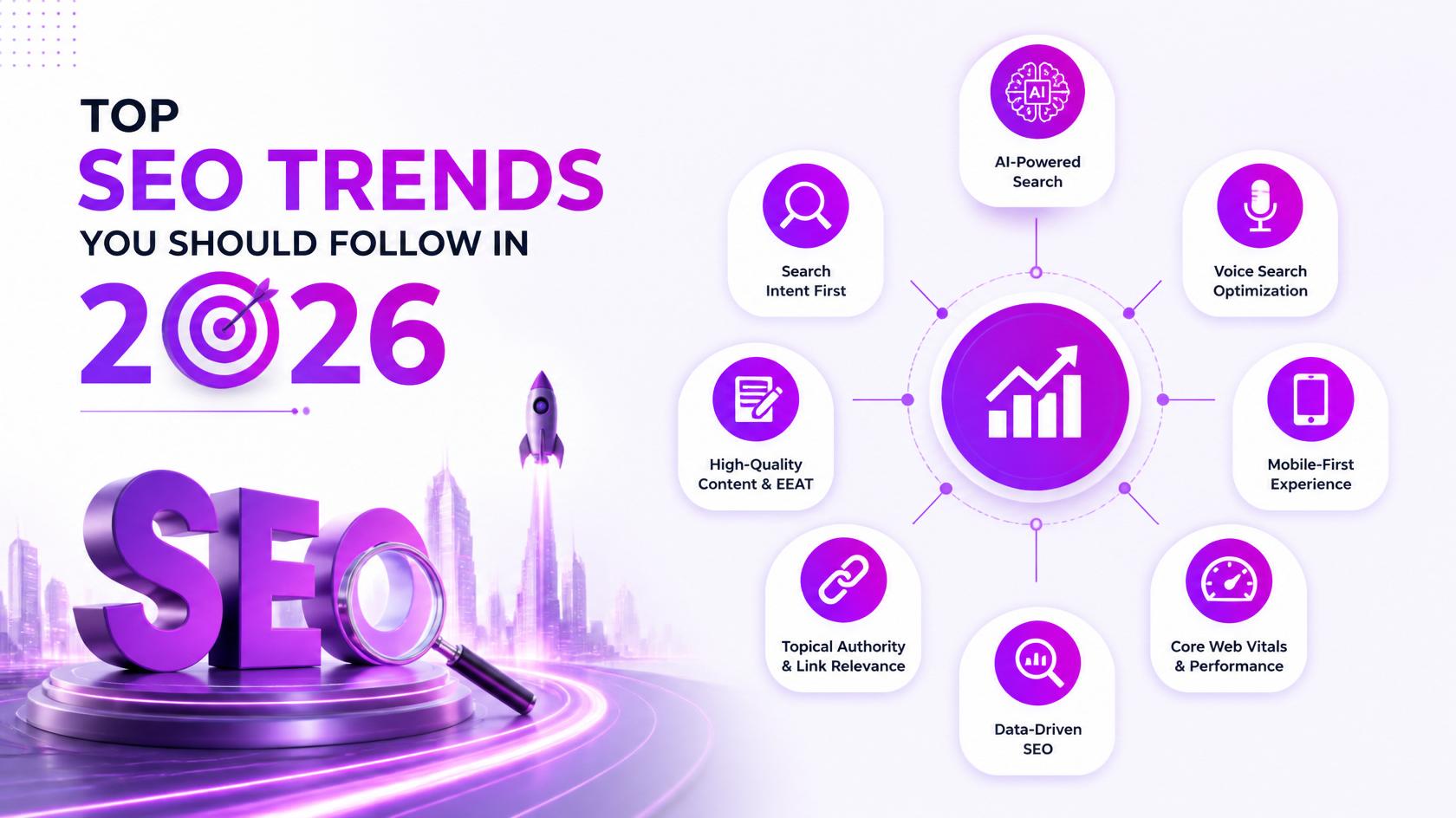
Introduction
SEO doesn’t stand still, and 2026 is proving to be one of the fastest-moving years yet. Google now answers a huge share of queries directly on the results page using AI, search behavior is shifting toward longer, conversational questions, and ranking factors like EEAT and page experience carry more weight than ever. If your SEO strategy still looks like it did three years ago, you’re likely losing visibility without even realizing it.
This matters for everyone — bloggers, small business owners, marketers, and SEO professionals alike — because the businesses that adapt early consistently capture the visibility that slower-moving competitors leave behind. Understanding the top SEO trends 2026 brings isn’t optional anymore; it’s the difference between growing organic traffic and slowly losing it to competitors and AI-powered search tools.
This guide walks through the twenty biggest SEO trends shaping this year, along with a best-practices checklist, common mistakes, expert tips, and answers to the questions professionals are asking most.
Introduction
SEO doesn’t stand still, and 2026 is proving to be one of the fastest-moving years yet. Google now answers a huge share of queries directly on the results page using AI, search behavior is shifting toward longer, conversational questions, and ranking factors like EEAT and page experience carry more weight than ever. If your SEO strategy still looks like it did three years ago, you’re likely losing visibility without even realizing it.
This matters for everyone — bloggers, small business owners, marketers, and SEO professionals alike — because the businesses that adapt early consistently capture the visibility that slower-moving competitors leave behind. Understanding the top SEO trends 2026 brings isn’t optional anymore; it’s the difference between growing organic traffic and slowly losing it to competitors and AI-powered search tools.
This guide walks through the twenty biggest SEO trends shaping this year, along with a best-practices checklist, common mistakes, expert tips, and answers to the questions professionals are asking most.
1. AI-Powered Search is Transforming SEO
Google’s AI systems now generate direct answers — AI Overviews — above traditional organic results for a growing share of queries. Generative search increasingly synthesizes information from multiple sources instead of just linking to them.
How it affects rankings: Pages written clearly, with well-sourced facts and a direct answer near the top, are more likely to be cited in AI-generated summaries.
Tip: Structure key sections to answer the core question in the first sentence or two, then expand with supporting detail — this format is exactly what AI systems tend to extract and cite.
2. Search Intent Becomes More Important
Matching content format to intent remains one of the highest-leverage SEO decisions you can make.
- Informational intent – “what is technical SEO”
- Commercial intent – “best SEO tools 2026”
- Transactional intent – “buy SEO course”
- Navigational intent – “Google Search Console login”
Example: Targeting “SEO tools” with a product page instead of a comparison guide will likely underperform, since most searchers for that term want a comparison first.
3. EEAT Will Continue Dominating Rankings
EEAT — Experience, Expertise, Authoritativeness, Trustworthiness — remains central to how Google’s quality systems evaluate content.
Practical ways to improve EEAT: – Add real author bios with credentials – Cite original data, studies, or first-hand experience – Keep information accurate and regularly updated – Display clear contact and business information
Pro Tip: Demonstrating genuine first-hand experience — actual photos, results, or specific details only someone who did the thing would know — has become one of the clearest EEAT signals in 2026.
4. Helpful Content Will Outrank AI Spam
As generic AI-generated content floods the web, Google’s Helpful Content systems increasingly reward what mass-produced content can’t easily replicate.
- Original research and data
- Genuine case studies
- Unique professional insights
- First-hand experience
- Regularly refreshed, accurate information
Mini case study: A niche fitness blog that replaced generic workout listicles with detailed, personally-tested routines and progress photos saw significantly stronger engagement and rankings within a few months — precisely because it couldn’t be easily copied by AI-generated competitors.
5. Semantic SEO and Topic Clusters
Google increasingly understands content in terms of entities and topics rather than isolated keywords.
- Topical authority – Comprehensive coverage of a subject across multiple pages
- Entity SEO – Optimizing around real-world concepts Google’s Knowledge Graph recognizes
- Content clusters – Pillar pages supported by interlinked, specific subtopic articles
Internal linking – Connecting related
6.Voice Search Optimization
Voice queries tend to be longer, more conversational, and question-based.
- Target natural phrases like “how do I improve my website’s SEO”
- Structure content in clear question-and-answer formats
- Aim for featured snippets, since voice assistants often read these aloud
- Optimize for local, conversational queries like “where’s the closest coffee shop”
7. Mobile-First SEO
Since Google indexes the mobile version of your site by default, mobile experience is non-negotiable.
- Fully responsive design across screen sizes
- Easy-to-tap buttons and readable font sizes
- Fast mobile load times
- Touch-optimized navigation and forms
8. Core Web Vitals Matter More Than Ever
- Largest Contentful Paint (LCP) – How quickly the main content loads
- Interaction to Next Paint (INP) – How responsive the page feels to user input
- Cumulative Layout Shift (CLS) – How visually stable the page is while loading
Optimization tips: Compress images, minimize unnecessary scripts, use a reliable hosting/CDN setup, and test regularly with PageSpeed Insights.
9. Video SEO is Growing Fast
- YouTube SEO – Optimize titles, descriptions, and tags for search
- Short-form videos – Increasingly surfaced directly in search results
- Video schema markup – Helps search engines understand and display video content
- Transcripts – Improve accessibility and give search engines text to index
- Thumbnail optimization – Directly impacts click-through rate
10. Visual Search Optimization
- Google Lens – Increasingly used for product and information discovery through images
- Image SEO – Descriptive file names and surrounding context
- Alt text – Clear, accurate descriptions for accessibility and image search
- Compression – Keeps pages fast without sacrificing visible quality
- Structured data – Helps qualify images for enhanced search features
11. Zero-Click Search Optimization
A growing share of searches are fully answered on the results page itself.
- Featured snippets – Concise, well-structured direct answers
- People Also Ask – Related question boxes offering extra visibility
- Knowledge Panels – Entity-based information summaries
- AI Overviews – AI-generated answers citing multiple sources
How to earn them: Answer questions clearly and directly near the top of relevant sections, use structured formatting, and add appropriate schema markup.
12. Local SEO is Becoming Smarter
- Fully optimized Google Business Profile
- Consistent local citations across directories
- Active review generation and response strategy
- Maps optimization for “near me” visibility
- Targeting specific local keywords (e.g., “SEO agency in Austin”)
13. User Experience (UX) Will Impact Rankings
- Clear, intuitive navigation
- Strong readability with short paragraphs and simple language
- Clean, distraction-free design
- Lower bounce rate through genuinely engaging content
- Higher engagement via clear calls-to-action
- Accessibility for all users, including screen reader compatibility
14. Technical SEO Remains Essential
- Updated XML sitemap
- Properly configured txt
- Correct canonical tags
- Site-wide HTTPS
- Valid structured data and schema markup
- No unresolved 404 errors
- Proper redirects (301, not chains)
Healthy crawl budget management for larger sites
15. Entity SEO Will Replace Keyword Stuffing
Google increasingly understands entities — people, places, brands, concepts — and their relationships within its Knowledge Graph, rather than relying purely on exact-match keywords.
Practical impact: Writing naturally about related concepts and topical relevance now outperforms forcing an exact keyword phrase repeatedly throughout a page
content to reinforce topical relevance
Best Practices Checklist
- ☐ Structure content for direct, extractable answers
- ☐ Match content format to search intent
- ☐ Strengthen EEAT with author bios and original insight
- ☐ Prioritize genuinely helpful, first-hand content
- ☐ Build topic clusters around pillar pages
- ☐ Use AI tools to assist, not replace, human expertise
- ☐ Optimize for voice and conversational queries
- ☐ Ensure full mobile responsiveness
- ☐ Maintain healthy Core Web Vitals
☐ Optimize video content and add transcrip
Common SEO Mistakes
- Ignoring AI Overviews – Fix by structuring content for clear, direct answers.
- Overlooking search intent – Fix by studying current top-ranking results before writing.
- Weak EEAT signals – Fix by adding real author credentials and original insight.
- Publishing generic AI content – Fix by adding first-hand experience and fact-checking.
- Ignoring topical authority – Fix by building content clusters instead of isolated posts.
- Over-relying on one AI tool – Fix by combining tools with human review.
- Skipping voice search optimization – Fix by targeting natural, question-based phrases.
- Poor mobile experience – Fix by testing regularly on real devices.
- Ignoring Core Web Vitals – Fix by auditing monthly with PageSpeed Insights.
- Neglecting video SEO – Fix by adding transcripts and schema to video content.
Expert Tips
- Structure answers for AI extraction, not just human readers.
- Treat topical authority as a long-term content investment.
- Combine multiple AI tools rather than relying on just one.
- Add real photos, data, or results to demonstrate first-hand experience.
- Prioritize Core Web Vitals fixes with the highest traffic impact.
- Use structured data wherever it’s genuinely applicable.
- Build a consistent content refresh calendar.
- Reclaim unlinked brand mentions as backlinks.
- Monitor which pages already get cited in AI Overviews.
- Optimize for “near me” and local conversational queries.
Frequently Asked Questions
- What are the biggest SEO trends in 2026? The biggest trends include AI-powered search, stronger EEAT requirements, semantic and entity SEO, Core Web Vitals, and zero-click search optimization.
- Is traditional SEO still relevant in 2026? Yes — fundamentals like technical SEO, quality backlinks, and search intent matching remain essential, even as AI search reshapes the landscape.
- How is AI changing SEO? AI is changing how search results are presented (AI Overviews, generative summaries) and how content needs to be structured to be clearly extractable and citable.
- What is EEAT and why does it matter more now? EEAT stands for Experience, Expertise, Authoritativeness, and Trustworthiness — it matters more now because it helps distinguish genuine content from mass-produced AI content.
- Do I need to rewrite all my old content for 2026? Not necessarily — prioritize refreshing your highest-traffic or highest-potential pages first, rather than rewriting everything at once.
- Does voice search really matter for small businesses? Yes, especially for local businesses, since voice queries are often local and conversational, like “best pizza near me.”
- What is entity SEO? Entity SEO is optimizing content around real-world concepts and relationships that search engines recognize through their knowledge graphs, rather than relying purely on exact-match keywords.
- Are backlinks still important in 2026? Yes. Quality, relevant backlinks remain a strong authority signal, though quality matters far more than quantity.
- How often should I update my content? Reviewing and refreshing important content every six to twelve months helps maintain rankings and accuracy.
- What are Core Web Vitals? Core Web Vitals are Google’s metrics for loading speed (LCP), interactivity (INP), and visual stability (CLS) — all part of page experience signals.
Conclusion
SEO in 2026 rewards the websites willing to adapt — combining strong technical foundations with genuinely helpful, first-hand content structured for both human readers and AI-powered search systems. The top SEO trends 2026 brings aren’t a replacement for SEO fundamentals; they’re an evolution of them, layering AI readiness, entity understanding, and stronger trust signals on top of the basics that have always mattered.
Start by auditing your website against the checklist above, prioritize the one or two trends most relevant to your goals, and build consistently from there. The websites that start adapting today will hold a real advantage over the ones that wait.
Enjoyed this guide? Share it with a colleague working on their 2026 SEO strategy, and explore our related guides on technical SEO, keyword research, and AI in SEO to keep building your knowledge.