Author name: azmat

Artificial inteligence

AI vs Traditional Marketing: Which Is Better?

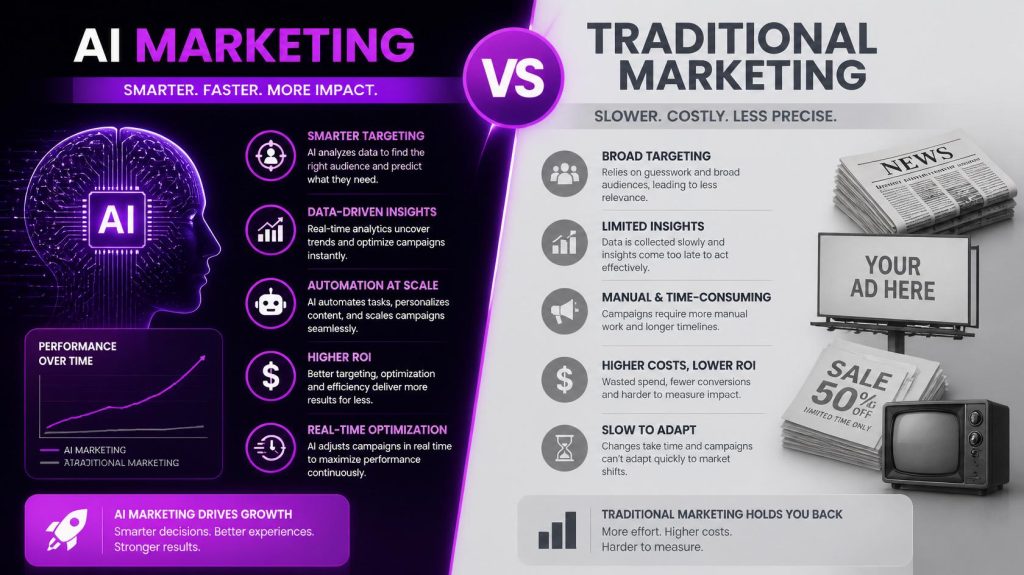
Introduction Every business eventually asks the same question: should we invest in AI marketing, stick with traditional marketing, or do both? The debate around AI vs traditional marketing has become one of the most important strategic decisions a business can make in 2026, because the two approaches work in fundamentally different ways. AI marketing uses machine learning, automation, and data to personalize campaigns, predict customer behavior, and optimize results in real time. Traditional marketing relies on established offline channels like TV, radio, print, and direct mail to build brand recognition and trust over time. Both have real strengths, and both have real limits. Businesses compare AI vs traditional marketing because budgets are limited and the wrong choice wastes both time and money. A startup with a small budget has very different needs than an established enterprise with decades of brand equity and a loyal offline customer base. In this guide, you’ll learn exactly what AI marketing and traditional marketing are, see a detailed side-by-side comparison, review the advantages and disadvantages of each approach, explore the best AI marketing tools of 2026, and get a clear recommendation on which strategy — or hybrid combination — fits your business best. We’ll also walk through real-world examples, a dedicated breakdown for small businesses, expert tips for adopting AI without losing your brand’s human touch, and a detailed FAQ section covering the questions business owners ask most often about AI vs traditional marketing. What Is AI Marketing? AI marketing is the use of artificial intelligence technologies — including machine learning, natural language processing, and predictive analytics — to plan, personalize, automate, and optimize marketing campaigns. Instead of manually managing every message and ad, AI marketing systems learn from data and adjust in real time. How AI Marketing Works AI marketing platforms collect data from customer interactions — website visits, purchase history, email opens, ad clicks — and use algorithms to identify patterns. Those patterns power decisions like which offer to show a specific customer, when to send an email, or which ad creative is likely to perform best. Key AI Technologies Used in Marketing Automation: handling repetitive tasks like email sequences, ad bidding, and social scheduling Machine learning: improving targeting and recommendations as more data is collected Predictive analytics: forecasting which customers are likely to buy, churn, or respond to an offer Personalization engines: tailoring content, offers, and product recommendations to each individual Together, these technologies let a small marketing team run campaigns that once required a much larger staff, while reacting to customer behavior in near real time instead of waiting for a monthly report. What Is Traditional Marketing? Traditional marketing refers to offline advertising and promotional methods that existed long before digital channels — and that still play a meaningful role today. It focuses on reaching broad or local audiences through physical and broadcast media. Common Traditional Marketing Channels TV ads: broad reach and strong brand-building through sight, sound, and motion Radio: cost-effective local reach, especially for drive-time audiences Newspapers: credibility and targeted local or industry-specific readership Billboards: constant visibility in high-traffic physical locations Flyers: low-cost, hyper-local promotion for events and small businesses Direct mail: physical, tangible offers that stand out in an inbox-fatigued world Events: face-to-face relationship building through trade shows, sponsorships, and community events Traditional marketing tends to build long-term brand recognition and trust, especially in communities and demographics that still respond strongly to offline media. Advantages of AI Marketing AI marketing offers real, measurable benefits when it’s implemented with clear goals rather than adopted just because it’s trendy. Automation AI handles repetitive tasks like scheduling posts, sending follow-up emails, and adjusting ad bids, freeing up time for strategy and creative work. A retail brand, for example, can automate abandoned-cart emails that send themselves within minutes of a customer leaving the site. Personalization AI can tailor product recommendations, email content, and website experiences to each visitor based on their behavior, which increases the likelihood of conversion compared to generic messaging. Better Targeting Machine learning models identify which audience segments are most likely to convert, helping businesses spend ad budgets on people who are actually likely to buy rather than a broad, unfiltered audience. Cost Savings By automating manual work and improving targeting accuracy, AI marketing often reduces wasted ad spend and the need for a large in-house team to run every campaign manually. 24/7 Customer Support AI chatbots answer common questions instantly at any hour, which improves customer experience and reduces the load on human support teams. Disadvantages of AI Marketing Initial Investment Quality AI tools, integrations, and training require upfront spending, which can be a barrier for very small businesses without existing marketing infrastructure. Learning Curve Teams need time to learn how to use AI tools effectively, interpret their outputs correctly, and avoid over-relying on automated suggestions. Privacy Concerns AI marketing depends heavily on customer data, which raises privacy questions and requires careful compliance with data protection regulations. Data Dependency AI systems are only as good as the data they’re trained on. Incomplete or biased data leads to inaccurate predictions and poor targeting decisions. Lack of Emotional Intelligence AI can personalize based on data, but it cannot fully replicate genuine human empathy, humor, or the emotional nuance that builds deep brand loyalty. Advantages of Traditional Marketing Brand Trust Established channels like TV and print often carry a sense of credibility and permanence that purely digital campaigns can take longer to build. Personal Interaction Face-to-face events and in-person sales conversations build relationships that are difficult to replicate through automated digital channels. Local Marketing Flyers, local radio, and community sponsorships remain highly effective for reaching a specific neighborhood or regional audience. Strong Emotional Connection A well-produced TV commercial or a memorable print campaign can create lasting emotional impressions that stick with audiences for years. Better Offline Visibility Billboards, transit ads, and in-store displays reach people throughout their day, independent of whether they are online or using a device. Disadvantages of Traditional Marketing High Cost TV spots, print placements, and large-scale

Digital Marketing Trend

Digital Marketing Trends for Businesses

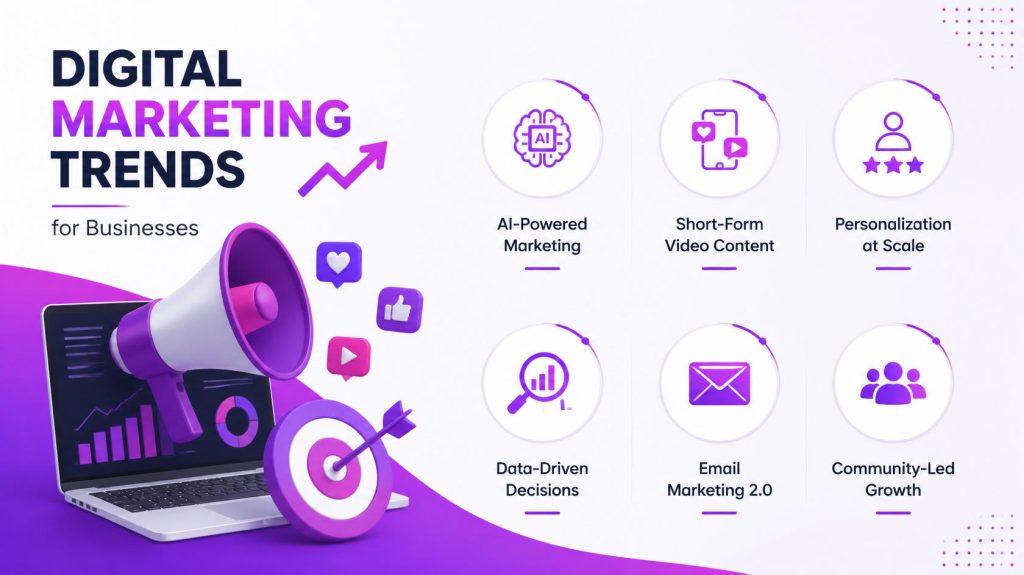
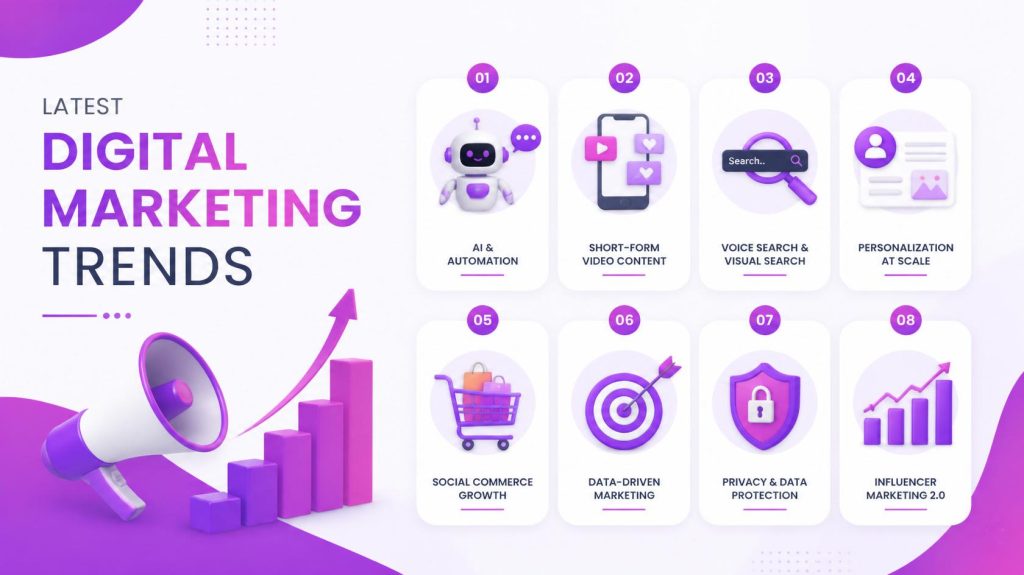
Introduction Digital marketing no longer moves in yearly cycles. It moves in weeks. Search engines rewrite their algorithms, social platforms change how content gets seen, and artificial intelligence tools reshape entire workflows almost overnight. For business owners, marketers, startups, and entrepreneurs, this pace of change is not a side note — it is the main story of 2026. A few years ago, a solid SEO strategy and a consistent posting schedule were enough to keep a brand visible. That is no longer true. AI-powered search results, voice assistants, short-form video, and privacy-first data rules have changed how customers discover, evaluate, and buy from businesses. Companies that adapt early capture attention and market share. Companies that wait get left behind, often without realizing it until their traffic and sales numbers tell the story. This guide breaks down the digital marketing trends for businesses that matter most in 2026 — from AI in marketing and SEO for AI search engines, to video, social media, email automation, personalization, and local SEO. You will also find a practical strategy framework, a 30-day action plan, common mistakes to avoid, a comparison table of the top trends, and a detailed FAQ section built for both readers and search engines. Whether you run a small local business, manage marketing for a growing startup, or lead a marketing team at an established company, this article gives you a clear, actionable roadmap for building a digital marketing strategy that works in 2026 and beyond. What Are Digital Marketing Trends? Digital marketing trends are the shifts in technology, consumer behavior, and platform algorithms that change how businesses reach, engage, and convert customers online. They span everything from new AI tools and search engine updates to changes in how people use social media, video, and messaging apps. Why These Trends Matter Trends matter because they reflect where your customers’ attention is actually going. A business that keeps using 2022 tactics in 2026 is talking to an audience that has already moved on. Following digital marketing trends for businesses is not about chasing every shiny new tool — it is about understanding which shifts are structural (like AI search) and which are temporary fads. Key Benefits of Following Digital Marketing Trends Higher visibility in search engines and AI-powered answer engines Better customer engagement through personalized, relevant content Improved return on ad spend (ROAS) through smarter targeting Stronger brand trust through transparency and authentic content A competitive edge over businesses that are slower to adapt In short, digital marketing trends are signals. Reading them correctly helps you invest your time and budget where it will actually generate growth. Why Businesses Must Follow Digital Marketing Trends in 2026 Several forces are converging in 2026 to make digital marketing trends more important than ever before. 1. The AI Revolution Generative AI has moved from novelty to infrastructure. Marketing teams now use AI for research, content drafts, ad copy variations, image generation, and customer support. Businesses that ignore AI spend more time and money to get the same or worse results as competitors who use it well. 2. Changing Consumer Behavior Customers research products differently than they did even two years ago. Many now start their buying journey with an AI chatbot, a short-form video, or a voice assistant instead of a traditional search bar. Marketing strategies built only around classic search behavior miss a growing share of the audience. 3. Search Engine Changes Search engines increasingly generate direct, AI-written answers instead of just showing ten blue links. This shift, often called AI Overviews or the Search Generative Experience, changes what it means to rank — visibility now includes being cited or summarized by an AI answer, not just appearing on page one. 4. Privacy Regulations and the Cookie-less Shift Third-party cookies are being phased out, and privacy laws around the world are tightening. Businesses that rely on old tracking methods are losing data accuracy, which makes first-party data collection and consent-based marketing essential, not optional. 5. Rising Competition More businesses are online than ever before, and many are experimenting with AI tools to move faster. Standing still is the same as falling behind, because your competitors are actively testing new channels, formats, and automation. Top Digital Marketing Trends for Businesses in 2026 Below are the 15 digital marketing trends shaping strategy for businesses of every size in 2026. Each trend includes what it means in practice, its benefits, its challenges, and best practices you can apply right away. 1. Artificial Intelligence (AI) in Marketing AI has become the backbone of modern marketing operations. Instead of replacing marketers, it removes repetitive work and speeds up decision-making. AI Tools and Use Cases AI content assistants for drafting blogs, ads, and product descriptions AI chatbots that handle customer questions around the clock AI automation for scheduling posts, sending emails, and tagging leads AI personalization engines that tailor offers to each visitor Benefits Faster content production without sacrificing quality when reviewed by humans Lower customer service costs through automated first-response support More precise targeting based on behavior patterns Challenges Generic, unedited AI content can feel repetitive and hurt trust Over-reliance on AI without human review can introduce factual errors Best Practices Use AI for first drafts, then edit with real expertise and examples Keep a human reviewing every customer-facing message before it goes out Track which AI-assisted campaigns actually perform better, and refine from there 2. SEO for AI Search Engines Search is no longer just about ranking in a list of links. AI Overviews and generative search experiences summarize answers directly on the results page, often pulling from a small number of trusted sources. What This Means for Your Content Clear, well-structured answers are more likely to be cited by AI Overviews Google’s EEAT standard — Experience, Expertise, Authoritativeness, Trustworthiness — matters more than ever Helpful, original content outperforms thin, keyword-stuffed pages Optimization Tips Answer the core question in the first two sentences of a section Use structured headings, bullet points, and tables that AI systems can

Digital Marketing Trend

AI Trends in Digital Marketing

AI Trends in Digital Marketing: The Complete Guide for 2026 Artificial intelligence is no longer an experimental add-on to marketing strategy — it’s the infrastructure most marketing teams now build on. From drafting a blog post in seconds to predicting which customers are about to churn, AI trends in digital marketing have moved from “interesting to watch” to “essential to use.” In simple terms, AI refers to computer systems that can perform tasks — writing, analyzing, predicting, personalizing — that once required direct human input. In marketing specifically, that means faster content production, sharper targeting, and campaigns that adjust themselves based on real-time data rather than a quarterly review. The shift has happened quickly. Multiple industry surveys now put generative AI adoption among marketers well above 80%, up from roughly half that just two years ago — a pace of adoption faster than almost any prior marketing technology. Whether you run a small business or manage marketing for an enterprise brand, understanding these trends isn’t optional anymore; it’s how you stay competitive. This guide walks through what AI in digital marketing actually means, the trends shaping 2026, the tools worth evaluating, and how to start implementing AI without losing the human judgment that still makes marketing work. What Is AI in Digital Marketing? AI in digital marketing is the application of machine learning, natural language processing, and data-driven prediction to marketing tasks — content creation, customer segmentation, ad targeting, and performance analysis among them. Instead of manually testing every headline or manually segmenting every list, marketers can let AI systems process far more data, far faster, than a human team could alone. Under the hood, most marketing AI tools rely on a few core technologies: large language models for text generation, machine learning models for prediction and scoring, and recommendation engines for personalization. Companies like Netflix, Amazon, and Spotify popularized consumer-facing AI personalization years ago; what’s new is that this same technology is now accessible to businesses of any size through affordable software rather than custom-built systems. In practice, this shows up as a chatbot answering a customer’s question at 2 a.m., an email platform choosing the best send time for each subscriber, or a content tool suggesting the exact topics your competitors are ranking for that you aren’t. Why AI Is Changing Digital Marketing Automation: Repetitive tasks — reporting, list segmentation, ad bidding — no longer require manual execution. Better customer experience: Faster response times and more relevant content improve how customers perceive a brand. Deeper data analysis: AI can process behavioral data at a scale no human team could review manually. Predictive marketing: Teams can act on what’s likely to happen next, not just what already happened. Personalization at scale: Individual-level targeting is now achievable across thousands or millions of customers. Improved ROI: Campaigns optimize continuously instead of waiting for a manual review cycle. Sharper targeting: Audiences can be defined and refined using behavioral signals, not just demographics. Faster campaign optimization: Underperforming creative or targeting can be adjusted in near real time. Top AI Trends in Digital Marketing in 2026 Here’s a closer look at the AI trends having the biggest measurable impact on marketing teams this year. 1. Generative AI for Content Creation Generative AI has moved from novelty to default workflow inside most marketing teams. Tools like ChatGPT, Claude, and Gemini are now used to draft blog posts, product descriptions, ad copy, landing page variations, video scripts, and email sequences. The advantage isn’t just speed — it’s the ability to test more creative variations before a human editor commits final judgment. Benefit: Cuts first-draft time from hours to minutes, freeing writers to focus on strategy, editing, and brand voice. Business use case: An e-commerce brand uses generative AI to produce hundreds of unique product descriptions at scale, then has editors refine tone and accuracy. Best tools: ChatGPT, Claude, Gemini, Jasper, Copy.ai Actionable tip: Build a brand-voice prompt template so every AI-assisted draft starts from consistent tone, audience, and formatting rules — then always have a human pass for accuracy and originality. 2. AI-Powered SEO AI has reshaped keyword research, search intent mapping, and on-page optimization. Modern SEO tools use machine learning to cluster topics, identify semantic gaps in existing content, and recommend internal linking structures that build topical authority rather than just chasing individual keywords. Benefit: Faster identification of content gaps and stronger topical authority. Business use case: Agencies use AI-assisted clustering to build full topic hubs instead of one-off blog posts, improving rankings across an entire content silo. Best tools: Surfer SEO, Ahrefs, SEMrush, Clearscope Actionable tip: Use AI to generate a topic cluster map first, then write pillar and supporting content around it — this signals topical depth to search engines. 3. AI Chatbots and Virtual Assistants AI chatbots now handle a meaningful share of front-line customer interactions — answering FAQs, qualifying leads, and guiding shoppers to the right product before a human ever steps in. Conversational AI has become noticeably better at understanding intent and context compared to the scripted bots of a few years ago. Benefit: 24/7 support availability and faster lead qualification. Business use case: A retail site deploys a chatbot that recommends products based on a shopper’s stated preferences, reducing bounce rate on category pages. Best tools: Intercom, Drift, HubSpot AI chat, Tidio Actionable tip: Start with a narrow use case (order status, FAQs) before expanding your chatbot into full sales conversations. 4. Predictive Analytics Predictive analytics uses historical data and machine learning to forecast what customers are likely to do next — from the probability they’ll churn to which products they’re likely to buy. Marketing teams use these models to prioritize spend on the segments most likely to convert. Benefit: More efficient ad spend and earlier intervention on at-risk customers. Business use case: A SaaS company flags accounts with declining product usage and triggers a retention campaign before the renewal date. Best tools: HubSpot AI, Salesforce Einstein, Google Analytics 4 predictive metrics Actionable tip: Start with churn prediction

Digital Marketing Trend

Future of Digital Marketing

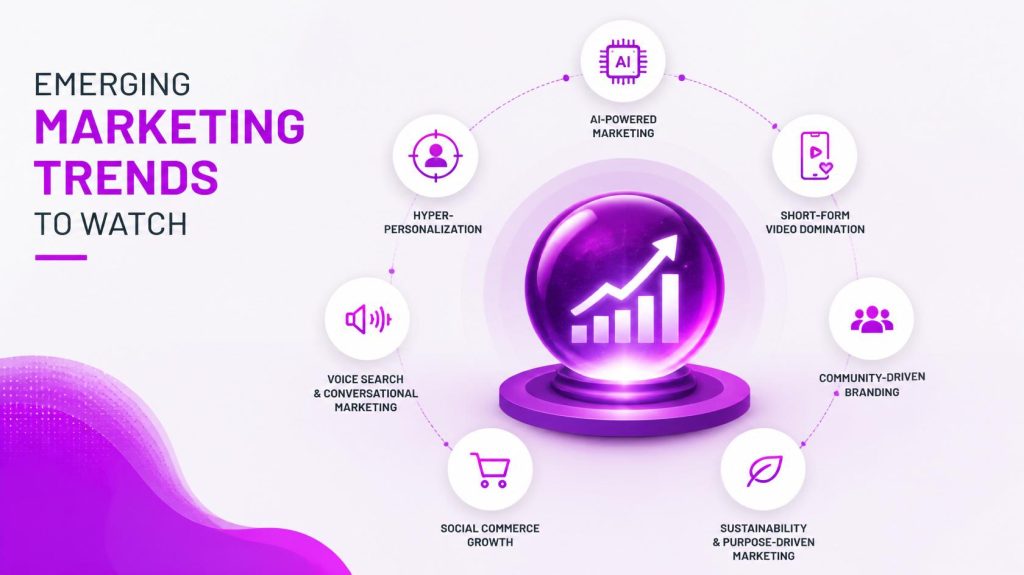
Introduction Here’s a number worth sitting with: businesses that lean into AI-driven personalization are seeing conversion lifts of well over 20% compared to generic campaigns, and global digital ad spend is on pace to cross the $700 billion mark within the next couple of years. Digital marketing isn’t evolving anymore — it’s sprinting. What worked in 2022 barely works today, and what works today will likely need a rewrite by 2027. The reasons are stacking up fast. Generative AI has moved from novelty to daily workflow. Google’s search results now blend AI-generated summaries with traditional links. Consumers expect brands to know them instantly, yet they’re more protective of their data than ever. Add in the death of third-party cookies, the explosion of short-form video, and algorithm updates that seem to land every quarter, and you have an industry that punishes anyone standing still. This guide breaks down exactly where digital marketing is headed — the technologies driving it, the channels worth your time, the skills that will matter, and the mistakes that quietly sink otherwise-solid strategies. Whether you’re a business owner planning next year’s budget, a freelancer building a service offer, or a student trying to pick a specialization, you’ll walk away with a clear, practical picture of the future of digital marketing and how to prepare for it. 1. What Is Digital Marketing? Digital marketing is the practice of promoting products, services, or brands through digital channels — search engines, social media, email, websites, apps, and paid ads — instead of relying solely on traditional media like print, television, or radio. It covers everything from a blog post optimized for search engines to a paid ad retargeting someone who abandoned a shopping cart. Why It Matters Unlike traditional marketing, digital marketing is measurable in real time. You can see exactly how many people saw an ad, clicked it, and bought something — then adjust your spend within hours instead of waiting for a quarterly report. That feedback loop is why digital channels now absorb the majority of most companies’ marketing budgets. The Current Landscape Today’s landscape is dominated by a handful of forces: search engines are answering questions directly instead of just linking out, social platforms have become discovery engines and storefronts, and AI tools are compressing tasks that used to take a team days into something one person finishes before lunch. Businesses that once treated a website and a Facebook page as “enough” now need a coordinated presence across search, social, email, and increasingly, AI chat interfaces. Why do businesses rely on it so heavily? Because it’s cost-efficient, targetable, and scalable — a small business can compete with a global brand on the same search results page if its content and SEO are strong enough. 2. Why Digital Marketing Is Evolving So Fast Several forces are converging at once, and together they explain why the pace of change feels relentless. The AI revolution: Generative AI now writes copy, designs creative, analyzes data, and even negotiates ad bids in real time — collapsing timelines that used to take weeks. Shifting consumer behavior: People research on TikTok, buy on Instagram, and expect answers instantly from AI chat tools rather than scrolling through ten blue links. Constant Google algorithm updates: Search algorithms now weigh experience, expertise, authority, and trust (E-E-A-T) alongside AI-generated summaries, forcing marketers to rethink what “ranking well” even means. Privacy regulations: Laws like GDPR and CCPA, plus the phase-out of third-party cookies, are pushing marketers toward consent-based, first-party data strategies. Automation: Marketing automation platforms now handle segmentation, bidding, and send-time optimization without a human touching every decision. Mobile-first users: The majority of searches and purchases now happen on phones, forcing brands to design for small screens, fast load times, and voice input first. 3. The Future of Digital Marketing The next phase of digital marketing is less about adding more channels and more about making every channel smarter, faster, and more personal. Six themes will define this shift. AI-Powered Marketing AI is moving from a helper tool to the operating layer of marketing itself — writing first drafts, generating ad variations, predicting churn, and optimizing budgets across channels without waiting for a human to log in. Predictive Analytics Instead of reporting what already happened, predictive models will forecast which customers are about to churn, which leads are worth a sales call, and which creative will fatigue first — letting marketers act before a problem shows up in the numbers. Hyper-Personalization Generic email blasts are giving way to dynamic content that changes based on browsing history, purchase patterns, and even the time of day someone opens an email. The bar for “relevant” keeps rising. Marketing Automation Automation platforms are getting smarter about intent, not just triggers — moving from “send this email three days after signup” to “send this email when behavior suggests the customer is ready.” Data-Driven Campaigns Every decision, from subject lines to ad creative, is increasingly tested and validated with data rather than gut instinct, thanks to cheaper and faster analytics tools. Customer Journey Optimization Brands are mapping the entire path — from the first social impression to post-purchase support — as one connected experience instead of separate campaigns run by separate teams. 4. Top Digital Marketing Trends for 2026 and Beyond These are the trends worth building a strategy around right now. Artificial Intelligence AI now touches nearly every stage of marketing — from audience research to ad optimization — making it the foundation trend beneath most others on this list. Generative AI Tools that draft copy, generate images, and produce video are compressing content production timelines from weeks to hours, though human editing remains essential for quality and trust. Voice Search As smart speakers and voice assistants become everyday tools, optimizing for natural, conversational queries is becoming as important as traditional keyword targeting. Visual Search Apps that let users search by uploading a photo (finding similar products, identifying plants, comparing prices) are turning images into a new kind of search query. Video Marketing

Digital Marketing Trend

Latest Digital Marketing Trends

Introduction Digital marketing does not stand still. Every year, new platforms rise, algorithms shift, consumer habits evolve, and yesterday’s best practice quietly becomes today’s outdated tactic. In 2026, that pace of change has only accelerated, driven largely by artificial intelligence, changing search behavior, and a generation of consumers who expect brands to be fast, authentic, and personal. For business owners, marketers, startups, and students alike, staying current is no longer optional. A strategy that worked beautifully in 2023 can quietly stop delivering results today if it hasn’t adapted to how people now search, scroll, and shop. Recent industry surveys consistently show that companies investing in AI-driven marketing, video content, and first-party data collection are outpacing competitors who haven’t updated their playbooks. This guide walks through the fifteen most important digital marketing trends for 2026 — from AI and search engine optimization to influencer partnerships, marketing automation, and the early signs of what’s coming next. Whether you’re building a marketing strategy from scratch or refining an existing one, you’ll find practical, actionable guidance you can apply right away. 1.Artificial Intelligence (AI) in Digital Marketing AI has moved from an experimental add-on to the backbone of modern digital marketing. Tools like ChatGPT, Claude AI, and Gemini are now used daily by marketing teams to brainstorm campaigns, draft copy, summarize research, and analyze customer data at a speed no human team could match alone. Where AI Is Making the Biggest Impact AI content creation: drafting blog outlines, ad copy, product descriptions, and email sequences in minutes AI automation: triggering personalized messages based on real-time user behavior AI image and creative generation: producing on-brand visuals and ad variations at scale AI-powered ad platforms: Google Performance Max and Meta Advantage+ use machine learning to optimize targeting and bidding automatically AI chatbots and virtual assistants: handling customer queries, qualifying leads, and guiding purchases 24/7 The benefit isn’t that AI replaces marketers — it’s that AI removes repetitive work so teams can focus on strategy, creativity, and relationship-building. A small business using Claude AI to draft first versions of blog posts, for example, can publish consistently without hiring a full content team, while still applying human judgment for accuracy, tone, and brand voice. 2. SEO Trends in 2026 Search engine optimization has shifted from keyword-stuffing tactics toward genuinely helpful, expert-backed content. Google’s ongoing algorithm updates increasingly reward pages that demonstrate real experience and answer the searcher’s actual intent. Key SEO Trends to Watch Helpful Content and search intent: content must directly solve the reader’s problem, not just target a keyword EEAT (Experience, Expertise, Authoritativeness, Trustworthiness): author bios, credentials, and citations matter more than ever Semantic SEO and topic clusters: covering a subject comprehensively across linked pillar and cluster pages Internal linking: guiding both users and search engines through related content Featured snippets and zero-click searches: structuring answers so they can be pulled directly into search results Technical SEO and Core Web Vitals: page speed, mobile usability, and stability directly affect rankings Structured data (schema markup): helping search engines understand and richly display your content AI SEO and Search Generative Experience (SGE): optimizing content to be cited by AI-generated search summaries, not just ranked in the traditional ten blue links The rise of zero-click searches means many users now get their answer directly on the results page without clicking through. Rather than fighting this trend, smart brands optimize for visibility within AI overviews and snippets while building content depth that still earns clicks for more complex queries. 3. Voice Search Optimization Smart speakers and voice assistants have normalized spoken search queries, which tend to be longer and more conversational than typed ones. Someone typing might search “best pizza NYC,” while the same person speaking to a smart speaker might ask, “What’s the best pizza place near me that’s open right now?” How to Optimize for Voice Search Target long-tail, question-based keywords that mirror natural speech Write conversational content that reads the way people actually talk Build a strong FAQ section answering common questions in full sentences Keep answers concise and direct, since voice assistants typically read out only one result Optimize local listings, since a large share of voice searches are location-based 4. Video Marketing Short-form video continues to dominate attention across nearly every platform. YouTube Shorts, Instagram Reels, and TikTok have trained audiences to expect fast, engaging, snackable content, while long-form video and live streaming still play a critical role in building trust and authority. Where to Focus Your Video Strategy YouTube Shorts and long-form YouTube video for searchable, evergreen reach Instagram Reels and TikTok for discovery-driven, algorithm-boosted engagement LinkedIn video for B2B thought leadership and personal branding Live streaming for real-time Q&A sessions, product launches, and community building Video SEO: optimizing titles, descriptions, captions, and transcripts so videos rank in search Real-world example: Netflix regularly uses short, highly shareable video clips across social platforms to promote new releases, turning individual scenes into standalone marketing assets rather than relying only on traditional trailers. 5. Social Media Marketing Trends Organic reach on social platforms has become harder to earn, pushing brands to focus on genuine community building rather than broadcast-style posting. At the same time, social platforms are increasingly functioning as search engines in their own right, and social commerce is turning feeds into storefronts. Platform-by-Platform Focus Instagram: Reels, Stories, and shoppable posts for discovery and direct sales Facebook: community groups and local business engagement LinkedIn: B2B networking, thought leadership, and employee advocacy X: real-time conversation, customer service, and industry commentary Threads: lightweight, conversational brand presence Pinterest: visual discovery for product-based and lifestyle brands Social SEO — optimizing captions, hashtags, and video content so it surfaces in in-app search — has become just as important as traditional SEO, since many younger users now search for recommendations directly on social platforms instead of Google. 6. Influencer Marketing Influencer marketing has matured well beyond celebrity endorsements. Brands now increasingly favor nano influencers (1,000–10,000 followers) and micro influencers (10,000–100,000 followers) because of their highly engaged, niche audiences and more affordable

Digital Marketing Trend

Top Digital Marketing Trends in 2026

Introduction A few years ago, ranking on Google mostly meant stuffing the right keywords into a page and building a few backlinks. That world is gone. Today, a shopper might ask an AI assistant for a product recommendation and buy it without ever clicking a traditional search result. A small bakery might get more customers from a 20-second video than from a year of flyers. This is the reality of digital marketing in 2026 — faster, smarter, and driven by artificial intelligence at almost every step. The Top Digital Marketing Trends in 2026 are shaped by three forces: the rise of AI-powered search and content tools, Google’s continued push toward genuinely helpful content, and a privacy-first internet where third-party cookies no longer run the show. Consumer behavior has changed too — people expect instant answers, personalized experiences, and authentic brands, not generic sales pitches. Businesses that adapt to these shifts are winning more visibility, trust, and revenue. Businesses that don’t are quietly losing ground, even if their traffic numbers look stable on paper. This guide breaks down exactly what’s changing, why it matters, and how you can apply it — whether you run a local shop, manage an agency, or are just starting to learn digital marketing. What is Digital Marketing? Digital marketing is the practice of promoting products, services, or brands using digital channels — search engines, social media, email, websites, apps, and increasingly, AI-powered platforms. Instead of one-way ads like TV commercials or billboards, digital marketing allows two-way, measurable, and highly targeted communication with an audience. Why it matters: Digital channels now account for the majority of global ad spending, and that share keeps growing every year as more buying decisions start online — often with a search engine, a social feed, or an AI chatbot instead of a physical store visit. Current market snapshot: Global digital ad spend continues to outpace traditional media spend by a wide margin. Mobile devices generate the majority of web traffic worldwide. Short-form video and AI-driven search results are capturing a growing share of consumer attention that used to belong to traditional search listings. In short, digital marketing in 2026 isn’t a “channel” anymore — it’s the primary way most businesses are discovered, evaluated, and chosen. 10 Top Digital Marketing Trends in 2026 Trend 1: AI-Powered Marketing What it is: AI-powered marketing uses machine learning and generative AI across the entire marketing function — from predicting which customers are likely to buy, to personalizing website content in real time, to optimizing ad bids automatically. Why it matters: AI can process far more customer data than any human team, spotting patterns that lead to better targeting and higher conversion rates. Benefits: Faster decision-making, more accurate targeting, reduced manual workload, and the ability to personalize experiences at scale. Example: Amazon has long used AI-driven recommendation engines to suggest products, and platforms like Netflix use similar models to personalize content suggestions for each viewer. Best practices: Start with one use case (like predictive lead scoring), measure results, then expand. Keep a human reviewing AI outputs before they go live. Mistakes to avoid: Treating AI as fully “set and forget,” or feeding it poor-quality data and expecting good results. Tools: HubSpot AI, Salesforce Einstein, Google Performance Max. Future prediction: AI will move from a support tool to the default operating layer for marketing decisions across nearly every industry. Trend 2: AI Content Creation What it is: Using generative AI tools to draft blog posts, ad copy, product descriptions, and social captions faster than manual writing alone. Why it matters: Content demand keeps rising, but marketing teams rarely get bigger budgets or headcount. AI closes that gap. Benefits: Faster production, more content variations for testing, and support for teams without large writing staff. Example: Agencies and in-house teams commonly use tools like Claude or ChatGPT to draft first versions of blogs, then have human editors refine tone, accuracy, and brand voice. Best practices: Always have a human fact-check and edit AI drafts. Add original data, quotes, or experience AI can’t generate on its own. Mistakes to avoid: Publishing unedited AI text, which often reads generic and can hurt reader trust and search rankings. Tools: Claude, ChatGPT, Jasper, Copy.ai. Future prediction: The winners won’t be who uses AI, but who combines AI speed with genuine human expertise and editing. Trend 3: Google AI Overviews What it is: AI-generated summary boxes that appear at the top of Google search results, answering a query directly using information pulled from multiple sources. Why it matters: These summaries can reduce clicks to traditional websites, even for pages that rank well organically — a shift often called “zero-click search.” Benefits (for brands that adapt): Being cited inside an AI Overview can still drive brand visibility and trust, even without a click. Example: Searching a product comparison query often now returns a Google AI Overview summarizing options before any traditional blue links appear. Best practices: Structure content with clear, direct answers near the top of the page, use headers that match real questions, and back claims with credible sources. Mistakes to avoid: Writing long, unstructured intros that bury the actual answer to the reader’s question. Tools: Google Search Console, Semrush AI toolkit, Surfer SEO. Future prediction: AI Overviews will expand to cover more query types, making “answer-first” content structure essential. Trend 4: SEO for AI Search Engines What it is: Optimizing content not just for Google’s traditional algorithm, but for AI-driven answer engines like ChatGPT search, Perplexity, and Google’s AI features — sometimes called “answer engine optimization.” Why it matters: More people are getting information directly from AI chat tools instead of scrolling search results. Benefits: Being featured as a source in AI answers builds authority and can drive high-intent traffic. Example: Brands like HubSpot and Shopify are frequently cited by AI tools when users ask marketing or e-commerce questions, largely due to their clear, well-structured educational content. Best practices: Use clear headings, concise definitions, original data, and structured data markup so AI

Artificial inteligence

How to Use ChatGPT for SEO and Content Marketing

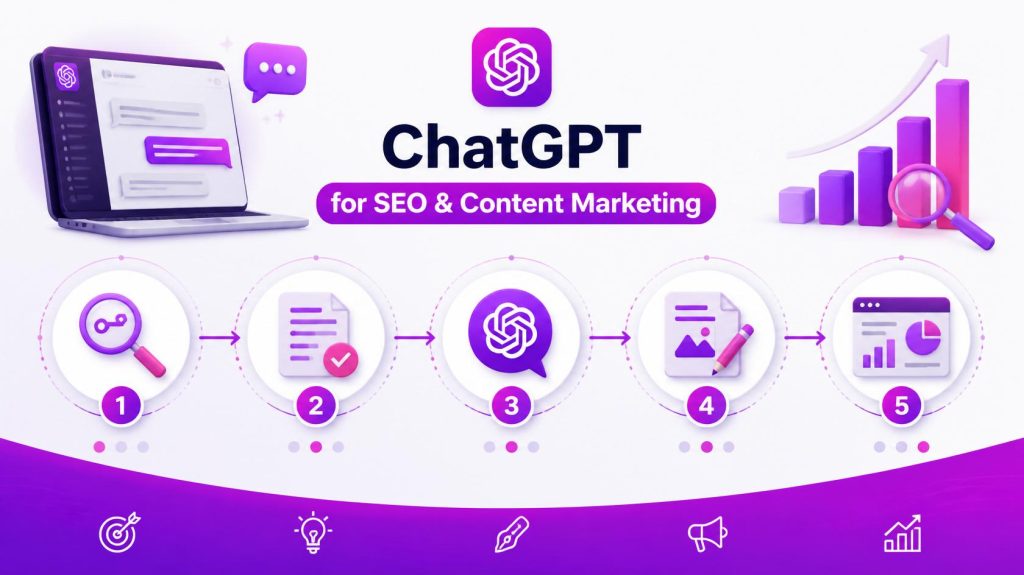
Introduction Artificial intelligence is no longer a concept of the future — it is the engine driving modern digital marketing right now. From automating repetitive tasks to generating entire content strategies in seconds, AI tools like ChatGPT have completely changed how businesses compete online. If you are a digital marketer, blogger, business owner, or content creator, chances are you have already heard of ChatGPT. But knowing it exists and knowing how to use it strategically for SEO and content marketing are two very different things. The numbers speak for themselves. Businesses that integrate AI into their content workflows are producing more content, ranking faster, and saving thousands of hours every year. Those who ignore AI risk falling behind competitors who are using it to scale at a pace that would have been impossible just a few years ago. In this comprehensive guide, you will learn: What ChatGPT is and how it works Why ChatGPT is critical for SEO and content marketing in 2026 Practical, step-by-step ways to use ChatGPT for every part of your SEO strategy The best prompts, workflows, and tools to maximize results Common mistakes to avoid and expert tips to stay ahead Whether you are just starting out or looking to sharpen your AI-powered marketing strategy, this guide covers everything you need to know. What is ChatGPT? ChatGPT is an AI-powered conversational tool developed by OpenAI. Built on large language model (LLM) technology, it can understand natural language input and generate human-like text responses on virtually any topic. At its core, ChatGPT is trained on massive datasets of text from the internet, books, and other sources. This training allows it to write, explain, summarize, translate, analyze, and answer questions across an enormous range of subjects — including SEO and digital marketing. ChatGPT vs. Traditional Search Engines Search engines like Google retrieve existing web pages based on your query. ChatGPT generates original responses based on patterns learned during training. Think of Google as a librarian that fetches books, while ChatGPT is an expert that explains the topic to you in real time. Free vs. Paid Versions ChatGPT Free (GPT-3.5): Good for basic tasks, content ideas, and drafting ChatGPT Plus / GPT-4o: Faster, smarter, with web browsing, image generation, and plugin support ChatGPT API: Ideal for developers building custom AI-powered tools and workflows Why Marketers Love ChatGPT It writes content drafts in seconds It brainstorms ideas without creative blocks It helps analyze competitors and keywords It adapts tone and style based on your instructions It works 24/7 without fatigue Why ChatGPT is Important for SEO and Content Marketing The average content marketer spends hours every week on repetitive tasks: researching keywords, writing outlines, drafting meta descriptions, and formatting blog posts. ChatGPT automates many of these tasks, freeing up time for higher-level strategy. Faster Workflows What used to take a full day — researching a topic, creating an outline, drafting a 2,000-word post — can now be completed in a fraction of the time. ChatGPT handles the heavy lifting so you can focus on editing, strategy, and creativity. Improved Productivity Marketers using ChatGPT consistently report completing 2-3x more content tasks per day. Whether it is generating social media captions, writing email sequences, or creating ad copy, AI multiplies your output without multiplying your team size. Better Brainstorming Creative block is real, and it costs businesses time and money. ChatGPT can generate hundreds of content ideas, blog titles, angles, and hooks in minutes — giving your team a constant supply of fresh inspiration. Content Ideation at Scale Want to build a 6-month editorial calendar? ChatGPT can generate a complete topic cluster strategy, pillar page ideas, and supporting article titles based on your niche and target keywords. Marketing Automation Support From drafting automated email sequences to generating chatbot scripts, ChatGPT integrates seamlessly into modern marketing automation workflows, saving both time and budget. How ChatGPT Helps in SEO Keyword Research ChatGPT is a powerful brainstorming partner for keyword research. While it does not have real-time search volume data, it can generate hundreds of keyword ideas, long-tail variations, LSI keywords, and semantic phrases that you can then validate in tools like Ahrefs or Semrush. Example prompt: “Generate 30 long-tail keywords for a plumbing services business in New York targeting homeowners.” Search Intent Analysis Understanding what a user actually wants when they type a query is the foundation of modern SEO. ChatGPT can classify keywords by intent (informational, navigational, commercial, transactional) and suggest content formats that best match each intent type. Content Planning ChatGPT excels at building content strategies. Provide your target niche, and it will map out pillar pages, topic clusters, subtopics, and supporting articles — essentially building your entire content architecture in minutes. SEO Blog Outlines One of the most popular uses is generating detailed blog outlines. ChatGPT creates structured outlines with H1, H2, and H3 headings, covering all the angles a well-optimized blog post should address — saving writers significant research time. Meta Titles Writing compelling, keyword-rich meta titles that stay under 60 characters is a skill ChatGPT handles exceptionally well. You can ask for multiple variations and choose the one that best balances the keyword and click-through appeal. Meta Descriptions ChatGPT writes click-worthy meta descriptions (150-160 characters) that include target keywords naturally and give users a compelling reason to click your search result over competitors. FAQs FAQ sections are goldmines for featured snippet rankings and voice search optimization. ChatGPT can generate 10, 20, or even 50 relevant FAQs for any topic, complete with concise answers optimized for Position Zero. Internal Linking Provide ChatGPT with your site’s list of articles or topics, and it will suggest logical internal linking opportunities — specifying which anchor texts to use and which pages to link to, improving both user experience and crawlability. Content Refresh Google rewards regularly updated content. ChatGPT can analyze an old blog post and suggest what to update: new statistics, expanded sections, improved headings, additional FAQs, and stronger CTAs to bring it back to peak performance. Schema Ideas ChatGPT understands structured

Artificial inteligence

Will AI Replace Digital Marketers?

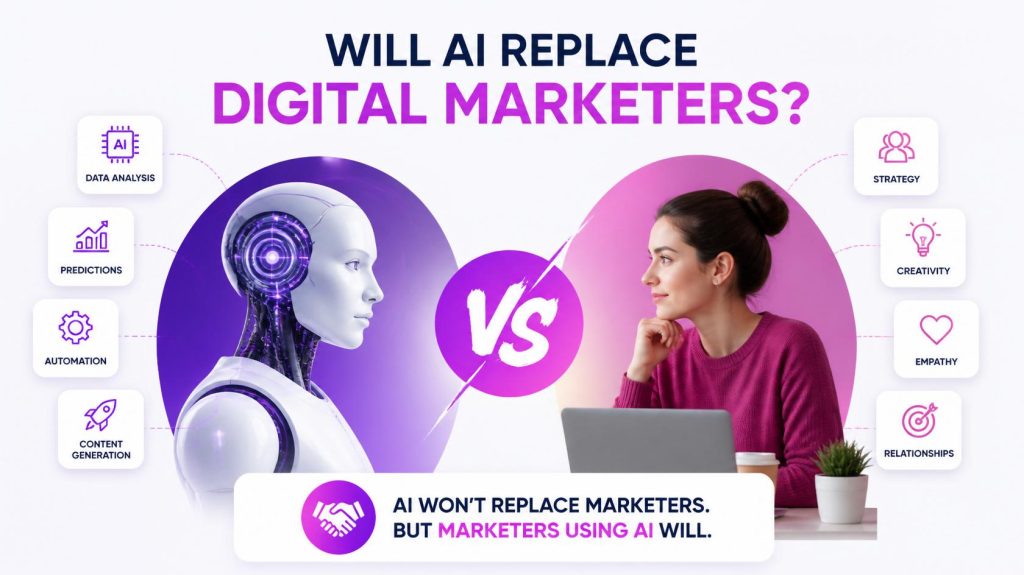
Introduction Ask that question in any marketing team meeting today, and you will get fifteen different opinions in under a minute. Since ChatGPT and other generative AI tools went mainstream, “will AI replace digital marketers?” has become one of the most searched, debated, and genuinely anxiety-inducing questions in the industry. It is not hard to see why. AI can now write a blog draft in seconds, generate a week of social captions before your coffee gets cold, and optimize an ad campaign’s bidding strategy faster than any human could manually adjust it. Businesses are adopting these tools at a rapid pace, not out of curiosity, but because the productivity gains are real and the competitive pressure to keep up is even more real. But speed and automation are not the same thing as replacement. In this guide, you will get an honest, balanced answer to whether AI is coming for marketing jobs — covering exactly what AI does better than humans, what humans still do better than AI, how AI is reshaping every major area of digital marketing, which jobs are most exposed, which new careers are emerging, the tools worth learning, and a practical, fifteen-point plan for staying relevant no matter how this technology evolves. What Is Artificial Intelligence in Digital Marketing? Before answering the big question, it helps to be precise about what we are actually talking about, since “AI” gets used as a catch-all term for several distinct technologies. Artificial Intelligence: Software that can perform tasks — like recognizing patterns or generating language — that typically required human intelligence. Machine Learning: A subset of AI where systems learn from data and improve their predictions over time, rather than following fixed, hand-written rules. Generative AI: AI models, like ChatGPT, Claude, and Gemini, that create new content — text, images, audio, or video — based on patterns learned from massive training data sets. Marketing Automation: Software that automatically executes repetitive marketing tasks, such as sending triggered emails or scheduling social posts, often using AI to decide timing and targeting. In practice, these technologies are already woven into daily marketing work: AI drafts emails, machine learning models score leads, generative AI produces ad creatives, and automation platforms run entire nurture sequences without a marketer touching a single send button. This is the baseline AI in digital marketing has already reached — and it is exactly why the replacement question feels so urgent. Why Is AI Becoming So Popular? Faster Work: Tasks that took hours, like drafting reports or writing first drafts, now take minutes. Better Analytics: AI models process large data sets and surface patterns that would take a human analyst far longer to find manually. Automation: Repetitive workflows — scheduling, tagging, basic reporting — now run with minimal manual input. Cost Savings: Producing more content and managing more campaigns no longer requires proportionally larger teams. Content Creation: Blog drafts, ad copy variations, and social captions can be generated in volume almost instantly. Personalization: AI tailors messaging, offers, and recommendations to individual users at a scale manual segmentation cannot match. Put simply, AI lets marketing teams do more, faster, with tighter budgets — which is precisely the combination every business is chasing. Will AI Replace Digital Marketers? Here is the short answer: no, AI is not on track to fully replace digital marketers — but it is absolutely replacing specific tasks within marketing roles, and that distinction matters enormously. Now the longer answer. AI is exceptional at well-defined, data-rich, repeatable tasks: drafting copy variations, analyzing large data sets, optimizing ad bids, and scheduling content. These are exactly the tasks AI is currently automating across marketing teams, and that automation is real and accelerating. What AI still struggles with is everything that depends on judgment shaped by lived experience: understanding subtle cultural context, building genuine trust with a client or customer, making an ethical call in a gray area, or originating a creative concept nobody has tried before. These are not minor gaps — they are the core of what separates good marketing from forgettable marketing, and they are precisely where human marketers remain irreplaceable. The realistic outcome, already playing out across the industry, is a shift in what the marketer’s job looks like rather than the disappearance of the job itself. AI becomes the engine for execution and analysis; humans become the strategists, editors, and relationship-builders directing that engine. Marketers who adapt to that shift are thriving. Those who ignore it are the ones genuinely at risk — not from AI itself, but from competitors who learned to use it well. What AI Can Do Better Than Humans Data Analysis: AI processes large volumes of customer and campaign data far faster than any human analyst, spotting patterns in minutes rather than days. Keyword Research: AI tools surface keyword opportunities and search volume trends across thousands of terms in seconds. SEO Suggestions: AI-powered SEO tools score content against top-ranking competitors and flag specific gaps to fix. Email Automation: AI personalizes subject lines, send times, and content for thousands of subscribers simultaneously. Ad Optimization: AI adjusts ad bids in real time based on auction conditions far faster than manual bid management. Image Generation: AI tools like Midjourney and Canva AI produce campaign visuals in minutes instead of days. Predictive Analytics: AI models forecast customer behavior, like churn risk or purchase likelihood, from historical patterns. Customer Segmentation: AI groups customers into precise micro-segments based on behavior that would be tedious to sort manually. For example, an e-commerce brand might use AI to analyze a year of purchase data, identify which customers are likely to churn next month, and automatically trigger a personalized win-back email — all without a marketer manually reviewing a single spreadsheet. What Humans Still Do Better Than AI Creativity: Original ideas, unexpected angles, and genuinely new creative concepts still come from human imagination, not pattern-matching. Emotional Intelligence: Reading a client’s unstated concerns or a customer’s frustration in tone requires emotional awareness AI does not genuinely possess. Storytelling: Crafting a

Artificial inteligence

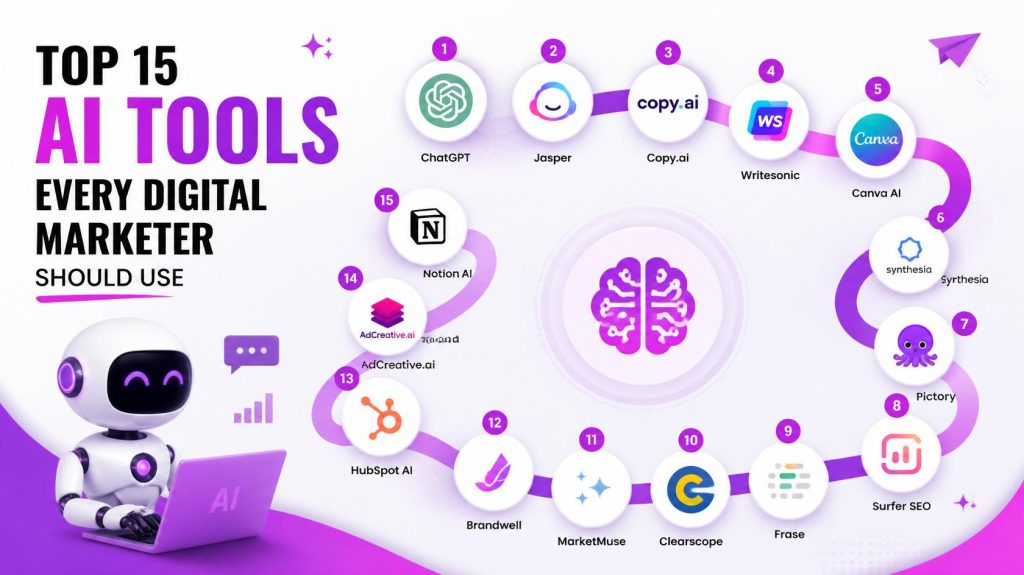
Top 15 AI Tools Every Digital Marketer Should Use

Introduction A few years ago, “AI tools for digital marketing” meant a handful of niche chatbots and a couple of clunky automation plugins. In 2026, AI sits at the center of almost every serious marketing stack — drafting content, optimizing it for search, designing the visuals around it, automating the campaigns that promote it, and analyzing the results, often before a human even opens their laptop. Marketers are not adopting AI because it is trendy. They are adopting it because teams using the right AI tools are publishing more content, ranking faster, running smarter ad campaigns, and responding to customers quicker than teams still doing everything manually. The gap between AI-assisted teams and everyone else keeps widening every quarter. That is exactly why this guide exists. Below, you will find a detailed breakdown of the 15 AI tools every digital marketer should know in 2026 — what each one does, who it is genuinely best for, its real strengths and weaknesses, realistic pricing expectations, and a practical use case for each. You will also get a side-by-side comparison table, guidance on choosing the right tool for your situation, the biggest risks to watch for, expert tips, common mistakes, and answers to the questions marketers ask most. What Are AI Marketing Tools? AI marketing tools are software platforms that use artificial intelligence — most commonly machine learning and natural language processing — to handle marketing tasks that would otherwise require significant manual time and effort. Artificial intelligence, in this context, simply means software that can learn patterns from data and make decisions or generate content without being explicitly programmed for every single scenario. Machine learning is the technique that allows these systems to improve their predictions and outputs as they process more data over time. Automation is what ties it all together in practice: once an AI model can reliably perform a task, that task can run on autopilot, with humans setting the rules and reviewing the results rather than doing the work line by line. This matters in digital marketing because the field is fundamentally about volume and timing — producing enough content, reaching the right audience at the right moment, and reacting to results quickly. AI tools make that volume and speed achievable without proportionally larger teams or budgets, which is exactly why they have moved from “nice to have” to “essential” so quickly. Top 15 AI Tools Every Digital Marketer Should Use Each tool below is broken down by overview, who it is best for, main features, benefits, pros and cons, pricing, a real-world use case, what makes it stand out, and an overall rating out of 10. 1. ChatGPT Overview: ChatGPT, built by OpenAI, is the conversational AI that arguably kicked off the modern AI marketing boom. It generates text, brainstorms ideas, writes drafts, and even analyzes data when paired with its advanced features. Best For: Marketers, freelancers, and content teams who need fast, flexible writing and ideation support. Main Features: Multi-turn conversational chat, custom GPTs for specific workflows, image input/analysis, and a code interpreter for basic data tasks. Benefits: Speeds up brainstorming, first drafts, ad copy variations, and meeting prep, freeing up hours every week. Pros: Extremely versatile across writing tasks Huge ecosystem of custom GPTs and plugins Easy for beginners to start using immediately Cons: Requires fact-checking before publishing Generic tone unless carefully prompted Pricing: Free tier available; paid Plus and Team plans unlock advanced features and higher usage limits. Real-World Use Case: A small agency uses ChatGPT to draft ten blog outlines and twenty ad copy variations in a single afternoon, then has an editor refine the best ones. Why It Stands Out: No other tool matches its sheer flexibility across writing, brainstorming, and lightweight analysis in one chat window. Rating: 9/10 2. Google Gemini Overview: Gemini is Google’s multimodal AI assistant, built to work seamlessly with Search, Workspace, and Google Ads. Best For: Marketers already running campaigns inside the Google ecosystem. Main Features: Multimodal input (text, image, and video), deep Workspace integration, and real-time grounding through Google Search. Benefits: Keeps research, copywriting, and visual ideation inside the same tools marketers already use for ads and analytics. Pros: Strong multimodal capabilities Tight integration with Google Ads and Analytics workflows Useful for real-time, search-grounded answers Cons: Smaller third-party plugin ecosystem than ChatGPT Some advanced features still rolling out region by region Pricing: Free tier available; Gemini Advanced is offered through a paid subscription. Real-World Use Case: A performance marketer uses Gemini to draft Google Ads copy and generate matching visual concepts in the same session. Why It Stands Out: Its native integration with Google’s own advertising and search infrastructure is unmatched by competitors. Rating: 8.7/10 3. Claude AI Overview: Claude, developed by Anthropic, is known for high-quality long-form writing, careful reasoning, and the ability to work with very long documents at once. Best For: Teams producing in-depth content, strategy documents, or research-heavy material. Main Features: A large context window for analyzing long documents, nuanced tone control, and strong document summarization. Benefits: Produces long-form drafts that typically need less heavy editing than other AI writers. Pros: Excellent writing quality and reasoning Handles long documents and research well Strong at maintaining a consistent brand tone Cons: No native image generation Smaller plugin/app ecosystem than ChatGPT Pricing: Free tier available; paid Pro and Team plans offer higher usage limits. Real-World Use Case: A content strategist feeds Claude a full competitor content audit and asks it to draft a pillar-page outline that fills the gaps. Why It Stands Out: Its reasoning quality and ability to handle long, nuanced writing tasks set it apart for serious content work. Rating: 9/10 4. Jasper AI Overview: Jasper is a content generation platform built specifically for marketing teams, with a strong focus on maintaining brand voice across large volumes of content. Best For: Marketing teams and agencies managing multiple brand voices at scale. Main Features: Trainable brand voice profiles, campaign-specific templates, and built-in team collaboration tools. Benefits: Keeps content consistent across dozens

Artificial inteligence

How AI Is Transforming Digital Marketing in 2026

Introduction Five years ago, “using AI in marketing” mostly meant a chatbot that answered FAQs and a spreadsheet formula that auto-tagged leads. In 2026, that picture looks almost quaint. AI now drafts first versions of blog posts, predicts which subscribers will churn before they do, decides in real time how much to bid on a Google Ads auction, and writes thousands of personalized ad variations while a marketing team sleeps. This shift did not happen overnight, but it accelerated faster than almost anyone in the industry expected. Businesses adopted AI not because it was trendy, but because the alternative — relying purely on manual processes — could no longer keep pace with the volume of data, content, and customer touch points modern marketing demands. Competitors who embraced AI in digital marketing started shipping more content, running smarter ad campaigns, and responding to customers faster, and everyone else had to catch up. In this guide, you will learn what AI in digital marketing actually means, why it has become essential rather than optional in 2026, the specific ways it is reshaping content, SEO, social media, email, advertising, and customer support, the tools leading the space, and a practical, step-by-step plan for putting AI to work in your own marketing — without losing the human judgment that still separates good marketing from great marketing. What Is AI in Digital Marketing? At its core, artificial intelligence in marketing means using software that can learn from data and make decisions or generate content with little to no direct human input for each individual task. Instead of a marketer manually segmenting an email list or writing fifty product descriptions one by one, AI systems handle the repetitive, pattern-based work, and humans focus on strategy and oversight. Three technologies do most of the heavy lifting behind AI-powered marketing:•        Machine Learning (ML): Helps marketing platforms learn from historical campaign data to predict outcomes, such as which ad creative is likely to convert best for a given audience segment.•       Natural Language Processing (NLP): Allows tools like ChatGPT, Claude, and Gemini to understand and generate human-like text, which powers everything from blog drafts to chatbot conversations and sentiment analysis on customer reviews.•       Predictive Analytics: Uses historical and behavioral data to forecast future actions, such as predicting which customers are likely to make a purchase, unsubscribe, or respond to a particular offer. In practice, these technologies overlap constantly. A predictive analytics model might flag that a customer is about to churn, an NLP-driven tool then drafts a personalized win-back email, and a machine learning algorithm decides the optimal time to send it. That kind of coordinated, automated decision-making is what people mean when they talk about AI in digital marketing today. Why AI Is Becoming Essential for Marketers in 2026 A decade ago, AI in marketing was a competitive advantage reserved for companies with deep pockets and dedicated data science teams. In 2026, it is closer to table stakes, for a few clear reasons. Increased Competition Every industry now has more digital competitors producing more content and running more campaigns than ever before. Standing out requires either dramatically more output or dramatically smarter targeting — and often both. AI makes both achievable without proportionally larger teams or budgets. Data-Driven Marketing Marketers today are flooded with data from websites, apps, social platforms, ad networks, and CRMs. Sorting through that volume manually is no longer realistic. AI tools process this data continuously and surface insights — such as which content drives the most qualified leads — that would take a human analyst days or weeks to uncover. Rising Customer Expectations Customers have grown used to platforms like streaming services and e-commerce sites anticipating what they want. They now expect the same from every brand they interact with: relevant emails, timely offers, and support that feels personal rather than generic. AI-powered personalization is largely how brands meet that bar at scale. Automation Needs Marketing teams are frequently asked to do more with the same or smaller headcount. Automating repetitive work — scheduling posts, tagging leads, generating first-draft copy — frees up human time for strategy, creative direction, and relationship-building, which AI still cannot fully replace. Personalization Demands Generic, one-size-fits-all campaigns increasingly underperform. AI enables personalization at a scale no manual process could match — different subject lines, product recommendations, or ad creatives for different micro-segments, sometimes down to the individual user.   1. AI-Powered Content Creation Content creation has seen perhaps the most visible AI transformation. Marketers now use AI writing assistants to draft blog posts, generate email copy variations, and produce social media captions in a fraction of the time manual writing once took. Tools like ChatGPT, Claude, and Gemini are widely used for brainstorming headlines, producing first drafts, repurposing long-form content into shorter social posts, and even translating campaigns into multiple languages. The most effective marketing teams treat AI output as a strong starting point — a first draft that a human editor then refines for accuracy, brand voice, and originality, rather than a final, publish-ready product. 2. AI in SEO AI-powered SEO strategies have moved well beyond simple keyword density checks. AI tools now help marketers understand search intent — whether a searcher wants information, a product comparison, or a direct purchase — and recommend content structures that match that intent. Specific applications include faster keyword research and clustering, content optimization recommendations based on what is already ranking, and technical SEO audits that flag crawl errors, slow-loading pages, or broken internal links. Platforms such as Surfer SEO, Semrush, and Ahrefs have built AI directly into their keyword research, content scoring, and competitive analysis features, making AI and SEO almost inseparable in 2026. 3. AI in Social Media Marketing Social media moves fast, and AI helps marketers keep up. AI tools now handle content scheduling across multiple platforms, analyze audience behavior to determine optimal posting times, and flag emerging trends before they peak. Engagement optimization tools can suggest which captions, hashtags, or formats are likely to perform best for

Scroll to Top